

Picture this familiar scenario: Your twelve-year-old child comes home from soccer practice, basketball training, or gymnastics, clutching the front of their knee. At first, you suspect an ordinary bruise or a minor twist. But over the ensuing weeks, a noticeable, tender bony bump begins to protrude just below the kneecap. Running, jumping, ascending stairs, and kneeling become agonizing, leaving both parent and young athlete wondering whether a permanent joint injury has occurred.
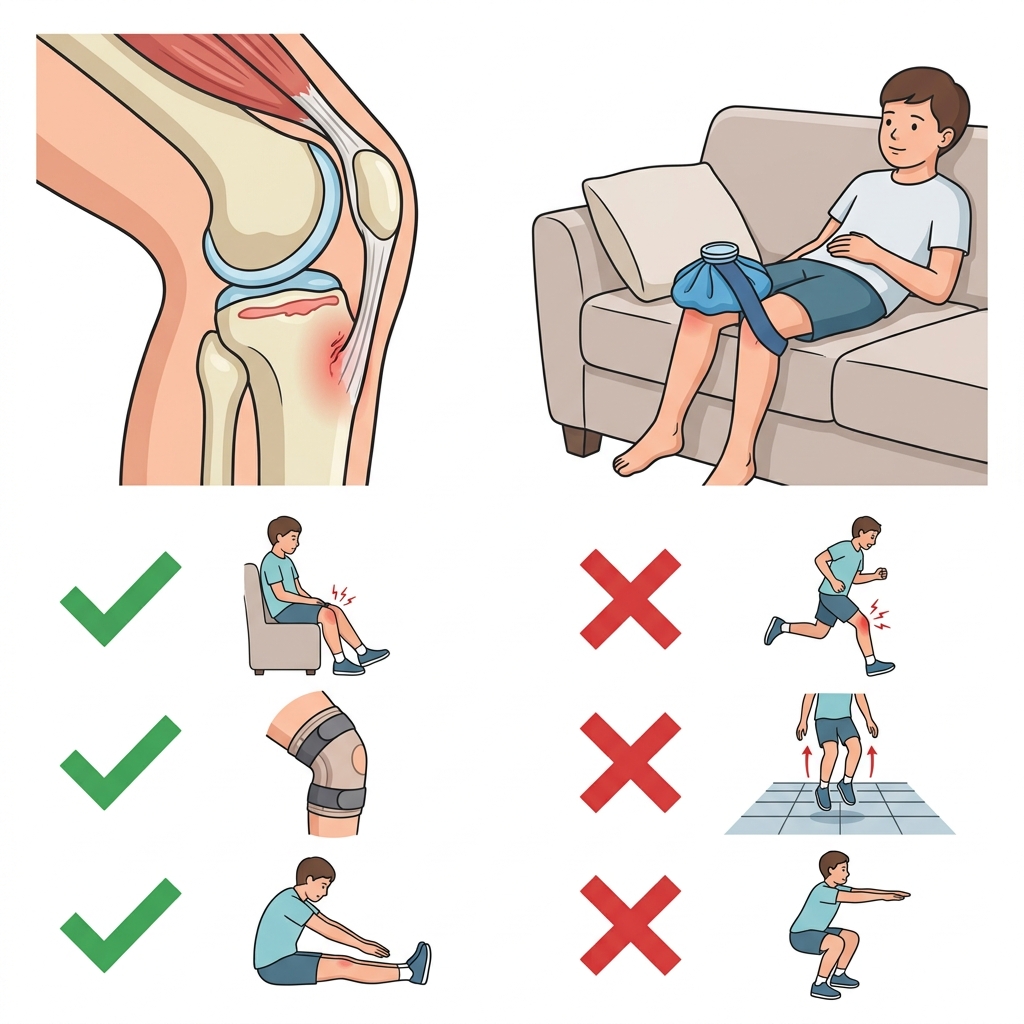
In the vast majority of active children and adolescents, this classic presentation points to Osgood-Schlatter disease (tibial tubercle apophysitis). Despite the alarming label of "disease," it is not an infection or a systemic illness. Rather, it is a self-limiting traction apophysitis triggered by intense biomechanical stress during periods of rapid skeletal elongation. With appropriate rest, cross-training, and targeted physical rehabilitation, young athletes can navigate this condition safely without long-term functional impairment.
⚡ Key Clinical Takeaways.
- Nature of the Condition: Osgood-Schlatter disease is an overuse traction injury of the tibial tuberosity apophysis (the secondary ossification center where the patellar tendon anchors to the shinbone), not an infection or malignant tumor.
- Peak Vulnerability: Most prevalent between ages 9 and 14 in girls and 10 and 15 in boys, coinciding directly with the adolescent pubertal growth spurt and participation in running or jumping sports.
- clear Hallmarks: Focal tenderness, soft-tissue swelling, and a visible bony prominence at the tibial tubercle that worsens with dynamic quadriceps contraction.
- Prognosis: Excellent and self-limiting. Symptoms resolve once the cartilaginous growth plate fuses into mature bone (typically between ages 14 and 18). Conservative management focuses on activity modification, cryotherapy, and kinetic chain rehabilitation.
What Is Osgood-Schlatter Disease?
Osgood-Schlatter disease is an apophysitis—an inflammation of an apophysis, which is a growth plate where a major tendon attaches to a developing bone. The site involved is the tibial tuberosity, located on the anterior proximal tibia roughly 2 to 3 centimeters (0.8 to 1.2 inches) below the inferior pole of the patella (kneecap).
Unlike the epiphyseal plates responsible for longitudinal bone growth, an apophysis is exposed to high tensile forces rather than compressive loads. During puberty, this region transitions through distinct stages of development (cartilaginous, apophyseal, epiphyseal, and bony fusion). Until this cartilaginous zone ossifies fully, it represents the weakest mechanical link in the pediatric musculoskeletal chain—far more susceptible to microtrauma than the adjacent patellar tendon or mature cortical bone.
how it happens: Why Does It Happen During Growth Spurts?
The biomechanical root of Osgood-Schlatter disease lies in a temporary structural mismatch between bone growth and soft-tissue elongation:
- Skeletal Disproportion: During the adolescent growth spurt, long bones such as the femur and tibia elongate rapidly. Surrounding muscular structures—mostly the rectus femoris and vastus muscle groups (quadriceps)—often fail to match this longitudinal expansion at the same rate, resulting in severe muscular tightness and reduced flexibility.
- Repetitive Micro-Avulsions: With repetitive dynamic loading (such as sprinting, kicking, or landing from jumps), the quadriceps mechanism exerts powerful, repetitive tensile traction through the patellar tendon onto the vulnerable, unossified tibial tuberosity.
- Inflammatory and Reparative Response: This recurrent mechanical pulling causes microscopic avulsion fractures of the fibrocartilage and chondro-osseous junction. The body responds with localized inflammation, neovascularization, and reparative bone remodeling. As healing bone is repeatedly stressed and re-laid down, the tibial tuberosity hypertrophies, forming the hallmark firm bony bump.
Who Is Most at Risk?
Osgood-Schlatter disease affects about 20% of athletic adolescents, compared to roughly 5% of non-athletic peers. Clinical risk factors include:
- Age and Biological Maturity: Typically manifests between 10–15 years in boys and 9–14 years in girls, aligning with peak height velocity (PHV).
- Sport Selection: Sports requiring eccentric quadriceps load, rapid deceleration, and repeated vertical jumping—including soccer, basketball, volleyball, track and field (hurdles, high jump), distance running, and gymnastics.
- Bilateral Presentation: While it often begins asymmetrically, bilateral involvement occurs in 20% to 30% of diagnosed patients.
- Biomechanical Factors: Tightness of the quadriceps and hamstrings, poor core or hip abductor strength, and overpronation of the foot which alters lower extremity alignment.
Recognizing the Symptoms: What Does It Feel Like?
Symptoms develop insidiously over weeks to months rather than following an acute traumatic event:
- Localized Pain: A dull ache centered directly over the tibial tuberosity, which sharpens during activity and subsides with rest.
- Focal Tenderness: Exquisite tenderness to direct pressure over the bony prominence below the kneecap. Children often report severe pain when kneeling on hard surfaces or bumping their shin against furniture.
- Swelling and Prominence: Visible enlargement and firm soft-tissue swelling over the upper shinbone.
- Functional Limp: An antalgic gait may emerge following strenuous training sessions or competitive matches.
- Aggravating Movements: Squatting, stair climbing, jumping, and resisted terminal knee extension consistently reproduce the discomfort.
How Is Osgood-Schlatter Diagnosed?
In the vast majority of cases, an experienced primary care doctor, sports medicine specialist, or orthopedic surgeon can establish a clear diagnosis based on clinical history and physical examination alone:
1. Physical Examination.
The clinician palpates the anterior knee structures. Precise, reproducible point tenderness isolated strictly to the tibial tuberosity—without joint effusion, joint line tenderness, or ligamentous instability—is diagnostic. Clinicians also assess quadriceps and hamstring flexibility (such as the Ely test and popliteal angle) and check for patellar tracking disorders.
2. Imaging Studies.
Plain radiographs (X-rays) are usually not required for classic presentations. However, lateral and anteroposterior radiographs may be ordered if atypical red flag symptoms exist to rule out avulsion fractures of the tibial tubercle, osteomyelitis, or primary bone neoplasms (such as osteosarcoma). typical X-ray findings in advanced Osgood-Schlatter include soft-tissue swelling over the tuberosity and fragmentation or ossification centers within the distal patellar tendon.
🚨 Red Flags: When to Seek Immediate Medical Evaluation.
While Osgood-Schlatter is a benign overuse condition, adolescent knee pain can sometimes signal serious underlying orthopedic or systemic conditions. Seek immediate medical attention or visit an Emergency Department (call 911 in the US/Canada or 999 in the UK) if you note:
- Severe, Non-Mechanical Pain at Rest: Pain that awakens the child from deep sleep or persists despite total immobilization.
- Systemic "B-Symptoms": Unexplained fevers, night sweats, rigors, unintended weight loss, or persistent fatigue.
- Joint Effusion or Erythema: Significant swelling inside the knee capsule itself, marked warmth, or spreading redness (suggestive of septic arthritis or acute hemarthrosis).
- Inability to Bear Any Weight: Sudden, acute inability to ambulate, potentially indicating an acute complete tibial tuberosity avulsion fracture or a slipped capital femoral epiphysis (SCFE, which often presents as referred knee pain).
- Pain Located Elsewhere: Pain that tracks higher up into the hip, groin, or mid-thigh.
Evidence-Based Treatment and Home Management.
The cornerstone of managing Osgood-Schlatter disease is conservative care. Complete, prolonged bed rest is unnecessary and often counterproductive. Instead, the goal is activity modification while maintaining cardiovascular fitness and biomechanical function.
1. Activity Modification (Relative Rest).
Adolescents do not need to abandon sports entirely. Instead, they should reduce the frequency, duration, and intensity of high-impact jumping and sprinting. If pain exceeds a 3 or 4 out of 10 during or right away after sports, activity should be scaled down. Transitioning temporarily to low-impact cardiovascular alternatives—such as swimming, flat-road cycling, or water running—unloads the extensor mechanism while preserving aerobic conditioning.
2. Cryotherapy (Ice Application).
Apply ice packs wrapped in a thin cloth directly to the tibial tubercle for 15 to 20 minutes following sports activities and 2 to 3 times daily during acute flare-ups. Never apply bare ice directly to skin to avoid thermal injury.
3. Targeted Physical Therapy and Rehabilitation.
Once resting pain resolves, a structured physical therapy regimen provides long-term relief:
- Stretching: Gentle static stretches for the quadriceps, hamstrings, iliotibial band, and gastrocnemius-soleus complex reduce traction forces on the apophysis.
- Isometric to Eccentric Strengthening: Isometric quad sets and straight leg raises build foundation, progressing toward closed-chain kinetic exercises (e.g., shallow wall sits, terminal knee extensions, gluteal bridging).
- Core and Hip Stabilization: Strengthening the gluteus medius and core stabilizes dynamic knee valgus, optimizing the tracking vector of the patellar tendon.
4. Pharmacotherapy.
Short courses of nonsteroidal anti-inflammatory drugs (NSAIDs, such as ibuprofen) or acetaminophen (paracetamol) may be used under a doctor's guidance during acute painful episodes. These medicines should be used to alleviate discomfort during daily living, not as a chemical shield to push through competitive sports. Topical NSAID gels provide localized anti-inflammatory benefit with minimal systemic absorption.
5. Supportive Orthotics and Strapping.
An infrapatellar strap (patellar tendon strap or Cho-Pat brace) worn around the tendon between the kneecap and tibial bump distributes tension across the wider tendon surface, dampening direct traction on the apophysis. Padded knee sleeves protect the prominent bump from painful direct impacts during court or floor contact.
Is Surgery Ever Required?
Surgery is virtually never indicated during childhood or active skeletal growth, as operative interventions carry a risk of premature growth plate fusion and secondary recurvatum deformities. In rare instances where an adult experiences persistent, recalcitrant pain due to ununited ossicles embedded within the patellar tendon, elective minor surgical excision can be considered after skeletal maturity is complete.
Do's and Don'ts for Managing Osgood-Schlatter Disease.
Navigating recovery requires consistency from parents, coaches, and young athletes alike:
| Recommended Best Practices (DO). | Harmful Practices to Avoid (DON'T). |
|---|---|
| Adjust activity to pain tolerance: Let pain be the guide; modify reps and training load without enforcing complete immobility. | Don't enforce "no pain, no gain": Forcing a child to play through sharp pain risks micro-avulsion exacerbation and prolonged recovery times. |
| Incorporate dynamic warm-ups: Dedicate 10 to 15 minutes before athletic sessions to dynamic stretches and tissue warm-up. | Don't rely on pain relievers before games: giving NSAIDs so an athlete can play through pain masks joint warning signals. |
| Cross-train with low-impact sports: Encourage swimming or cycling to maintain cardiovascular fitness while letting the knee heal. | Don't use corticosteroid injections: Corticosteroids around the patellar tendon are strictly contraindicated due to high risks of tendon rupture and subcutaneous fat atrophy. |
| Replace worn footwear: Use supportive, shock-absorbing athletic shoes suited to the playing surface. | Don't panic over the residual bump: Understand that while pain will disappear as bones mature, a painless bony bump often persists permanently. |
🩺 Doctor's Clinical Note.
"When parents bring in an ambitious young athlete with Osgood-Schlatter disease, the most difficult part of the consultation is rarely medical—it is emotional. Young teenagers often fear that being sidelined means losing their spot on the varsity team or falling behind their peers. I always reassure them that Osgood-Schlatter is a temporary, self-resolving bump in the road, not a career-ending injury. Our goal is not complete immobility, but smart load management. By treating the symptoms, stretching tight quadriceps and hamstrings, and working collaboratively with coaches, these young athletes can stay active and return to full-throttle performance once their skeletal growth stabilizes."


💬 Comments (0)
No comments yet. Be the first to share your thoughts here.
Add Your Comment