

When you are ready to become a mother, your doctor or midwife will ask you to undergo various tests. One of the very first and most important tests is to check your blood type. This not only checks your blood group (such as A, B, O, AB), but also something else, called the ' Rh factor '. Why do you think this is so important? What do you know? Your `(Rh factor)` can sometimes affect the health of the baby in your womb. Therefore, it is very important for both you and your baby to be clear about this early in your pregnancy.
What is Rh Factor? Let's understand it simply.
Okay, now let's see what this `(Rh factor)` everyone is talking about. Imagine that the red blood cells in our blood are like little balls. Some people have a special protein, a small particle, on the surface of these red blood cells. That protein is what we call `(Rh factor)`. Not everyone has this in their blood. But the majority of people in the world have this protein in their red blood cells.
- So, if someone has this Rh protein in their blood , we call them `(Rh-positive)` . It's like saying 'yes, it does'.
- On the other hand, if someone doesn't have this Rh protein in their blood, we call them `(Rh-negative)` . It's like saying 'no, no'.
Now you have a little more clarity, right? In your blood report, the blood group is listed with a + or - sign like A+, B-, O+, and this `(Rh factor)`. That means that an 'A positive' person has blood type A and also has the Rh protein, while a 'B negative' person has blood type B and does not have the Rh protein.
So what is Rh Incompatibility?
Now you have a good idea about `(Rh factor)`. So let's see what `(Rh Incompatibility)` is. Although this may seem like a bit of a confusing word, it is actually quite simple. `(Rh Incompatibility)` is a condition that can occur when the `(Rh factor)` of the mother and the father of the baby are not the same, either positive or negative, that is, they are different from each other . In particular, we talk about this more when the mother is `(Rh-negative)` and the father is `(Rh-positive)`.
Let's take an example and see. Then it will be clearer.
Imagine this simple scenario. There is a mother named Nimali, whose blood type is `(Rh-negative)` (meaning that she does not have that protein in her blood). Her husband, let's say Kasun, whose blood type is `(Rh-positive)` (that protein is present in his blood).
Now that Nimali and Kasunu are expecting a baby, there is a high chance that the baby will inherit the `(Rh-positive)` trait from the father.. That means the baby's blood could be `(Rh-positive)`. Remember, it doesn't always happen, but it's more likely to happen. It's generally said that about half of the babies born to an `(Rh-negative)` mother and an `(Rh-positive)` father are likely to be `(Rh-positive)`.
So, the mother (Nimali) is `(Rh-negative)`, but the baby is `(Rh-positive)`. This is when we talk about `(Rh Incompatibility)`. That is, the `(Rh factor)` of the mother and the baby are different. It's like two people living in the same house, but they both like different types of food. There is a slight incompatibility.
Why is it that the first baby is usually okay? Then how does the problem arise?
You might be thinking, 'Okay, so why wouldn't the first baby have a problem with such an incompatibility?' That's true. Most of the time, this `(Rh Incompatibility)` is a big problem during a mother's first pregnancy, meaning it doesn't harm the baby . The main reason for that is that during pregnancy, the mother's and baby's blood systems are separated. Even though nutrients are exchanged through the placenta, the baby's red blood cells hardly enter the mother's circulatory system (that is, the mother's blood system). It's like a protective barrier.
However, when the baby is born, that is, during childbirth , there is a high chance that the mother's and the baby's blood will mix a little. This is normal. If the baby's `(Rh-positive)` blood (if the mother is `(Rh-negative)`) enters the mother's body, the mother's immune system recognizes the Rh protein in the baby's blood as 'foreign'. Just like when a germ or something that causes an allergy enters our body. Then the mother's immune system starts making special protective proteins called `(antibodies)` against this Rh protein. These `(antibodies)` are like trained soldiers. They are made to attack and destroy foreign cells if they come back. Once these `(antibodies)` are made, they remain in the mother's body, and will be activated if something like this happens again.
What other ways can antibodies be produced?
There are other ways in which these `( antibodies )` can develop in a `(Rh-negative)` mother's body, not just during childbirth. It is important to be aware of these as well:
- If you have ever received `(Rh-positive)` blood in an accident before, you may not have been properly checked for `(Rh factor)` at the time.
- If you have had a previous miscarriage , the fetus's blood can also enter the mother's body during a miscarriage.
- `(Ectopic pregnancy)`If you have had an ectopic pregnancy (a pregnancy outside the uterus). This is also a very dangerous condition and can also cause the formation of antibodies.
- Some tests performed during pregnancy , such as amniocentesis (a test that removes a small amount of fluid from the baby's amniotic sac), can also cause a small amount of bleeding.
It is important to remember that in cases like this, the baby's (or fetus') `(Rh-positive)` blood can enter the mother's body and cause `(antibodies)` to form.
So when is the baby at risk? How serious is it?
As mentioned earlier, the Rh `(antibodies)` that develop in the mother's body only become a problem during the mother's second or subsequent pregnancies . The first baby is usually not harmed, because the `(antibodies)` begin to develop with childbirth.
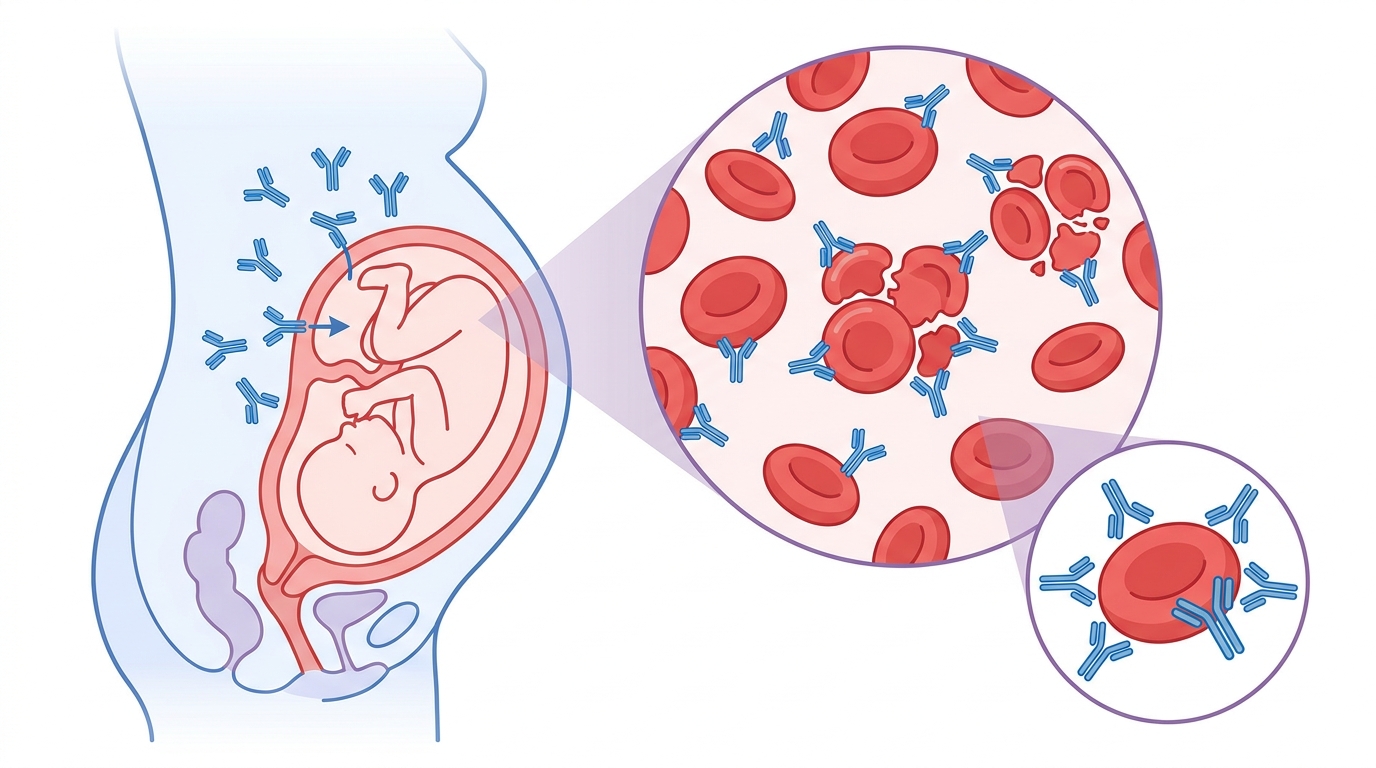
Imagine that a mother (who is `(Rh-negative)` and now has `(antibodies)` in her body) is carrying a `(Rh-positive)` baby in her womb. Then, those Rh `(antibodies)` that were previously formed in the mother's body and are on alert can recognize the Rh proteins on the surface of the baby's red blood cells as ``foreign, enemy.'' Like sentinels. Then these `(antibodies)` cross the placenta and enter the baby's blood, and begin to attack the baby's innocent red blood cells.
This can cause the baby's red blood cells to swell, burst, and be destroyed. We call this condition ``Hemolytic disease of the newborn'' or simply Rh disease. This can greatly reduce the amount of blood in the baby's body (especially the number of red blood cells that carry oxygen). This means the baby will develop anemia . This can be very serious.
- A baby can develop severe jaundice , which is a yellowing of the eyes and skin. This is caused by a substance that is produced when red blood cells break down.
- This can affect the baby's heart, liver, and spleen. In some cases, the heart may even fail.
- In very severe cases, the baby can even die in the womb.
So this is not something to be taken lightly. But, don't worry, the treatments we are going to talk about now are designed to prevent these things.
How is Rh Incompatibility treated? Should we be afraid?
Now you may be feeling a little scared when you hear about this. But, the good news is that there are now very good, effective treatments that can completely prevent the dangerous problems that can arise due to this condition called `(Rh Incompatibility)`. So there is no reason to be unnecessarily afraid or worried. The most important thing is to take medical advice on time and do as they say.
Rh Immune-Globulin Vaccine: This is our main protector
If doctors decide that a pregnant mother is at risk of Rh incompatibility (that is, if the mother is Rh-negative and the father is Rh-positive, or if the father's Rh factor is unknown), they will give the mother a special injection called Rh immune -globulin. This is the hero of this story. This injection is usually given in two doses, at the right time, during the first pregnancy:
- The first vaccination is usually given around 28 weeks of pregnancy. This is when the mother's and baby's blood can often start to mix slightly.
- The second injection is given within 72 hours of the baby's birth. This is very important because the blood is most likely to be mixed during delivery.
This `(Rh immune-globulin)` vaccine works just like a vaccine , but with a slight difference. What this does is completely prevent the mother's body from developing those dangerous Rh `(antibodies)` ( antibodies ) mentioned earlier. It's like building a protective wall before an enemy comes. This can prevent health problems that the newborn baby may have, and if you are expecting another child in the future, this will also be a great protection during that pregnancy.
Remember, if a mother has a miscarriage, an amniocentesis , or any other type of bleeding during pregnancy, doctors will always give her a dose of this Rh immune-globulin vaccine. If there is a small risk of developing antibodies, eliminate that too.
What to do if antibodies have already formed in the mother's body?
Imagine, sometimes, perhaps because this vaccine was not given at the right time in a previous pregnancy, or for some other reason, a doctor finds that a mother has already developed Rh `(antibodies)` in her body. What do you do then? Don't worry, there is treatment for that too. If that happens, the mother and baby are monitored very closely and with special attention throughout the pregnancy. The main thing is to see if the `(antibodies)` level in the mother's blood increases dangerously and if it affects the baby. Special scans and blood tests are used for this.
Very rarely, if the incompatibility is severe enough to put the baby at risk, the baby may need to have special blood transfusions. These are called exchange transfusions . If this is done before the baby is born (in the womb), it is called intrauterine fetal transfusions.) Yes, it can be done after birth. This ``exchange transfusion`` removes the blood from the baby's body that has been damaged by those ``antibodies`` and replaces it with blood that has healthy, ``Rh-negative`` red blood cells. This stabilizes the baby's red blood cell count, and also minimizes the damage to the baby from the mother's ``antibodies`` that are already in the baby's blood.
But, I repeat, because of the amazing success of this `(Rh immune-globulin)` vaccine, there are very few cases of `(exchange transfusions)` being done these days. In Sri Lanka too, this vaccine is used very successfully, in almost every hospital, so we can have great confidence in it.
What else is important for you to know about this?
If you think you are pregnant but you don't know your Rh factor, the most important thing is not to panic, but to see your family doctor or an obstetrician-gynecologist as soon as possible and start proper prenatal care . This will definitely include checking your blood type and Rh factor. This is the first step.
If you recognize the condition called `(Rh Incompatibility)` early and get the necessary treatment, especially the `(Rh immune-globulin)` vaccine on time , you can prepare to welcome your baby into this world healthy, without unnecessary fear or doubt. Therefore, being aware of this and understanding the information correctly will be a great strength for you.
Talk openly with your doctor about this. Don't be afraid or hesitant to ask any questions or concerns you may have. Don't think about things like, 'Is this the right thing to ask?' or 'What will the doctor think?' They are there to help you and your baby, to educate you. The more questions you ask, the more you will understand. It's good for you and your baby.
So, here are the things you need to remember from what we've talked about (Take-Home Message):
Rh incompatibility is not something to be afraid of, it can be managed and prevented!
- Know your blood type and Rh factor: It is very important to know this before you get pregnant or early in your pregnancy. This is the first step.
- Be especially careful if the mother is `(Rh-negative)` and the father is `(Rh-positive): This is when the risk of `(Rh Incompatibility)` comes in. Tell your doctor about this.
- Trust the `(Rh immune-globulin)` vaccine: This vaccine is the most important thing that protects you and your baby. Be sure to get it when your doctor prescribes it.
- Although the first baby is usually not affected, subsequent children can be affected: so this needs to be taken into account anew with each pregnancy. Even if you have been vaccinated before, you will need to get it again this time.
- Tell your doctor if you have had previous miscarriages, ectopic pregnancies, or blood transfusions: This information is very important to your doctor , as these can cause antibodies to form.
- Follow your doctor's instructions exactly and on time: This is the most important thing of all. Get the tests your doctor tells you to do, get the vaccinations when they say they will, and listen to what they say.
- Don't be afraid to ask questions: Talk to your doctor about anything that's on your mind. The more informed you are, the more comfortable you'll be.
So, I hope this information is very useful for you. A healthy, happy mother and baby is the only hope for all of us! Best wishes to you!
` Rh incompatibility, pregnancy, Rh factor, Rh immune-globulin, antibodies, baby's health, blood type
Doctor's Note
Rh Incompatibility occurs when the blood type of the mother is Rh-Negative and the blood type of the baby in the womb is Rh-Positive. Here, if the baby's blood cells mix with the mother's blood, the mother's immune system considers the baby's blood as an enemy and produces antibodies to destroy it. Although this usually does not harm the first pregnancy, in the second pregnancy these antibodies can destroy the baby's blood cells and cause severe anemia or infant death. To prevent this, it is essential to get 'Anti-D' vaccine at the right time during pregnancy.
❓ Some more questions you may encounter (FAQ)
How is Rh incompatibility diagnosed?▼
By checking the mother's blood type during early pregnancy and by using the blood test called 'Indirect Coombs Test' to see if the antibodies are formed in the mother's body.
When is the Anti-D (RhIG) vaccine given?▼
This vaccine is usually given at 28 weeks of pregnancy and within 72 hours of delivery (if the baby is confirmed to be Rh-Positive). It is also given in case of miscarriage or a blow to the abdomen.
Is there a problem when an Rh-Positive mother has an Rh-Negative baby?▼
no There is no problem if the mother is Rh-Positive. A problem arises only when the mother is Rh-Negative and the baby is Rh-Positive.


💬 Comments (0)
No comments yet. Be the first to share your thoughts here.
Add Your Comment