
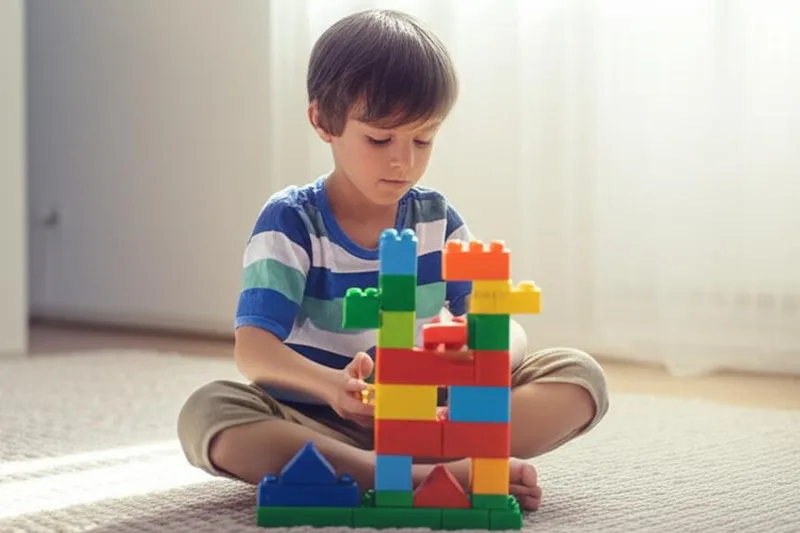
Do you sometimes feel like your little one is a little different from other children? Maybe he doesn't look you in the eye. Or maybe he likes to play alone in his own world. Sometimes he repeats the same things, or he is very sensitive to even the slightest sound. It's normal for you as a parent to feel scared and curious when you see things like this. Today we're going to talk about a topic that shows these characteristics, and that many people talk about but don't really know about. That's Autism.
Simply put, what is autism?
Autism, or medically known as Autism Spectrum Disorder (ASD) , is not a disease. It is a complex condition that occurs in brain development. As a result, the way a person with autism understands information, communicates, learns, and behaves may be different from others.
Think of our brains as a city with many roads. In the brains of people with autism, these roads are connected in a slightly different way. That's why the way they see the world, the way they understand what they hear, and the way they respond are different.
The important thing is that autism is a "spectrum." This means that the way the condition affects each person is very different. While some may have little impact, others may need more support to even do everyday tasks .
This condition usually shows symptoms that can be identified before the child is 3 years old. Also, it is a lifelong condition.
Is it right to talk about "levels" of autism?
You may have heard the terms "high-functioning" and "low-functioning" autism used. "High-functioning" refers to those who are able to do schoolwork and communicate without much difficulty. "Low-functioning" refers to those who need help with everyday tasks and have intellectual disabilities. But using these terms can be hurtful to those people because it makes them feel like they are being judged.
Instead, doctors now use a classification based on the level of support a person needs, which refers to how much help we need to help that person live well in society.
| Level of cooperation | Simply explained |
|---|---|
| Level 1: Requiring support | There are some difficulties in social relationships. It is difficult to get used to changes in daily routine. Some guidance is needed. |
| Level 2: Requires substantial support | There are obvious difficulties in speech and social interactions. Repetitive behaviors interfere with daily life. |
| Level 3: Requiring very substantial support | Speech is very limited. Social interactions are very difficult. Significant support is needed in almost every aspect of daily life. |
What are the common symptoms of autism?
Autism is a spectrum, so symptoms can vary widely. However, there are a few common symptoms.
Symptoms that can be seen in young children
- Eye contact: Reluctance to make eye contact while talking or playing.
- Not responding to name: Not looking back when your name is called, even at 9 months of age.
- Playing alone: Lack of interest in playing with other children.
- Speech delay: Not speaking or using words in an age-appropriate manner.
- Not using gestures : Not saying "tata bai" or extending your hand to show something.
- Stimming: Repeating the same thing over and over again, such as waving your arms, rocking your body, or spinning in circles.
- Using toys in strange ways: Arranging toys in a row and getting angry if the order is changed.
- Sensitivity: Being overly sensitive or insensitive to things like ordinary sounds, smells, light, or the touch of clothing.
- Dislike of changes in routine: Getting very upset if the slightest change in what you do every day changes.
What is 'Meltdown'?
This is not just a tantrum. When a person with autism is overwhelmed by the amount of information coming from their environment (noise, people, light), their nervous system becomes 'overloaded'. They then lose control of themselves. At this point, they may scream, cry, roll over, and hit things. The best thing to do at this point is to give the person a safe space and time to calm down.
What causes autism? Do vaccines really work?
The exact cause of autism is not yet known , but scientists believe it is caused by a combination of genetic and environmental factors.
- Genetic factors: If someone in the family has autism, the risk of others developing it is slightly higher.
- Age: The risk of a child developing autism may increase slightly as the parents age.
- Complications during birth: Things like being born with very low birth weight.
- Gender: Autism is more common in boys than girls.
The most important and emphatically stated point: There is no link between vaccines and autism! This has been proven time and again by extensive research conducted around the world. The idea that vaccines cause autism is a complete myth. Vaccines are meant to protect our children from serious diseases. So don't be afraid to give your child the vaccines your doctor recommends on time.
How do you know for sure if you have autism?
Diagnosing autism is not as simple as a blood test. It is done by a team of specialist doctors who carefully observe the child's behavior and development.
This process usually occurs in two steps:
1. Developmental Screening: When you take your baby to the clinic, the doctor or family health worker will ask questions about your baby's development (talking, walking, playing). If they suspect there is a delay or problem here, they will refer you to a specialist.
2. Comprehensive Evaluation: Here, a child psychiatrist or developmental pediatrician examines the child thoroughly. They observe the way the child plays, talks, and interacts with others. They also ask the parents detailed questions about the child's behavior. All of this is taken into account to determine whether or not autism is present.
If an adult suspects they have autism, they can talk to their doctor and be referred to a specialist, such as a psychiatrist.
Treatment and Management: Don't be fooled by false treatments!
First, remember that there is no "magic bullet" that can cure autism. This is a lifelong condition. But with early detection, proper treatment, and support, a child's abilities can be maximized and daily life can be made much easier.
There are several main treatment methods:
- Behavioral Therapy: Helps change inappropriate behaviors by understanding why a behavior occurs and what the consequences are. Applied Behavior Analysis (ABA) is a well-known type of therapy.
- Developmental Therapy:
- Speech Therapy: Develop communication skills.
- Occupational Therapy: Practice doing daily tasks (dressing, eating) on your own.
- Physical Therapy: Improve movement skills like walking and running.
- Psychological Therapy: Methods such as Cognitive-Behavioral Therapy (CBT) are used to help with conditions such as anxiety or depression that come with autism.
Beware! Dangerous "false cures"
There are some dangerous, bogus treatments that claim to "cure" autism. Don't fall for these. Not only are these a waste of money, they can also harm your child's life.
| Dangerous fake treatments you should never try | |
|---|---|
| ❌ Raw camel milk | ❌ Chelation (removing heavy metals from the body) |
| ❌ Miracle Mineral Solution (MMS) / Chlorine Dioxide | ❌ Advise to avoid vaccination |
| Here's how to spot a fake treatment: If it claims "miracle cures," "instant results," charges exorbitant prices, or only presents personal stories instead of medical evidence, be suspicious. Be sure to talk to your doctor before starting any treatment. | |
Take-Home Message
- Autism is not a disease. It is a change in brain development. It is part of a person's personality.
- Autism is a spectrum. The way it affects each person is very different.
- There is no scientific link between vaccines and autism. It's a proven myth.
- Autism cannot be "cured." But early detection and the right treatment and support can help them live successful, happy lives.
- If you have any concerns about your child's development, don't hesitate to talk to your doctor or family health worker.
- Don't be fooled by fake "miracle" treatments. Seek expert medical advice before doing anything.


💬 Comments (0)
No comments yet. Be the first to share your thoughts here.
Add Your Comment