
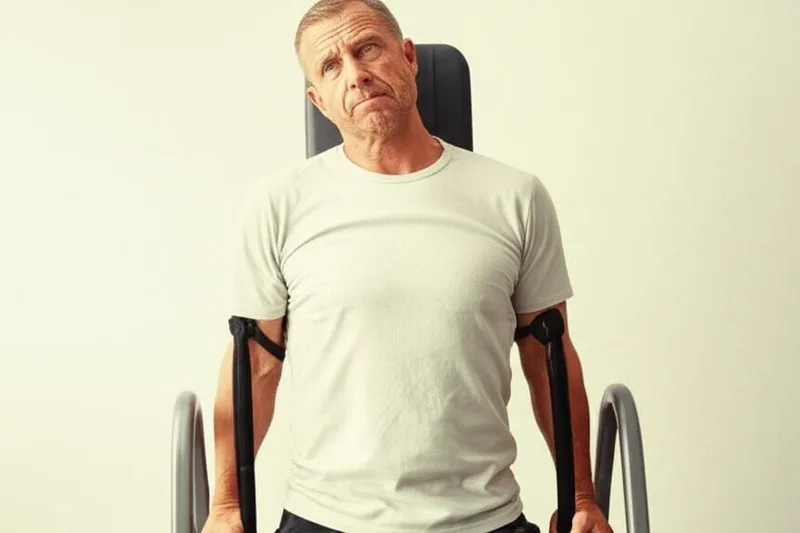
Have you ever seen someone sit on a table with their legs up and their head down? Sometimes this method is said to be good for back pain, sciatica pain, or even kidney stones . Is there really a scientific basis behind this? Let's see what the real story is about this so-called Inversion Table and this treatment method.
What is Inversion Therapy?
Inversion Therapy is also called spinal traction . It's very simple. When we stand or walk, gravity constantly puts pressure on our spine from top to bottom. Imagine that the vertebrae in our spine are pressed together. When you turn your head downward on an inversion table, this gravitational pressure is reversed.
Simply put, this reduces the pressure between the vertebrae in your spine. When you lower your head this way, that pressure is reduced and a little space is created between the vertebrae. The theory behind this is that this relieves the pressure on the nerves and discs between the vertebrae.
| When to use Inversion Therapy |
|---|
| - Back pain |
| - Muscle spasms or pain |
| - Compressed spinal disks |
| - Sciatica pain |
| - To help clear kidney stones |
Some people use it for general stretching of joints and muscles and to relax the body.
Does this really work?
This is the most important question. There are mixed results about how effective inversion tables are. Since it is not as invasive as major surgery, it is an option to consider before resorting to surgery. However, there is a possibility of accidents due to improper use, so great care must be taken. It is wise to have someone nearby for help whenever possible.
For back pain
Some people find this to be a short-term relief from back pain or pain caused by a herniated disc. However, keep in mind that this is often not a long-term solution. Some studies have shown that the relief obtained from this is no different than that obtained from a sham treatment.
For sciatica pain
A 2012 study in England showed that inversion therapy, combined with physical therapy, can effectively treat sciatica caused by a herniated disc. This may also reduce the risk of needing back surgery.
For kidney stones
This treatment can also help to remove kidney stones. Studies show that after the stones are crushed with shock waves, this treatment, along with fluids (diuresis) given in the hospital, makes it easier to pass the stones.
How to use an inversion table?
It's best to do this under the supervision of your physical therapist or doctor. They can teach you exactly how to do it and watch you.
If you are young and do not have any heart problems, you can use this at home. However, you must follow these safety instructions.
- Have someone to help you: Don't do this alone. If you can't get back up, you need someone to help you.
- Don't put your head all the way down: Start at a small angle, like 30 degrees. For an older person, even 10 degrees is enough.
- Wear safety straps properly: Wear safety straps properly to avoid slipping and falling.
- Do it for just a few minutes: Try it for a minute or two a day at first and see how you feel. Limit it to 5 minutes, twice a day at most.
- Stand up slowly: When you are standing up again after treatment, do not stand up suddenly. Stand up slowly and carefully. Standing up too quickly can cause muscle tension or increase back pain.
- Combine with exercise : To make this treatment more effective, it is important to keep your body flexible and stretch. Ask your doctor about appropriate exercises.
The most important thing is to definitely talk to your doctor before starting something like this and make sure this is right for you.
What are the side effects and risks of this?
This is not for everyone. When you lie face down on an inversion table, your heart rate slows down, your blood pressure increases, and the pressure in your eyes increases.
Because of these effects, it can be very dangerous for people with the following medical conditions:
- High blood pressure
- Glaucoma or other eye diseases
- Heart disease
- If you have had a previous stroke
- Hiatal hernia
- Inner ear problems
- During pregnancy
Also, if you have arthritis in your knees or hips, using an inversion table can damage your joints.
Where can I buy these?
Inversion tables can be purchased online or in specialty stores. Some have features like armrests, safety belts, and cushioned surfaces. Some can even be folded for easy storage.
But these are not very cheap. They usually range in price from thousands to hundreds of thousands of rupees.
Take-Home Message
- Inversion tables can provide short-term relief for things like back pain, but they're not a panacea.
- If you use this, safety first . Have someone help you, start at a low angle, use safety harnesses, and slowly and carefully straighten up.
- If you have medical conditions such as high blood pressure, heart disease, glaucoma , or are pregnant , avoid using these without medical advice. It can be dangerous.
- In any case, before starting any such treatment, be sure to consult your doctor to make sure it is appropriate for you.


💬 Comments (0)
No comments yet. Be the first to share your thoughts here.
Add Your Comment