
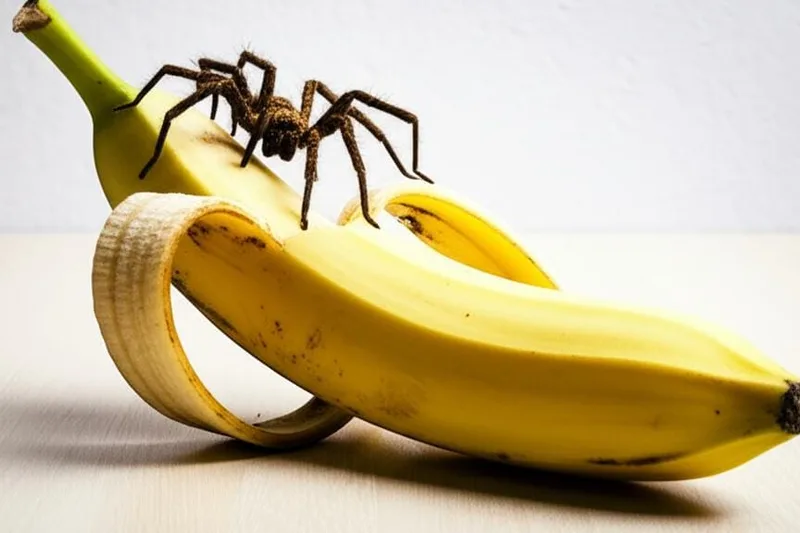
You may have heard of the 'Banana Spider'. Some people think that this name is given to spiders with a yellow, long body like a banana. Others are afraid that these dangerous spiders are hiding in boxes of bananas imported from abroad. Who is this 'banana spider' really? Are these spiders dangerous to us? Let's talk about this clearly today.
Who are these 'banana spiders' really?
The first thing to understand is that there is no single species of spider called 'Banana Spider'. This is more like a nickname. People use this name for several species of spiders. There are two reasons for this:
1. Because of their appearance: Some spiders have yellow bodies and are elongated like a banana.
2. Because they are found during banana transportation: Some spider species, especially from South American countries, are likely to be shipped with banana shipments distributed around the world.
Simply put, there are several types of spiders that are mainly known by this name.
- Golden Silk Orb-weaver: Scientific name `(Trichonephila clavipes)`. It is commonly known as the 'banana spider'. This name is derived from the fact that the female of this spider is often yellow in color. The webs made by these spiders are made of golden silk, about 3-6 feet long, very strong webs. There are spiders of this species in our country as well.
- Brazilian Wandering Spiders: Scientifically belonging to the genus `(Phoneutria)`, these are the most dangerous species, known to be found in banana boxes.
- Bromeliad Spiders: Scientifically belonging to the genus `(Cupiennius)`, these are wandering spiders.
- Hawaiian Garden Spider: Scientific name `(Argiope appensa)`.
What do these spiders look like and what are their differences?
Each type of spider, known as the 'banana spider', looks very different. Let's look at this table to help us identify them.
| Type of spider | Appearance | Living areas |
|---|---|---|
| Golden Silk Orb-Weaver (Golden Silk Orb-weaver) | The female is about 1-3 inches long. The body is orange/brown with yellow spots. The legs have brown and orange bands. The male is much smaller (about half an inch) and dark brown. | They are found in the United States, from Florida to Central and South America. This type of spider is also found in Asian countries. |
| Brazilian wandering spider (Brazilian Wandering Spider) | A large, brown spider. Its legs are about 4-5 inches long. Its most distinctive feature is its red fangs/jaws. It is very fast. | As the name suggests, they roam the jungles of Brazil and South/Central America at ground level, sometimes hiding behind houses, cars, and logs. |
| Bromeliad spider (Bromeliad Spider) | The body is small (less than an inch), but the legs are long. It is orange and gray in color. Because of the red color of this spider's fangs, some people confuse it with the previously mentioned dangerous spider. | Lives in Central and South America. Hunts without making nets. |
| Hawaiian garden spider (Hawaiian Garden Spider) | The female is about 2.5 inches long and comes in a beautiful array of colors, including red, yellow, black, and white. The male is about a quarter of the size and is brown. | It's limited to Hawaii in the US. It's only been there from countries like Taiwan and Guam. |
The most important question: Are these spiders poisonous?
Okay, now let's look at the scary side of this. Some of these spiders are venomous, but some are not.
- Golden Silk Orb-Weaver: This spider does not pose a major threat to humans. It only bites if you try to touch it or if it gets too close. Even that bite is less painful than a bee sting, causing only a little redness. So there is nothing to be afraid of if you see such a large spider in your garden.
- Brazilian wandering spider: This one is a bit more dangerous . It even made it into the Guinness Book of Records in 2007 as the most venomous animal in the world. But don't worry, these spiders are not found in Sri Lanka . Also, deaths from bites from this spider are very rare. There have been as few as 10 reported deaths. Only 2% of bites are serious enough to require antivenom.
- Bromeliad Spider: Although this spider's fangs are red, the venom is not as potent as the previously mentioned spider. A bite can cause severe pain and numbness for about 10 minutes, but it goes away within half an hour.
- Hawaiian garden spider: Not poisonous to humans.
Most importantly, this most dangerous type of spider, the Brazilian wandering spider, does not live naturally in Sri Lanka.
What to do if you get bitten by a spider?
Usually, a bite from a spider in our country is not a serious injury. However, if you experience unusual symptoms (severe pain, swelling, difficulty breathing) or suspect that you were bitten by a dangerous spider, go to the nearest hospital's Emergency Treatment Unit (ETU) immediately . Don't panic. If possible, take a clear picture of the spider without causing yourself any harm. This will help the doctors treat you. Sometimes, if the doctors need to, they will call the National Poison Information Centre at the Colombo National Hospital for further advice.
Are there spider eggs inside bananas? True story!
This is also a story that is spread among many people. The story is that spiders lay eggs inside banana flowers, and when we peel the banana, the baby spiders come out.
This is a complete lie. That won't happen.
But there is a truth. That is, sometimes, especially when transporting bananas in bulk, a spider or two can hide inside the boxes of bananas . This is a very rare occurrence. If you have any doubts about this, pack a box of bananas carefully when you bring it home. It is safer to wear a pair of thick gloves.
What do you do if you see a spider in the house?
Most of the time, you'll find a harmless, common spider in your home. You can use these methods to get rid of them:
- Catch and release: Place a glass or cup on the spider, place something like thin cardboard underneath, carefully catch it, and release it outside the house.
- Spider traps: You can use sticky traps that are available at the store.
- Spider poisons/sprays: Use a spider poison spray only if absolutely necessary.
- Expert help: If the spider population is too large to control, seek the help of a pest control specialist.
Take-Home Message
- 'Banana Spider' is not a single species of spider, but a nickname for several species of spider.
- Spiders such as the Golden Silk Orb-weaver, which are commonly seen in our country and gardens , do not cause much harm to humans.
- The Brazilian Wandering Spider, considered the most venomous spider in the world, does not live naturally in Sri Lanka.
- Spiders do not lay eggs inside bananas, but occasionally, spiders can be found in boxes used to transport bananas.
- If you develop any unusual symptoms after being bitten by a spider, do not panic and immediately go to the nearest hospital's Emergency Department (ETU). Give your doctor the necessary advice.


💬 Comments (0)
No comments yet. Be the first to share your thoughts here.
Add Your Comment