
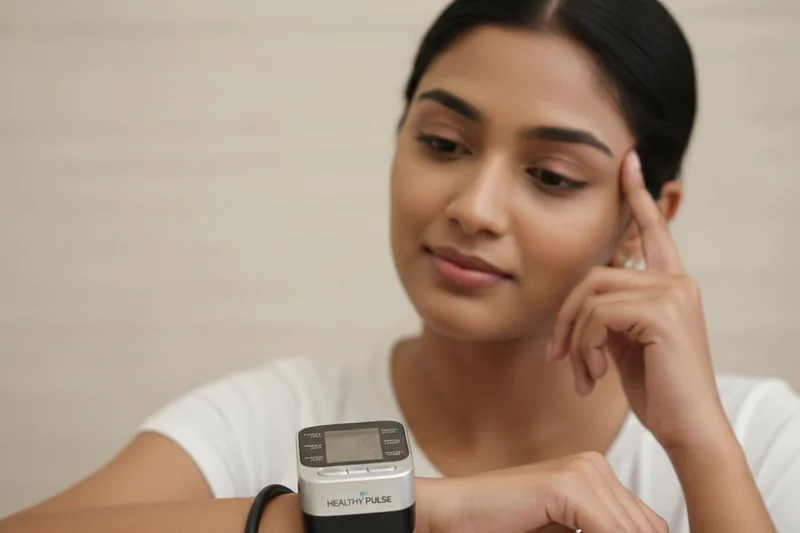
You've probably seen these small machines in pharmacies or online stores that you can easily put on your wrist to check your blood pressure. They look like a watch and seem very easy to use. But when you see them, you're probably wondering, "Is the reading really accurate?", "Is this better than the big machine you put on your upper arm?", "Is this okay for me?" So today, let's talk about everything you need to know about these wrist blood pressure monitors.
What is this wrist blood pressure monitor?
Simply put, this is a device that allows you to measure your blood pressure (BP) at home. Most of these have a cuff that you wrap around your wrist. This cuff is connected to a digital display screen that shows your pressure reading.
There are some monitors that are now available that can be worn like a smartwatch. These wearable devices can track not only your blood pressure, but also other information, such as how much exercise you've done and how you've slept.
The main advantage of a device like this is that it allows you to get an idea of how your blood pressure changes during your normal daily activities. This means that instead of only checking it when you go to the doctor, it helps both you and your doctor get a better understanding of how your blood pressure is at home and at work.
However, there is one very important thing to remember here. Wrist-based monitors are generally considered to be less accurate than upper arm monitors. Therefore, doctors only recommend them in certain special cases.
What is the difference between looking at the upper arm and looking at the wrist?
Both types of monitors measure the pressure of blood flowing through the arteries in our upper body. However, this measurement is taken from two different places. This difference can cause some differences in the results. Let's understand this difference clearly.
| Reason for the change | Upper Arm Monitor | Wrist Monitor |
|---|---|---|
| The place where the measurement is taken | The measurement is taken from the brachial artery, which is located in the upper arm, just above the elbow. This is where a doctor examines in the clinic. | The measurement is taken from the radial artery, located at the wrist. This artery is located more superficially than the skin. |
| Accuracy | This is considered the most accurate and recommended method in medical science. It is called the "gold standard." | If you use it in exactly the right position, you can get the right results. But if the position is even slightly wrong, the results can be completely wrong. |
| Possible change in pressure value | This is more reliable because the value obtained is similar to the pressure in a major artery close to the heart. | Because it is measured in a small artery, far from the heart, the pressure here can naturally be slightly different than in the upper arm. Some studies have shown that the top value (systolic) may be slightly higher at the wrist. |
For these reasons, it is important to use a home device under the guidance of your doctor , even if it is a home device. This will allow your doctor to understand the difference between the readings you take at home and the readings you take at the clinic and act accordingly.
So, who really needs a wrist-mounted monitor?
If your doctor tells you to monitor your blood pressure at home, there may be several reasons for doing so. Typically, an upper arm monitor is the first thing they recommend. However, in some special cases, a wrist monitor may be more appropriate.
Why do you tell me to check my blood pressure at home?
- If you have been diagnosed with high blood pressure (Hypertension) or low blood pressure (Hypotension) .
- If you have risk factors for high blood pressure.
- If you have started a new medication for your blood pressure, see how effective it is.
- If you are pregnant.
- If your doctor suspects that you have "white coat hypertension," that is, your blood pressure is only elevated when you see your doctor or go to the hospital, but is normal at home.
- If you suspect you have "masked hypertension" , that is, your blood pressure is normal at the doctor's office, but it is elevated at home.
In any of the above cases, doctors' first choice is the upper arm monitor.
So, who is the wrist monitor suitable for?
- If you have difficulty finding a cuff that fits your upper arm properly (for example, if you are very large or very thin).
- If you have a medical condition or disorder that makes it painful to measure your upper arm blood pressure.
In this case, using a wrist monitor may be more practical. However, the final decision on which type is right for you should be made only after discussing it with your doctor.
How do you use this machine properly?
To get accurate results from a wrist monitor, it's essential to use it exactly as it should be . Even a small mistake can completely change the reading.
If you buy a new device, the best thing to do is to take it with you the next time you see your doctor. That way, your doctor can compare the readings from the clinic's device with the readings from your device to get an idea of its accuracy. You can also practice the exact position you need to use it on the spot.
When measuring your blood pressure at home, follow these steps.
| The correct procedure to follow before and during blood pressure measurement | |
|---|---|
| Step 1: Preparation | |
| Calm down. | Avoid coffee, tobacco products, and exercise 30 minutes before taking your blood pressure. Go to the bathroom and sit quietly for at least 5 minutes before taking your blood pressure. |
| Sit correctly. | Sit in a chair, with your back straight and your feet flat on the floor. Place a flat surface, such as a table, in front of you. |
| Step 2: Obtaining the Measurement | |
| Wear the device. | Fit the cuff of the device to your wrist, making sure it is neither too tight nor too loose. |
| Hand position (this is very important) | Place your elbow on the table. Then, gently bend your arm, placing the palm of your hand with the wrist on your chest, at the same level as your heart . |
| Take the measurement. | Take the measurement while remaining relaxed in this position, without talking or moving. |
Things you should never do when taking a measurement:
* Keeping your wrist above or below heart level.
* Resting your wrist on a table or in your lap.
* Keeping your hand down.
Maintaining this posture precisely is the secret to achieving the right result.
The importance of keeping a pressure logbook
Your machine may have old readings stored in memory. However, it is very important to write down all of those readings in a book. That way, it will be easier to show to the doctor.
Record the following in your logbook:
- The date and time each measurement was taken.
- Typically, your doctor will tell you to take your readings twice a day (before breakfast and before bed). Each time, take two readings about a minute apart. That means four readings per day will be recorded in the book.
- If there is anything special about that day, write it down briefly. For example, "I'm feeling extra tired today," "I didn't sleep well last night," or "I'm feeling a little sick." Your doctor may also ask you to write down the times you took your medications.
When should you seek medical advice?
Just checking your blood pressure at home won't fix everything. It's only an aid to medical treatment. Therefore, seek medical advice immediately in situations like this.
| Emergency! Call 1990 immediately or go to the ETU (Emergency Treatment Unit) | |
|---|---|
| Hypertensive Crisis | If your blood pressure suddenly rises to 180/120 mmHg or higher , accompanied by symptoms such as severe headache, dizziness, chest pain, and difficulty breathing, this is a medical emergency. |
| Talk to your doctor. | |
| Unusual reading | If your blood pressure continues to be higher or lower than normal for you for several days. |
| Questions about the device | If you are having difficulty using your home monitor or have doubts about its accuracy. |
| If you don't understand the values | If you have questions about what normal values are, what high and low values are. |
Take-Home Message
- Before purchasing a wrist blood pressure monitor , be sure to consult your doctor . He or she will be the one to decide which type is best for you.
- According to medical recommendations, an upper arm monitor is always more accurate. However, in some special cases (e.g., for those whose arm cuff does not fit properly), a wrist monitor may be appropriate.
- To get the most accurate reading, it is essential to always keep your wrist at heart level when taking the measurement. This is the most important thing.
- Record the measurements you take in a logbook and bring it with you to discuss with your doctor every time you see him.
- Home blood pressure monitors are not a substitute for medical advice and clinical testing. They are only an aid in managing your health.




💬 Comments (0)
No comments yet. Be the first to share your thoughts here.
Add Your Comment