
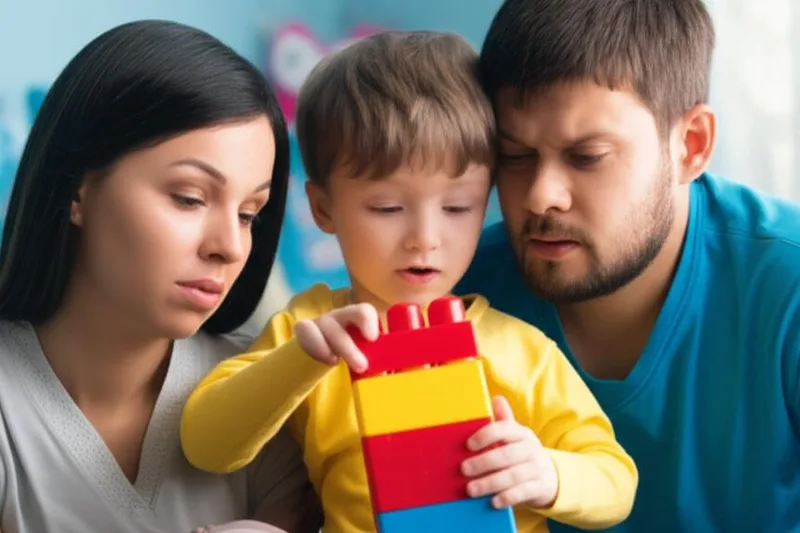
As parents these days, we think about our children a lot, don't we? We are especially attentive to the child's development, speech, and behavior with others. In the meantime, you must have heard the word ' autism ' often. Perhaps you have a little fear or doubt in your mind as to whether this condition is really widespread. Don't worry. Let's talk about this honestly and simply today.
Autism Spectrum and the Growing Statistics
First, let's understand what autism is. Simply put, it's not a disease. It's a set of developmental changes in the brain. This can cause a child to interact with others in society, communicate, and behave differently.
This is called a "spectrum" because the nature and severity of symptoms vary greatly from person to person. Some children may have mild symptoms, while others may need more support. Conditions such as `Asperger's syndrome` and `Pervasive Developmental Disorder -- Not Otherwise Specified (PDD-NOS)` also fall into this broad spectrum.
Now look at these statistics. In the 1970s and 1980s, only about one in 2,000 children were diagnosed with this condition. But today, in some developed countries, organizations like the CDC (Centers for Disease Control and Prevention) say that about one in 150 8-year-old children may have some form of autism spectrum disorder (ASD).
Two questions come to mind when anyone sees these numbers:
1. Has the number of children with autism really increased? Or is it because we are more aware of it now and doctors are recognizing it more quickly?
2. If this situation has indeed increased, what is the reason for it?
Is it a real increase? Or a change in perception?
There are different opinions among experts on this. Some say that this is not really an increase, but a "diagnostic substitution". That is, a child who was diagnosed with 'intellectual delay' or some other name 10-15 years ago may now be correctly identified as a child on the 'autism spectrum' with new medical knowledge. Until 1992, autism did not have a separate classification even in the school system.
Also, in the past, when people thought of autism, they thought of a very severe, intellectually disabled condition. But today, many children diagnosed with it have mild forms of the condition.
However, many experts believe that rather than debating these statistics, it is more important to find answers to the question, "Why does one in 150 children have this condition?" Because it is now clear that this condition is more common than we previously thought.
Why is it so difficult to find reasons?
You may wonder why it's hard to find a definitive cause. Experts say that finding the cause of autism can be even more complex than finding the cause of cancer.
Think about it, we can see cancer with an X-ray, a scan, or a biopsy. But there is no reliable blood test , biomarker, or brain scan that can accurately diagnose autism.
That means there is no single cause for this. It's like a puzzle that's hard to solve. It's currently accepted that this is a condition caused by a combination of genetic and environmental factors .
| Main factors that may cause | Let's simply find out about it. |
|---|---|
| Genetic Influence | Twin studies show that genes play a major role. If one identical twin has autism, the other has a 75% chance of developing it too. Increasing maternal and paternal age may also be a risk factor. Certain genetic conditions, such as Fragile X syndrome , are associated with a small percentage of cases. |
| Environmental Influence | This condition can develop in a genetically susceptible child due to environmental influences. For example, research is being conducted on maternal exposure to excessive amounts of pesticides or other chemicals during pregnancy . These are still in the research phase. |
Is the story about vaccines and autism true?
One topic that inevitably comes up when talking about this is the link between vaccines and autism. Many parents believe that thimerosal, a mercury-containing preservative that was previously used in some vaccines, is responsible.
However, many of the world's leading medical institutions and research institutes have concluded that a direct cause-and-effect relationship between vaccines and autism has not been proven.
However, in one particular case, a vaccine was reported to have exacerbated a pre-existing, undiagnosed condition (a disorder of the mitochondria) in a child, leading to the development of autism. This shows how complex and individualized this issue is.
What can we expect from future research?
Scientists are not standing still. They continue to research this complex relationship between genes and environment.
- Large studies like CHARGE and SEED collect data from thousands of children and look for common patterns that influence this.
- The study examines how the mother's immune system affects the development of the baby's brain during pregnancy. Some research has shown that certain antibodies in the mother's blood react with the brain tissue of the fetus.
- They are also looking into whether certain hormone levels in children's bodies, for example the hormone leptin, are higher in children with autism.
All of this leads us to one thing: There is no simple answer to autism, saying, "This is the only cause." It is a complex condition that involves many factors, including genes, environment, and the mother's health.
Take-Home Message
- Autism Spectrum Disorder is not a disease. It is a condition related to brain development that varies from person to person.
- The condition is more commonly diagnosed now than it used to be, largely due to increased awareness and improved diagnostic methods.
- There is no single cause for this. The world currently believes that it is the result of a combination of genetic and environmental factors.
- If you have any doubts or concerns about your child's development, speech, or behavior, please do not panic and seek advice from a qualified doctor, such as an experienced pediatrician or psychiatrist.
- Rather than getting confused by what people say on the internet or in public, seeking proper medical advice is the best thing you can do for yourself and your child.


💬 Comments (0)
No comments yet. Be the first to share your thoughts here.
Add Your Comment