
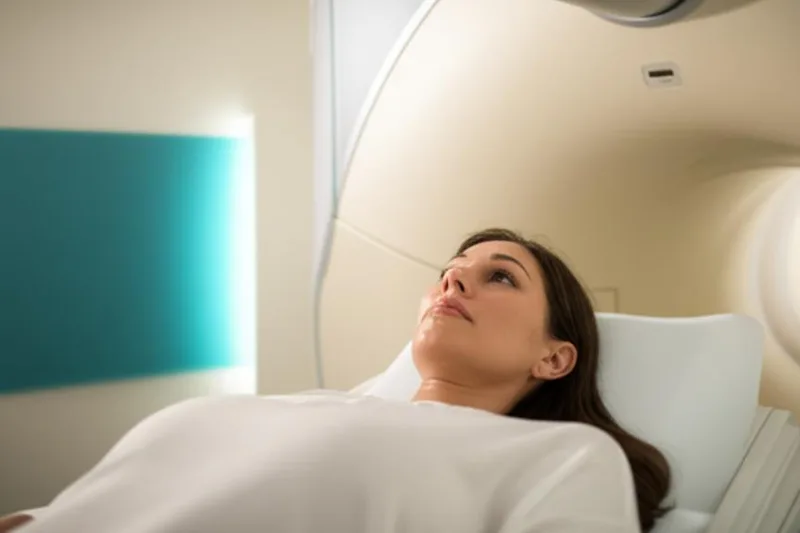
Has your doctor told you to have a Breast MRI? Or have you heard about this MRI when talking about the risk of breast cancer ? Many people get a little scared when they hear this name, and many questions come to mind. It's normal to think things like, "Is this a big test? Will it hurt? What will happen?" So today, let's clear up all your doubts about this, what is a Breast MRI, why is it done, and how safe is it, very simply, as if you were talking to a friend.
What is a Breast MRI? Why is it done?
Simply put, Breast MRI (Magnetic Resonance Imaging) is a test that uses a strong magnetic field and radio waves to produce very clear, detailed images of your breasts. It does not use X-rays.
But the important thing is, a Breast MRI is not a basic breast cancer test that is done for everyone. Usually, the first thing we do to look for breast cancer is a mammogram. An MRI is often done in addition to that, and only in a few special cases.
- For women at high risk: Women whose doctors determine that they have a 20% or higher lifetime risk of developing breast cancer, such as a family history of breast cancer , are recommended to have an MRI along with a mammogram once a year.
- When cancer has already been diagnosed: If someone has already been confirmed to have breast cancer, MRI is very helpful in accurately measuring the exact size of the tumor and how far it has spread .
Most importantly: A breast MRI is not a substitute for a biopsy to determine whether a breast lump is cancerous (benign or malignant).
And there's another thing. Sometimes an MRI can show something that isn't cancer, but looks like cancer. We call that a ' false positive '. If that happens, you can be unnecessarily worried and may even have to go for a biopsy. Also, some of the tiny calcium-like spots (microcalcifications) that are visible on a mammogram are not visible on an MRI. These tiny spots are what help us detect some cancers in their early stages.
Therefore, it is best to discuss with your doctor whether you need a breast MRI or not.
Is this Breast MRI test really safe?
Yes. Breast MRI is a very safe test if proper safety procedures are followed. There are no risks for the average person.
However, since this uses a strong magnet, if you have any metal devices inside your body, you must definitely tell the doctor and the technologist conducting the test.
You can get a better understanding of this from the two tables below.
| Cases where MRI is usually not a problem | |
|---|---|
| If you have any of the following conditions, you can usually have an MRI. However, it is best to inform your doctor about this as well. | |
|
|
| Things you should definitely tell your doctor before an MRI | |
|---|---|
| If you have something like this, you should never hide it and tell your doctor, because these things can be dangerous with an MRI. | |
|
|
Be sure to remember these things too.
In addition, tell your doctor about these things:
- If you are pregnant or suspect you are pregnant.
- If you weigh more than 135 kilograms (300 pounds) (some machines have a weight limit).
- If you have difficulty sitting still with your arms raised for 30-60 minutes at a time .
- If you have Claustrophobia , which is the fear of small, narrow, enclosed spaces. This is something that many people have, so don't be shy about saying it.
What happens before, during and after the test?
Okay. Now let's see what exactly happens on test day.
Before the Test
It is best to remove all jewelry and metal objects such as watches, earrings, and necklaces when you come for the test and leave them at home. Do not bring your wallet or credit cards with magnetic strips. The MRI machine's magnet can erase the information on them. Also, if you have hearing aids, you should remove them. The hospital usually has secure lockers to store your belongings.
During the Test
You will be put on a hospital gown. You will then be made to lie on your stomach on the MRI machine bed. Your breasts will be positioned so that they are in two small holes. The most important thing is to remain still throughout the test.
When the machine starts, you will hear a loud "dug-dug" sound. It will last for a few minutes. Apart from that sound, you will not feel anything strange or painful. Sometimes, a special contrast agent called gadolinium may be injected into a vein in your arm to make the images clearer.
The entire test takes about 45 to 60 minutes. All told, you should set aside about an hour and a half. If you have any questions or concerns, don't be afraid to talk to the technician who is present at the time.
After the Test
As soon as the test is over, you can resume your normal activities, eat and drink normally. There is no problem. Then, on the appointed day, your doctor will review the test report and explain it to you.
Take-Home Message
- A breast MRI is an important test in addition to a mammogram, especially for women at high risk. It is not a substitute for a mammogram.
- This is very useful for seeing the size and spread of an already diagnosed cancer.
- This is a very safe test, but be sure to inform the doctor and technician about any metal devices in your body, a pacemaker, or any other medical condition.
- Remove all metal jewelry and items before the test.
- Although the test is not painful, the machine is a bit noisy. It is also very important to remain still.
- Talk openly with your doctor about any questions or concerns you have. Never harbor doubts.


💬 Comments (0)
No comments yet. Be the first to share your thoughts here.
Add Your Comment