

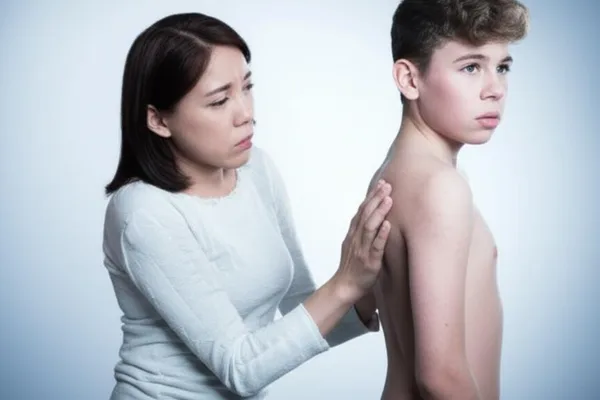
Have you ever noticed that one of your child's shoulders is a little higher than the other? Or does their back seem to be slightly tilted to one side when they stand up straight? It's normal for parents to feel a little worried and anxious when they see something like this. In many cases, this can be caused by a condition known as scoliosis in medical science. So, let's talk about this exactly, and simply, today.
Simply put, what is scoliosis?
Scoliosis is a condition where our spine curves sideways instead of being straight. Think of our spine as a straight pole. In scoliosis, the spine curves into a "C" or "S" shape.
This curvature may be very slight for some people, and more noticeable for others. However, if an X-ray shows that the curvature is more than 10 degrees, doctors call it scoliosis.
This condition is most common between the ages of 10 and 15, when children are growing rapidly. It is more common in girls than boys, and they are more likely to need treatment . In many cases, no specific cause can be found.
What are the symptoms of someone with scoliosis?
If you or your child has scoliosis, you may notice these things.
| External features | Symptoms felt by the body |
|---|---|
| Having a bed where your back is visible when you stand up straight. | Low back pain. |
| The shoulders are not at the same level (one is raised and the other is lowered). | Back stiffness. |
| One shoulder blade protruding further than the other. | Pain and numbness in the legs due to nerve compression. |
| Ribs protruding more on one side than the other. | Fatigue. |
| The hips are tilted to one side or the hip bones are of unequal height. | Difficulty breathing when the upper back pain is severe. |
The important thing is that many children who develop scoliosis at a young age do not feel any pain. So do not ignore these symptoms because they are not painful. However, if your child has severe back pain, you should definitely see a doctor to see if there is another cause.
How do you accurately determine if you have scoliosis?
There are several tests to find this out.
Basic test (Adam's Forward Bend Test)
This is the simplest test to do first. The doctor will ask you or your child to bend forward at about a 90-degree angle from the waist, keeping your legs together and your knees bent. When you bend forward, the doctor , looking from behind, can easily see if your back is arched, your shoulder blades are level, and your ribs are protruding to one side.
Confirmation tests
If any doubts arise from the above examination, the doctor will order an X-ray.
- X-ray : This is used to accurately measure the degree of spinal stenosis. This measurement determines whether treatment is needed or not.
- CT scan or MRI scan: Sometimes, a doctor may recommend a CT or MRI scan to further investigate the cause of the twitching. CT can look at the bones, while MRI can look at soft tissues like the spinal cord.
Pulling levels
- 10-24 degrees: Mild scoliosis
- 25-39 degrees: Moderate (Mode RA te) scoliosis
- 40 degrees or more: Severe scoliosis
What are the main types of scoliosis?
Scoliosis can be divided into several main types depending on how it occurs.
| Type | Simple explanation |
|---|---|
| Idiopathic Scoliosis | This is the most common type. "Idiopathic" means "of unknown cause." In about 80% of cases, no specific cause can be found. |
| Congenital Scoliosis | This is a congenital condition that occurs when the bones (vertebrae) in the spine are not properly formed while the baby is growing in the womb. |
| Neuromuscular Scoliosis | This is caused by cerebral palsy or another disease of the nervous system. Muscle weakness causes the spine to lose support and become hunched over. |
| Degenerative Scoliosis | This is a type that occurs in adults, especially after the age of 65. It is caused by the degeneration of the discs between the vertebrae of the spine as we age. |
What are the treatments?
Treatment depends on the extent of the back spasm, the patient's age, and whether the spasm continues to worsen.
1. Observation :
If the swelling is mild (less than 25 degrees), especially if the child is still growing, the doctor may recommend that you come back every 4-6 months without any treatment. During this time, they will take X-rays to see if the swelling is getting worse.
2. Scoliosis Brace:
If your child is still growing and has moderate scoliosis (25-40 degrees), your doctor may recommend a brace to help prevent further scoliosis. It is made of plastic and is worn under clothing. It may be worn for 16-23 hours a day. It can be worn while doing normal activities or playing sports.
3. Surgery:
If the curvature of the spine is severe (more than 40-50 degrees) or if the curvature continues to increase despite wearing a brace, surgery is recommended. The main goal of surgery is to stop the curvature from increasing further and straighten the spine as much as possible.
- Spinal Fusion: In this procedure, the surgeon uses bone fragments or similar material to fuse the damaged area of the spine together. They are held together with metal rods and screws (hardware).
- Expandable Rod: This is done for young children who are still growing. Rods are attached to the spine and the length of the rods is adjusted every few months as the child grows.
- Vertebral Body Tethering: This is also a new method. Screws are placed on the outer edge of the spine and a strong cord is pulled through them. This controls the growth of the side that is being pulled and allows the other side to grow, straightening the spine.
Remember, lifting heavy bags or sitting incorrectly does not cause scoliosis. These can cause back pain, but they are not a direct cause of scoliosis. And there is no specific way to prevent it.
How to live with scoliosis? Does exercise help?
Having scoliosis doesn't mean you can't live your life normally.
- Exercise: Exercises like swimming and walking are great for strengthening your back muscles. You can also see a physiotherapist and learn exercises that are right for your condition. Ask your doctor what exercises are right for you.
- Healthy Weight: Maintaining a healthy body weight prevents unnecessary stress on the bones.
- Good posture: Practice standing and sitting up straight whenever possible.
- Medical Checkups: Don't miss out on going to the doctor's scheduled checkups.
If left untreated, it can sometimes lead to complications such as long-term back pain and breathing difficulties (in severe cases). Therefore, if in any doubt, it is best to seek medical advice.
Take-Home Message
- Scoliosis is a sideways curvature of the spine. It is often diagnosed at a young age.
- If your child's shoulders are uneven, their hips are heavy on one side, or they appear to have a backache, see a doctor immediately.
- Scoliosis that occurs in young people is often painless, so don't ignore the symptoms, even if there is no pain.
- Not all cases of scoliosis require surgery. Treatment depends on the severity of the curvature and age.
- With proper treatment and management, someone with scoliosis can live a completely normal, active life .




💬 Comments (0)
No comments yet. Be the first to share your thoughts here.
Add Your Comment