

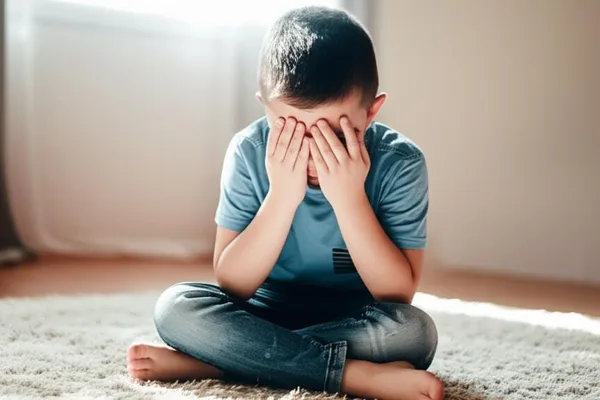
Does your child suddenly get very angry over something small? Or does he jump up and down and struggle uncontrollably even when he feels a little happy? Sometimes you might think, "Why is my child acting like this? He's just trying to make things worse." But the most important thing we need to understand as parents is that the child is not doing these things on purpose. Especially if the child has ADHD, which means attention deficit hyperactivity disorder, they need more time and effort than other children to control their emotions .
Why is it so difficult for these children to control their emotions?
Young children are usually a bit impulsive and act impulsively. That's normal. As they grow older, they learn to understand and control their emotions, that is, to develop self-regulation .
Simply put, this is like a fan regulator in our homes. When we feel hot, we use the regulator to increase the speed of the fan. When we feel cold, we reduce the speed. Similarly, a child also learns to understand when his emotions become "hot," that is, when anger, sadness, or anxiety increase, and to "cool" his mind, that is, to calm down.
However, in children with ADHD, this "regulator" in their brains works a little differently. It takes a while for it to develop . That's why it's hard for them to gauge the "temperature" of their emotions and control them appropriately. Suddenly, their emotions become very intense. That's why they get very angry over small things, or become so excited that they can't control themselves over small joys.
How do feelings of a child with ADHD manifest?
Not all children with ADHD behave the same way. Some children may become uncontrollable when they are sad or angry, and may scream or throw things on the floor. Another child may not be interested or motivated when asked to do something they don't want to do.
However, there are some common characteristics that can be observed. Once you see these, it will be easier for you to understand your child.
| Characteristic | A simple explanation |
|---|---|
| Getting very upset over small things | Imagine, a toy breaks, or the tip of a colored pencil breaks. A normal child would be a little sad and forget about it. But a child with ADHD may be sad, scream, and cry as if the whole world has collapsed. It is very difficult for them to get rid of that feeling. |
| Difficulty calming down after an upset | If they fight with someone, or if you scold them, that anger and sadness is already deep in their hearts. It's hard for them to forget it quickly and make friends again like a normal child. |
| Seeing even a small criticism as a big mistake | Even if you say something small like "improve your handwriting," they will feel like you've done them a huge disservice, like you've hit them. They can be very hurt by it. |
| Wanting to get something immediately when needed | If they say, "I want an ice cream," they want it "right now." If they say, "I'll give it to you in a while," they can't tolerate it. They feel that need so strongly that they lose patience. |
This is the same with emotions like happiness and excitement. They feel them very strongly. So even if they feel a little happiness, they can become so happy that they can't control themselves, they can struggle and scream.
How can you help your child control their emotions?
Although this can be a bit complicated for a child with ADHD, with your help, your child can develop this skill. These tips will be very useful to you.
1. Don't underestimate your child's feelings.
When your child is crying or upset, don't say, "What's wrong, don't cry so much." At that time, your child needs a safe environment to talk about their feelings. Instead of asking questions, listen carefully to what your child is saying. Try to think from your child's perspective. Even if it seems strange to you, remember that your child really feels the same way . Show them that you understand by saying things like, "You're sad that the toy broke, right? I understand."
2. Develop healthy habits
It is easier for us to control our emotions when we eat well and get enough sleep. When we are hungry and tired, we get angry over small things, right? This affects a child with ADHD even more. Therefore, make sure that your child has a good nutritious diet and gets enough sleep . It is also very important to exercise at least an hour a day. Encourage your child to run and play.
In some cases, your doctor or psychologist may recommend specific behavioral therapies . These include therapies such as ``Cognitive Behavioral Therapy (CBT)`` and ``Dialectical Behavior Therapy (DBT)``. These teach your child how to identify and manage their thoughts and feelings.
3. Make a list of ways to calm your mind (Coping Skills)
When your child is angry or sad, identify with them some ways they can calm themselves down without harming themselves or others. We call these coping skills . Some of these can be done at home, while others can be done outside.
- Breathe deeply: Practice breathing in while counting 1, 2, 3, 4 in your mind, and breathing out while counting.
- Exercise: When you get angry, ask them to run around the yard or go up and down the stairs.
- Listening to music: Let the child listen to a calming song that he likes.
- Journaling or drawing: Encourage them to write down or draw what's on their mind.
- Talking to someone you trust: Teach yourself, your dad, or a best friend to tell you what's on your mind.
4. Think about yourself as a parent.
Taking care of a child with ADHD is not easy. It can be emotionally stressful at times. To help your child, you need to be in good mental health first . Make a list of ways to calm yourself down when you feel stressed. Don't be shy about asking for help from family and friends when you need it. Sometimes, you may need counseling too. Also, joining support groups for parents of children with ADHD can be a great source of strength.
If you have a serious problem with your child's behavior, instead of trying to find solutions on your own, you should definitely consult a pediatrician or psychiatrist for advice . They will provide the most suitable solution for you and your child.
Take-Home Message
- ADHD is not a deliberate act by a child, it is a real medical condition.
- These children's feelings are not "wrong", they just feel them more "naturally" than others.
- Your patience, understanding of your child, and the healthy habits you instill at home are your child's greatest strength.
- Respect your child's feelings, listen to them, and teach them ways to calm down.
- You are not alone in this journey. If necessary, seek professional help for yourself and your child. It is best to seek advice from an experienced doctor.




💬 Comments (0)
No comments yet. Be the first to share your thoughts here.
Add Your Comment