
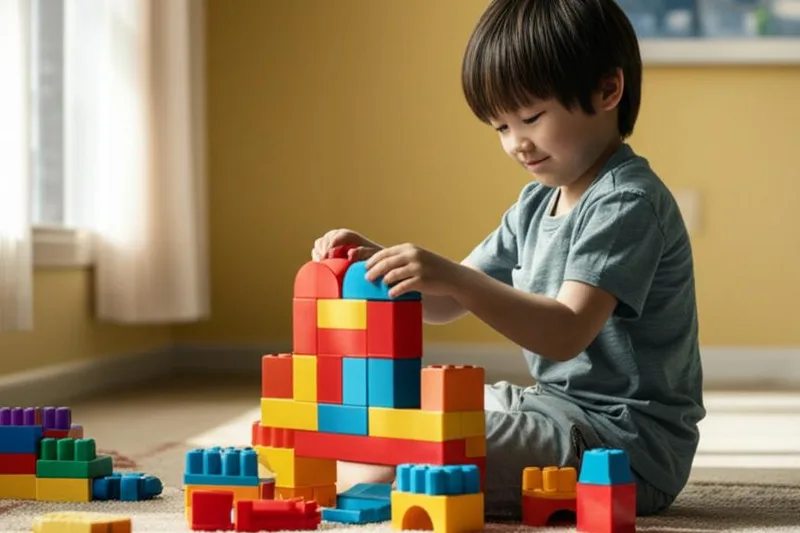
Does your little one not play like other children? Do you feel like he is alone in his own world? Sometimes he seems not to listen when we talk, and sometimes he does not look at what we are showing him. These things can cause you great concern, and even a little fear. It is very normal. Today we are going to talk about the latest treatments available for such children, which can improve their lives in a wonderful way.
Can you teach how to play? - Video Modeling
Imagine this scenario. There are some Batman and Robin toys on a table. A teacher shows a short video of someone taking these toys and playing with them in a beautiful story. A little boy, about 6 years old, is watching this video with great interest. He has autism.
When the video ends, the teacher lovingly pats his head and takes him to the table with the toys. Now he is expected to play by saying the same dialogues as he saw in the video.
This method is called Video Modeling . Normally, children play by making up stories in their minds and using toys in that way. But children with autism are not born with that ability. So, they have to be taught how to play in that way. The goal is to gradually understand this concept and eventually get them used to playing with things in their minds, using their own imagination.
What is this 'Applied Behavioral Analysis (ABA)'?
Video modeling is just one small tool in autism treatment. All of this belongs to a broader treatment approach called 'Applied Behavioral Analysis' . We call this ABA for short. This is what is currently accepted as the 'gold standard' in autism treatment worldwide.
Simply put, ABA is a method of teaching children new things and good behavior without punishing them, using constant positive reinforcement . When a child does something well, they are rewarded, praised, and shown love. This helps to change their inappropriate behaviors (e.g., screaming, self-harm) and builds good social skills and language skills.
Under this treatment method, the child is taught a wide range of things, from very basic language skills to educational and vocational training. The course is tailored to the child's age and ability level.
The important step called 'Joint Attention'
Another new thing is the development of the concept of 'Joint Attention'. This is a very important first step in building relationships with others. Imagine, if you suddenly look out the window and say, "Oh... look at that beautiful bird," a normal child will just look where you are looking. But a child with autism often ignores that. He doesn't pay attention to what you are looking at or what you are thinking.
This is a key feature of autism. So to develop this 'Joint Attention' ability, therapists use various methods. For example, when the therapist looks at a toy, they turn on the toy with a remote control only if the child looks at it. Then the child learns that when the other person looks, something good, something fun happens.
Although these may seem like small things, they are crucial in building a child's social skills .
Why is it important to get a diagnosis early?
Research has shown that the sooner such treatments are started, the better the results . Autism can usually be diagnosed by the age of 18 months.
Scientists are now trying to see if a blood test at birth could detect the condition in the future. Some studies have found significant differences in certain proteins and immune cells in the blood of children with autism and those without.
One idea is that not only can early treatment be started, but perhaps if there is an environmental trigger that can cause autism, it can also protect the child. But these are still in the research stage.
The important thing is that autism is not a single disease. It is a condition that comes in different levels, with different characteristics. That is why scientists use the word 'Autisms' instead of 'Autism'. Every child is different.
Other treatments and future prospects
One common symptom seen among children with autism is repetitive behaviors. Some medications are used to control these symptoms. For example, low doses of Selective Serotonin Reuptake Inhibitors (SSRIs) such as Prozac have been shown to improve these behaviors.
But this is very important: Medication is never a sole treatment for autism. It is only given to control some of the child's specific symptoms (e.g., excessive restlessness, repetitive behaviors). It should all happen in conjunction with other treatments, such as behavioral therapy, as part of an integrated approach, and only under the supervision of a qualified doctor.
Get a simple idea of these treatment approaches from the table below.
| Treatment Approach | Simple explanation |
|---|---|
| Applied Behavior Analysis (ABA) | Teaching language, social skills, and good behavior through positive reinforcement is the mainstay of treatment. |
| Video Modeling | Teaching how to play, how to speak, etc. by showing videos. |
| 'Joint Attention' training | To accustom the child to pay attention to what others are paying attention to. |
| Medication | Only on medical advice to control specific symptoms such as repetitive behaviors and hyperactivity. |
| Neural Retraining | Attempts to improve the linguistic abilities of the brain through computer programs. (Still in the research stage) |
Brain retraining?
Another promising future is the concept of 'Neural Retraining'. Scientists now know that our brains are not set in stone, but are very flexible (plastic). Using computer programs, the brains of children with language impairments can be trained to recognize speech better. However, the current programs are a bit too complex to use with children with autism. So, scientists are trying to create simple programs that are suitable for these children. These are still in the research stage and will come in the future.
Be careful of treatments that have no scientific basis!
This is very important. When you find out that your child has autism, you are tempted to do anything. Some people, taking advantage of this opportunity, may tell you about "miracle" treatments that have no scientific basis and are unproven .
For example:
- Special diets
- Giving the hormone Secretin
- Things like mercury detoxification.
None of these have been scientifically proven to be effective treatments for autism. So, don't try these things just because you see them on the internet or someone tells you to. They could do more harm than good to your child.
Always trust only scientifically proven, research-backed treatments. Talk to your doctor or therapist and follow the treatment path they recommend.
Methods like ABA cannot be expected to provide overnight "magical" relief. It is something that requires long-term, dedicated work. However, it is certain that it can dramatically improve the lives of these children and provide them with the skills they need to function well in society.
Take-Home Message
- Autism is not a disease, it is a condition of neurodevelopmental abnormalities. Every child is different.
- If you notice any changes in your child, take your child to a specialist (e.g., pediatrician, psychiatrist) as soon as possible. The sooner treatment begins, the better the results.
- Applied Behavioral Analysis (ABA) is the most scientifically proven, recognized and successful treatment method in the world.
- Medications are only used to control certain symptoms. They should be used under medical advice and in conjunction with other treatments.
- Don't follow unproven "magic" treatments that have no scientific basis, just because you read them on the internet or hear about them. Always consult your doctor.
- You don't have to go through this journey alone. There are doctors, therapists, and parent groups who can help you. Don't be afraid to reach out to them for help.




💬 Comments (0)
No comments yet. Be the first to share your thoughts here.
Add Your Comment