

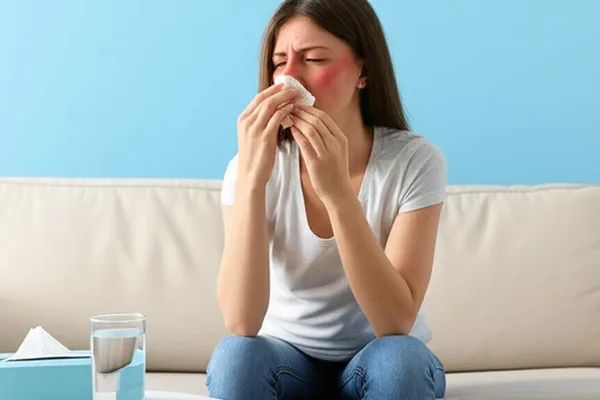
Do you suddenly start sneezing and runny noses when you sweep up some dust at home ? Or do you get a rash and itchy skin after eating certain foods, such as shrimp or shellfish? These things have probably happened to you too. Most of the time, the cause of this is a condition we all know as 'allergy'. So today, let's talk about this allergy, that is, allergies, in a simple way.
What exactly is an allergy?
Simply put, an allergy is when our body's defense system, the immune system, overreacts to something that is actually harmless to us. Think of it like a bodyguard. His job is to fight off harmful germs that enter the body. But sometimes this bodyguard sees something that is actually harmless, like a speck of dust, pollen, or a protein in food, and thinks it is a big enemy and starts a big fight.
This is what we call an allergen , and when an allergen enters the body, the body's defense system releases chemicals like histamine . These chemicals are what cause the symptoms of an allergy, such as itching, hives, and sneezing.
Allergies are a very common condition in our country and around the world. They can affect both children and adults.
How does an allergy feel? What are the symptoms?
The symptoms you experience when you have an allergy depend on what you are allergic to and how it enters your body. An allergen can enter the body in several main ways:
- Breathing in through the nose (things like dust, pollen)
- By eating ( food ) through the mouth
- Contact with skin surfaces (some coatings, metals)
- From an insect bite (wasp, hornet venom)
Let's look at the most common types of allergies and their associated symptoms in a table like this.
| Cause of Allergy | Common Symptoms |
|---|---|
| Airborne Allergens Ex: pollen, dust mites, pet dander, mold |
|
| Certain Foods For example: nuts like peanuts and cashews, seafood like shrimp and squid, eggs, milk | |
| Insect Stings Ex: Wasp, hornet stings |
Anaphylaxis - a severe allergic reaction that can be life-threatening!
This is a very important and urgent condition that we all need to know when talking about allergies. Anaphylaxis is a very severe, whole-body allergic reaction. It can be life-threatening within minutes.
Important: If someone experiences one or more of the following symptoms all at once, it may be anaphylaxis. In such a case , immediately take them to the nearest hospital Emergency Department (ETU).
Symptoms of anaphylaxis include:
- Difficulty breathing, shortness of breath, or a whistling sound when breathing
- Feeling of tightness in the throat, hoarseness when speaking
- Swelling of the face, eyelids, lips, or tongue
- Severe itching and rash all over the body
- Feeling dizzy, blue eyes, loss of consciousness
- Numbness of the hands, feet, lips, or scalp
For some people with severe allergies, doctors advise them to always carry an auto-injector containing a medicine called epinephrine . It can be used in an emergency like this. But even if you get an injection like this, you should definitely go to the hospital .
How do I know for sure if I have an allergy?
If you suspect you have an allergy, it's best not to rely on guesswork. The best thing to do is see your doctor . He or she will ask about your symptoms and, if necessary, refer you for some allergy tests.
Allergy Tests
- Skin-prick test: This involves placing a very small amount of a liquid solution of the allergens you think you may be allergic to on your arm or back and then pricking the skin with a small prick. If you are allergic to the substance, the area will turn red and swell slightly after about 15 minutes.
- Intradermal skin test: This is done if the above test does not give a clear result. In this, a very small amount of the allergen is injected into the outer layer of the skin.
- Patch test: This is used to diagnose contact dermatitis, which is a type of skin allergy. You are asked to put a patch containing the allergen on your skin and leave it on for a couple of days. Then, your doctor removes it and checks your skin for a reaction.
- Blood test: This involves taking a sample of your blood and testing it for levels of an antibody called Immunoglobulin E (IgE) . This IgE level is elevated in an allergy.
Remember, before taking any of these tests, your doctor will advise you to stop taking any allergy medications you are taking for a few days, as these medications can interfere with the test results.
How to live with allergies? Managing them.
There is currently no cure for allergies. But we can control the symptoms and live a normal life. There are three main ways to do that.
1. Avoid the Allergen: The best and first thing you can do is to identify exactly what you are allergic to and stay away from it as much as possible. For example, if you are allergic to dust, keep your home clean, or if you are allergic to a food, avoid eating that type of food.
2. Taking medication: Your doctor may prescribe allergy medications, such as pills, nasal sprays, and eye drops. These medications work by reducing the effects of histamine and controlling symptoms. It is important to take these medications exactly as your doctor tells you to.
3. Immunotherapy: Also called "allergy shots," this is a longer-term treatment. It involves injecting your body with a very small amount of the allergen, starting with a small dose and gradually increasing the dose over time. This helps your immune system "get used to" the allergen. Over time, your body stops overreacting to it. This treatment can take 3-5 years to be effective. It can also be a bit expensive. However, the results last long after you stop taking the medication.
Take-Home Message
- An allergy is when our body's immune system overreacts to something that is harmless.
- Know exactly what you're allergic to and avoid those things as much as possible.
- If you experience severe symptoms such as difficulty breathing and facial swelling, it could be an emergency called anaphylaxis . Go to the ETU immediately.
- If you suspect you have an allergy, don't self-medicate based on guesswork. Always consult your doctor .
- Using the medication prescribed by your doctor exactly and following his instructions is very important to controlling symptoms.




💬 Comments (0)
No comments yet. Be the first to share your thoughts here.
Add Your Comment