
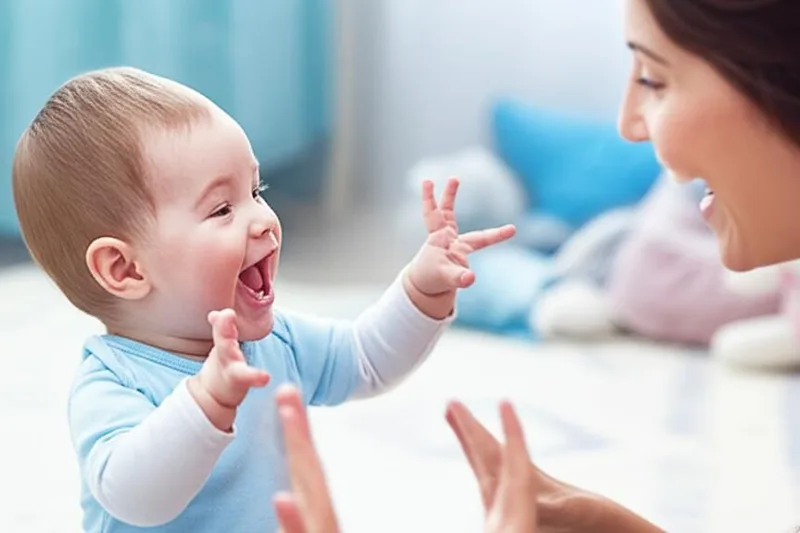
Do you ever have a baby who cries for no reason? You may be confused as to whether it's because he's hungry or something else. You'll have to deal with this problem until your baby can say things like "Mommy, I'm hungry" or "I want that toy." But would you believe me if I told you that even before your baby can talk, there's a way to tell you what's on his mind? That's what we call `Baby Sign Language`.
What is Baby Sign Language?
Simply put, this is a way of teaching young children to tell you about their needs, feelings, and what they see through simple hand gestures before they learn to speak. This is much simpler than the sign language used by deaf children.
Actually, none of us do this without realizing it. Imagine, we teach a baby to wave his hand to say "tata bai" right? That's also a signal. And so is this method. What happens here is that we teach a few simple hand signals to say when the baby wants "milk", "more", or "I'm hungry".
For example, a 10-month-old girl named Sophia went to an aquarium with her mother. She saw penguins swimming in the water and made a hand gesture for "fish." When her mother corrected her and made a hand gesture for "bird," her daughter made a hand gesture for "fish." Then, when her mother made two separate gestures for "bird" and "swimming," her daughter understood and made a hand gesture for "bird." Look, how amazing it is to be able to have a conversation with a 10-month -old about whether a penguin is a fish or a bird.
Will this delay the baby's ability to talk? - A big fear for many mothers!
This is the biggest fear of many parents, especially grandparents in our country. You may have heard the saying, "If you get used to asking for things with your hands, your child will be lazy to talk." But research has proven that this is a complete myth . In fact, the opposite is true.
Imagine, a baby who starts crawling will try to stand and walk next, but won't always crawl, right? That's how it is. When the baby expresses his ideas through signs and receives responses from his mother and father, he feels great joy and interest. When he realizes, "Ah... they understand what I'm saying," he looks for a better, easier way to express himself. The best way to do that is to speak with words. So, sign language is not something that blocks the way to talk , but something that delays it.
Research has shown that children who learn sign language know many more words by the age of 2. Also, in a test conducted at the age of 8, the intelligence quotient (`IQ`) of children who learned sign language was about 12 points higher than other children. However, the main thing we need to understand here is that this is not about increasing the baby's `IQ` or making him an Einstein.
"The main goal of this is to strengthen the bond between parents and child and make that time a very beautiful and comfortable time for both of them. The baby gets a chance to express his needs, what he thinks, what he wants to share with us. It makes life a lot easier" - Dr. Linda Acredolo.
What are the main benefits of Baby Sign Language?
- Less crying: If you can signal whether your baby is hungry, sleepy, or wants to play without crying, how much less stress will it be for your baby and for you? The home environment will also become much more peaceful.
- The parent -child bond is strengthened: When you understand what your little one is thinking and you understand what your baby is saying, a wonderful bond is formed between the two.
- Speech and vocabulary skills increase: As mentioned earlier, this is a great time to start talking. Because you verbalize what your baby is signaling (e.g., "ball"), he quickly learns the relationship between words and objects.
- Helps with intellectual development: Since children get the opportunity to remember things and understand concepts (like naming a penguin) at an early age, it is a great stimulus for the development of the child's brain.
Okay, so how do we start this?
This is very simple. You can do this in two ways.
1. Using a Standardized Sign Language: For example, you can use simple signs in American Sign Language (ASL). The advantage of this is that if someone else who is taking care of your baby (grandparents, daycare teachers) knows those signs, it will be easier for your baby to communicate with them as well.
2. Making up your own signs: This is the easiest and most popular method. Rather than learning every sign from a book, you can make up simple signs that you and your baby can understand. For example:
- Milk: To open the hand with the palm of your hand, as if milking a cow.
- Eat : Bringing the fingers together and bringing them to the mouth.
- More: Tapping the fingertips of both hands together.
- Sleep: Place your palms together and tilt your head to that side.
The most important thing is that every time you make a sign, you must clearly say the corresponding word . That way, the baby will learn both the sign and the word.
| The most important things to remember when getting started |
|---|
| 1. Don't make this a lesson, make it a game: Don't force your child. Use these signals while going about your daily routine (while breastfeeding, feeding). |
| 2. Don't ask your child to put on a show in front of others: Don't pressure your child by saying things like, "Show me that sign for Aunty." |
| 3. Don't compare your baby to other children: Every child learns at a different pace. Be patient. |
| 4. Praise your baby when he tries: If your baby tries to make a certain gesture, even if it's not perfect, respond by smiling and hugging him. That's a great encouragement for him. |
| 5. Give your baby some time to think: When your baby is looking at something, give him a little time to signal what it is before you tell him what it is. Rather than giving him everything up front, give him a chance to express his needs. |
If you have any concerns or feel that your baby is having a delay in their speech development, it's best to talk to your pediatrician without panicking.
Take-Home Message
- ``Baby Sign Language`` is a simple, fun way to teach your baby to express themselves before they can speak.
- This won't delay your baby's speech, it will actually help it.
- The main benefit is that it reduces stress on both your baby and you, and strengthens the bond between you.
- When starting this, always say the corresponding word clearly while making the gesture.
- Don't force the baby. Keep this as a loving game, not a lesson.


💬 Comments (0)
No comments yet. Be the first to share your thoughts here.
Add Your Comment