Can the baby withstand contractions? Let's talk about the Contraction Stress Test''!

Can the baby withstand contractions? Let's talk about the Contraction Stress Test''!

Hello! You are now in the period of expecting a baby. During this time, you and your baby will have to undergo a lot of tests, right? Sometimes, when you hear the names of some of the tests that the doctor says, you feel a little scared. But don't worry, all of these are done for the good of you and the baby. Today we are going to talk about one such test. That is the `(Contraction Stress Test)` test.
What is this `(Contraction Stress Test)`?

Simply put, this `(Contraction Stress Test)` checks whether your baby can withstand the uterine contractions (i.e., the pushing like a baby) that occur during childbirth, and whether the baby is getting the right amount of oxygen from the placenta at that time. Imagine, when the baby is about to be born, your uterus tightens and pushes the baby out, and this is mainly to see how the baby's heartbeat (we also call it the heart rate) changes at that time. This allows the doctor to see how ready the baby is for childbirth, and whether the baby has the strength to withstand the pressure that comes at that time.

Why is this `(Contraction Stress Test)` being done?

Usually, a doctor recommends doing this `(Contraction Stress Test)` if other tests done previously, for example, a `(Nonstress Test)` or a `(Biophysical Profile - BPP)` (this is an `(Ultrasound scan)` done with the `(Nonstress Test)`) show that there is some minor problem. Then the doctor wants to know exactly, as I said before, whether the baby's heart rate is stable, that is, without any major changes, when the uterine contractions come. Because, if there is a big decrease in the heart rate at that time, it means that the baby is having difficulty coping with those contractions, and may be lacking oxygen . This is like a driver checking whether the engine of the car is in good condition before climbing a hill.

When do you need to do this?

Not everyone will need this test. Only your doctor can decide whether you need it or not. Doctors especially consider this ``Contraction Stress Test`` in these situations:

  • If you have a medical condition like Diabetes Mellitus.
  • If you have high blood pressure.
  • If your baby is not growing as well as expected (i.e. the baby is small - `Intrauterine Growth Restriction` or `IUGR`).
  • If you feel that your baby is moving less.
  • If the results of the previously mentioned ``Nonstress Test`` are not very satisfactory.
  • If an ultrasound scan shows that your amniotic fluid is low (oligohydramnios).
  • Your pregnancy periodIf you've skipped 40 weeks, that means you're overdue.
  • If the baby has had any complications during a previous delivery.

It is in cases like this that doctors try to further confirm the baby's condition with this test.

Do I really need to do this `(Contraction Stress Test)`?

This is a really good question. A doctor doesn't just suggest this test. It's for the safety of the baby . It's done to see how the baby responds to uterine contractions, and how the baby's heart rate responds to that stimulation. However, one thing about this is that sometimes this test can actually start labor and even induce labor. That's why the doctor thinks carefully before doing this, talks to you, and makes a decision. If you have any fears or doubts, definitely talk to your doctor about it. It's your right. The doctor will explain both the pros and cons of this to you.

How is this `(Contraction Stress Test)` done?

You may feel a little strange when you hear how to do this, but this is something that is done safely most of the time.

This involves gently stimulating your uterus and causing it to contract. This can be done in two ways:

1. By giving `(Pitocin)`: `(Pitocin)` is a synthetic version of the hormone `(Oxytocin)` (a hormone that is naturally released during labor). It is slowly given into your body through a saline solution. Then the uterus starts to contract little by little.

2. Nipple stimulation: Gently massaging your nipples also naturally releases the hormone `(Oxytocin).` This can also cause uterine contractions. Sometimes your doctor will tell you how to do this.

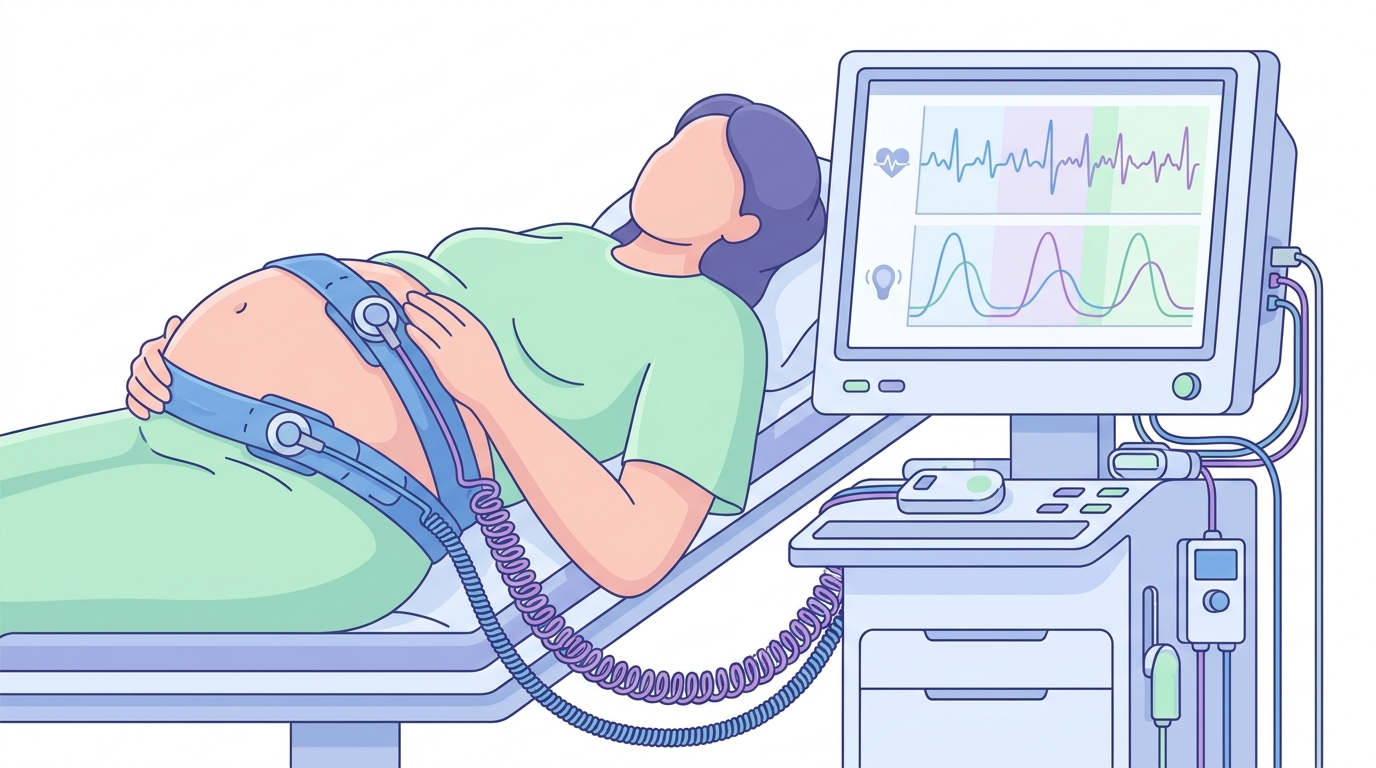
As your uterus contracts slowly, doctors and nurses continue to monitor your baby's heartbeat. They use a machine called a ``CTG machine'' (Cardiotocography machine). It does this by placing two straps around your abdomen. One measures your uterine contractions, and the other measures your baby's heart rate.

At this point, you may feel a little cramping. But it's not too intense, it's controlled. It's like a little stomach ache during your monthly period.

In this way, over a period of about 30 to 40 minutes, a certain number of contractions are induced (usually about 3 every 10 minutes), and the baby's heart rate is monitored during each contraction.

At what point during pregnancy is this done?

This ``Contraction Stress Test`` is usually done at 34 weeks of your pregnancy or later.. Because, if this is done before then, there is a higher chance of a premature birth. Since the baby is quite mature after 34 weeks, there may be no major risk even if the baby is born due to this test. However, in some special cases, if the doctor wants, this can be done a little earlier, depending on the baby's and your condition.

How long does it take for the results to come?

The good thing about this is that the results of the `(Contraction Stress Test)` are available almost immediately after the test is done . This means that the doctor can make a decision right away about how the baby is doing and what to do next. You don't have to wait too long either.

How to read the results?

It's good for you to know this too, so it'll be easier to understand what the doctor says.

  • Negative result: This is the best result . It means that the baby's heart rate does not slow down significantly (called `late decelerations`) when the uterine contractions occur. It means that the baby is able to tolerate these contractions well and is getting enough oxygen from the placenta. If you get a result like this, you will probably be asked to do this test or another test again in about a week, and continue to monitor the baby.
  • Positive result: This means that the baby's heart rate slows down during most of the contractions (there are `late decelerations`). This means that the baby is having a hard time coping with these contractions and may not be getting enough oxygen. In this case, the doctor may decide to deliver the baby early, perhaps by ``Caesarean section``.
  • Equivocal or Suspicious Result: Sometimes the result may be ambiguous. This means there are slight changes in the heart rate, but it is not severe enough to be called 'positive'. In this case, the doctor may extend the test for a little longer, or ask you to do it again later.

Are there any side effects?

As I mentioned earlier, the main risk of this test is premature birth or the onset of labor. Also, some people may experience a little nausea and vomiting due to the Pitocin . If the uterus is overstimulated (uterine hyperstimulation), it can also affect the baby a little. But this happens very rarely, because doctors do this very carefully, observing everything. Also, during this test, you may feel a little uncomfortable because you have to stay in one position for a while.

The most important things we need to remember

Okay, so we've talked a lot about this `(Contraction Stress Test)`. In short, here are some things to remember:

  • This is done to see if the baby can tolerate the heat and is getting enough oxygen .
  • This is usually done if there is a problem with a previously performed ``Nonstress Test'' or ``Biophysical Profile''.
  • From this testThere is a chance that the riot could start.
  • Uterine contractions are induced by either giving Pitocin or stimulating the nipples.
  • This is usually done after 34 weeks .
  • Results will be available soon .

The most important thing is, if you have any questions, concerns, or doubts about this test, be sure to talk to your doctor and clarify them. Listen carefully to what the doctor says. Everything is done for your safety and that of your baby.

Don't worry, just remember that everything will be fine. May the three of you and the baby be blessed!

👩🏽‍⚕️ Additional questions (FAQs)

💬 What is the Congenital Heart Test (CST) performed on pregnant mothers near the time of delivery?

After 32 weeks, a major test is done to see if the baby is getting enough oxygen. Here, a medicine is given to the mother's abdomen to induce false contractions, and the baby's heart rhythm is checked to see if it changes when the contractions occur.

💬 Does this test determine whether the child can handle this discomfort?

That's right! During a normal labor, the baby feels this same pressure when the mother pushes. If the baby's heartbeat slows down too much (lacks oxygen) when the contractions begin, doctors decide that the baby will not be able to survive a normal labor.

💬 If the results of this test are high risk, will I definitely have to have a cesarean section (C-Section)?

Yes. If the baby's heart rate is too low (an abnormal result), it is very dangerous for the baby's life to deliver the baby normally. Therefore, it is imperative to perform a Caesarean section immediately to safely deliver the baby.


` Pregnancy tests, Contraction Stress Test, Baby's Heartbeat, Uterine Contractions, (Contraction Stress Test), (Pitocin), (Nonstress Test)

Frequently Asked Questions (FAQ)

When do you need to do this?

Not everyone will need this test. Only your doctor can decide whether you need it or not. Doctors especially consider this ``Contraction Stress Test`` in these situations:

How to read the results?

It's good for you to know this too, so it'll be easier to understand what the doctor says.

⚠️ Important: The medical articles and information on Nirogi Lanka are for general awareness only, and are by no means a substitute for professional medical advice, diagnosis, or treatment. For any medical problem you have, consult a qualified physician immediately.

💬 Comments (0)

No comments yet. Be the first to share your thoughts here.

Add Your Comment

Please calculate: 6 + 5 =
Can the baby withstand contractions? Let's talk about the Contraction Stress Test''!

Can the baby withstand contractions? Let's talk about the Contraction Stress Test''!

Hello! You are now in the period of expecting a baby. During this time, you and your baby will have to undergo a lot of tests, right? Sometimes, when you hear the names of some of the tests that the doctor says, you feel a little scared. But don't worry, all of these are done for the good of you and the baby. Today we are going to talk about one such test. That is the `(Contraction Stress Test)` test.

What is this `(Contraction Stress Test)`?

Simply put, this `(Contraction Stress Test)` checks whether your baby can withstand the uterine contractions (i.e., the pushing like a baby) that occur during childbirth, and whether the baby is getting the right amount of oxygen from the placenta at that time. Imagine, when the baby is about to be born, your uterus tightens and pushes the baby out, and this is mainly to see how the baby's heartbeat (we also call it the heart rate) changes at that time. This allows the doctor to see how ready the baby is for childbirth, and whether the baby has the strength to withstand the pressure that comes at that time.

Why is this `(Contraction Stress Test)` being done?

Usually, a doctor recommends doing this `(Contraction Stress Test)` if other tests done previously, for example, a `(Nonstress Test)` or a `(Biophysical Profile - BPP)` (this is an `(Ultrasound scan)` done with the `(Nonstress Test)`) show that there is some minor problem. Then the doctor wants to know exactly, as I said before, whether the baby's heart rate is stable, that is, without any major changes, when the uterine contractions come. Because, if there is a big decrease in the heart rate at that time, it means that the baby is having difficulty coping with those contractions, and may be lacking oxygen . This is like a driver checking whether the engine of the car is in good condition before climbing a hill.

When do you need to do this?

Not everyone will need this test. Only your doctor can decide whether you need it or not. Doctors especially consider this ``Contraction Stress Test`` in these situations:

  • If you have a medical condition like Diabetes Mellitus.
  • If you have high blood pressure.
  • If your baby is not growing as well as expected (i.e. the baby is small - `Intrauterine Growth Restriction` or `IUGR`).
  • If you feel that your baby is moving less.
  • If the results of the previously mentioned ``Nonstress Test`` are not very satisfactory.
  • If an ultrasound scan shows that your amniotic fluid is low (oligohydramnios).
  • Your pregnancy periodIf you've skipped 40 weeks, that means you're overdue.
  • If the baby has had any complications during a previous delivery.

It is in cases like this that doctors try to further confirm the baby's condition with this test.

Do I really need to do this `(Contraction Stress Test)`?

This is a really good question. A doctor doesn't just suggest this test. It's for the safety of the baby . It's done to see how the baby responds to uterine contractions, and how the baby's heart rate responds to that stimulation. However, one thing about this is that sometimes this test can actually start labor and even induce labor. That's why the doctor thinks carefully before doing this, talks to you, and makes a decision. If you have any fears or doubts, definitely talk to your doctor about it. It's your right. The doctor will explain both the pros and cons of this to you.

How is this `(Contraction Stress Test)` done?

You may feel a little strange when you hear how to do this, but this is something that is done safely most of the time.

This involves gently stimulating your uterus and causing it to contract. This can be done in two ways:

1. By giving `(Pitocin)`: `(Pitocin)` is a synthetic version of the hormone `(Oxytocin)` (a hormone that is naturally released during labor). It is slowly given into your body through a saline solution. Then the uterus starts to contract little by little.

2. Nipple stimulation: Gently massaging your nipples also naturally releases the hormone `(Oxytocin).` This can also cause uterine contractions. Sometimes your doctor will tell you how to do this.

As your uterus contracts slowly, doctors and nurses continue to monitor your baby's heartbeat. They use a machine called a ``CTG machine'' (Cardiotocography machine). It does this by placing two straps around your abdomen. One measures your uterine contractions, and the other measures your baby's heart rate.

At this point, you may feel a little cramping. But it's not too intense, it's controlled. It's like a little stomach ache during your monthly period.

In this way, over a period of about 30 to 40 minutes, a certain number of contractions are induced (usually about 3 every 10 minutes), and the baby's heart rate is monitored during each contraction.

At what point during pregnancy is this done?

This ``Contraction Stress Test`` is usually done at 34 weeks of your pregnancy or later.. Because, if this is done before then, there is a higher chance of a premature birth. Since the baby is quite mature after 34 weeks, there may be no major risk even if the baby is born due to this test. However, in some special cases, if the doctor wants, this can be done a little earlier, depending on the baby's and your condition.

How long does it take for the results to come?

The good thing about this is that the results of the `(Contraction Stress Test)` are available almost immediately after the test is done . This means that the doctor can make a decision right away about how the baby is doing and what to do next. You don't have to wait too long either.

How to read the results?

It's good for you to know this too, so it'll be easier to understand what the doctor says.

  • Negative result: This is the best result . It means that the baby's heart rate does not slow down significantly (called `late decelerations`) when the uterine contractions occur. It means that the baby is able to tolerate these contractions well and is getting enough oxygen from the placenta. If you get a result like this, you will probably be asked to do this test or another test again in about a week, and continue to monitor the baby.
  • Positive result: This means that the baby's heart rate slows down during most of the contractions (there are `late decelerations`). This means that the baby is having a hard time coping with these contractions and may not be getting enough oxygen. In this case, the doctor may decide to deliver the baby early, perhaps by ``Caesarean section``.
  • Equivocal or Suspicious Result: Sometimes the result may be ambiguous. This means there are slight changes in the heart rate, but it is not severe enough to be called 'positive'. In this case, the doctor may extend the test for a little longer, or ask you to do it again later.

Are there any side effects?

As I mentioned earlier, the main risk of this test is premature birth or the onset of labor. Also, some people may experience a little nausea and vomiting due to the Pitocin . If the uterus is overstimulated (uterine hyperstimulation), it can also affect the baby a little. But this happens very rarely, because doctors do this very carefully, observing everything. Also, during this test, you may feel a little uncomfortable because you have to stay in one position for a while.

The most important things we need to remember

Okay, so we've talked a lot about this `(Contraction Stress Test)`. In short, here are some things to remember:

  • This is done to see if the baby can tolerate the heat and is getting enough oxygen .
  • This is usually done if there is a problem with a previously performed ``Nonstress Test'' or ``Biophysical Profile''.
  • From this testThere is a chance that the riot could start.
  • Uterine contractions are induced by either giving Pitocin or stimulating the nipples.
  • This is usually done after 34 weeks .
  • Results will be available soon .

The most important thing is, if you have any questions, concerns, or doubts about this test, be sure to talk to your doctor and clarify them. Listen carefully to what the doctor says. Everything is done for your safety and that of your baby.

Don't worry, just remember that everything will be fine. May the three of you and the baby be blessed!

👩🏽‍⚕️ Additional questions (FAQs)

💬 What is the Congenital Heart Test (CST) performed on pregnant mothers near the time of delivery?

After 32 weeks, a major test is done to see if the baby is getting enough oxygen. Here, a medicine is given to the mother's abdomen to induce false contractions, and the baby's heart rhythm is checked to see if it changes when the contractions occur.

💬 Does this test determine whether the child can handle this discomfort?

That's right! During a normal labor, the baby feels this same pressure when the mother pushes. If the baby's heartbeat slows down too much (lacks oxygen) when the contractions begin, doctors decide that the baby will not be able to survive a normal labor.

💬 If the results of this test are high risk, will I definitely have to have a cesarean section (C-Section)?

Yes. If the baby's heart rate is too low (an abnormal result), it is very dangerous for the baby's life to deliver the baby normally. Therefore, it is imperative to perform a Caesarean section immediately to safely deliver the baby.


` Pregnancy tests, Contraction Stress Test, Baby's Heartbeat, Uterine Contractions, (Contraction Stress Test), (Pitocin), (Nonstress Test)

Frequently Asked Questions (FAQ)

When do you need to do this?

Not everyone will need this test. Only your doctor can decide whether you need it or not. Doctors especially consider this ``Contraction Stress Test`` in these situations:

How to read the results?

It's good for you to know this too, so it'll be easier to understand what the doctor says.

⚠️ Important: The medical articles and information on Nirogi Lanka are for general awareness only, and are by no means a substitute for professional medical advice, diagnosis, or treatment. For any medical problem you have, consult a qualified physician immediately.

💬 Comments (0)

No comments yet. Be the first to share your thoughts here.

Add Your Comment

Please calculate: 6 + 5 =