

Hello! You must be thinking about the little one you are expecting these days, right? So, sometimes doctors talk about various tests to find out about the health of babies in advance. One such special test is `(Chorionic Villus Sampling)` , which we also call `(CVS)` for short. Although this is a bit complicated, let's understand it simply? This is really important information for many mothers.
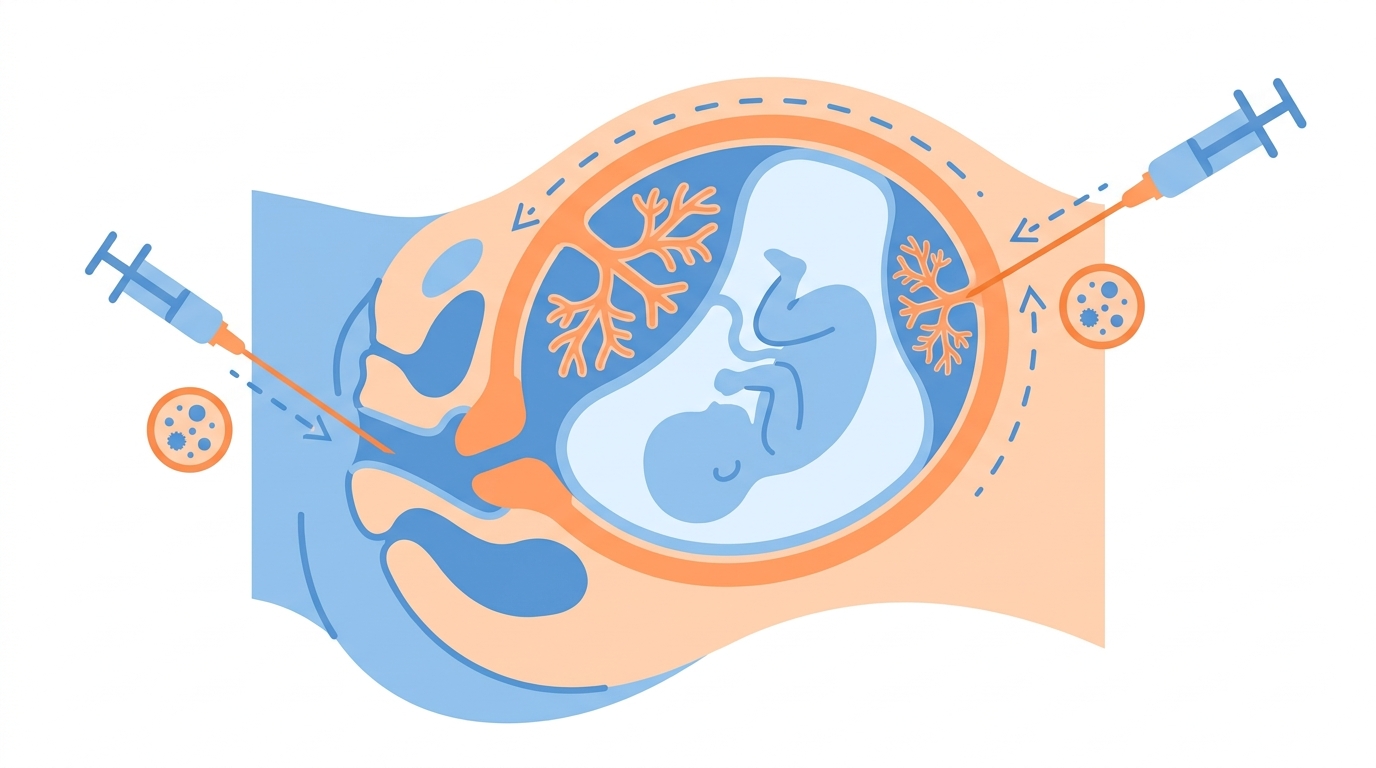
Let's first see what this `(CVS)` test is?
Simply put, when your baby is in the womb, you know that the baby gets its nutrition from a part called the placenta . This is a test that takes a few small cells from that placenta. The amazing thing is, these cells from the placenta and your baby's cells are genetically identical . That means we can learn about the baby's cells by examining the cells from the placenta. Isn't that a very advanced technology?
This test mainly checks to see if the baby has any chromosomal abnormalities . For example, conditions like ``Down syndrome`` . This is usually done between 10 and 13 weeks of pregnancy. That is, during the first three months of pregnancy.
Another important thing is that this `(CVS)` test is not a `diagnostic test` , but a `screening test`. That is, this test can tell exactly how likely it is that the baby will be born with a specific chromosomal disorder. Therefore, this is a very valuable test.
So, why is this `(CVS)` test done? Who is it important to?
Doctors actually inform all pregnant women about this test. However, it may be especially important for some people. That is, for mothers who have a high risk of their baby having a chromosomal abnormality. Who falls into this high-risk group? Let's take a look:
- Older pregnant mothers (especially those over 35 years of age ).
- Mothers who already have a child with a chromosomal disorder .
- Those who have shown a problem with a previous screening test.
- If anyone in your family or your partner's family has a history of genetic disorders .
CVS is also considered an alternative to amniocentesis , another test, because CVS can be done very early in pregnancy, giving parents more time to get the advice they need and make any decisions they need to make.
But there's something else to keep in mind here. Unlike amniocentesis, CVS doesn't provide information about neural tube defects, such as spina bifida . There's also some opinion that CVS carries slightly higher risks than amniocentesis. So, before you decide whether to have this test or not, you should carefully weigh the pros and cons. Talk to your doctor about this, okay?
So, do I really need to do this `(CVS)` test?
Here's why. In most cases, this test is not necessary for pregnant women who are not at high risk . However, your doctor may recommend that you have this test, especially in the following cases:
- If you are 35 years old or older .
- If anyone in your family (or your partner's family) has genetic disorders , or if there is a history of such disorders.
- If you already have a child with a genetic disease , or if the baby had a chromosomal abnormality in a previous pregnancy.
- If you have suspected that there may be a problem with a previous screening test .
The important thing is that you don't have to decide on your own whether or not to have this test. It's important to talk to your doctor about it and decide what's best for you. They will explain everything to you.
Okay, now let's see how exactly this `(CVS)` test is performed.
First, let's understand some of the important parts of this `(CVS)` test. You know, the placenta is the part of the body that provides nourishment to the baby from the mother, through the umbilical cord . In this placenta, there are very small, finger-like projections called `chorionic villi` . These are what are important to us. Because, the cells in these `chorionic villi` contain the same chromosomes and genetic makeup as your baby's cells. Isn't it amazing?
So, what is done in the `(CVS)` test is to take a sample of cells from the `chorionic villi`. Then, those cells are tested in the `laboratory` to see if there are any chromosomal abnormalities like `(Down syndrome)` or other genetic conditions like `(Tay-Sachs disease)` or `(fragile X syndrome)` .
There are two main ways to do this test.There is:
1. Transcervical Method
This involves passing a very thin tube through your vagina and into your cervix , guided by an ultrasound scan . Then, a tissue sample is taken from the chorionic villus using gentle suction . This may feel like a Pap smear for some people, but not for everyone.
2. Transabdominal Method
In this method, the doctor inserts a thin needle through your abdominal wall . This is also done under the guidance of an ultrasound scan, to precisely locate the right spot. The needle is used to obtain a sample of the chorionic villus. This method is also successful in most cases.
How will you feel when you take the test?
For some mothers, the CVS test is painless . For others, the test may feel a little cramping or a little backache during the sample collection, similar to a menstrual period . It varies from person to person. It is usually not painful.
After taking the sample, the doctor may also check the baby's heart rate . You will be advised to rest well for a few hours after the test. It is not good to struggle too much, you need to be a little careful.
Are there any risks involved in this `(CVS)` test?
Yes, like any medical test, there are some minor risks involved in this `(CVS)` test. It is important to be aware of these as well. There is nothing to worry about, these do not happen very often.
- Risk of miscarriage : This is the concern that many people have. The risk of miscarriage from a CVS test is very low, usually around 1% (maybe even lower) . However, some studies show that this risk may be slightly higher with the transcervical method mentioned earlier.
- Infection: This is very rare, but it is possible. Doctors are very careful about this.
- Spotting or bleeding : You may experience some light bleeding after the test. This is also more common with the transcervical method. This will subside in a day or two.
- Defects in the baby's fingers: This is very rare . Also, very early in pregnancy (like before 10 weeks)This test is the only way to reduce the chance of this happening. That's why it's done at the right time.
Don't be alarmed when you hear about these risks, okay? Most of these are very rare. Your doctor will talk to you about all of these, explain what your specific risks are, and how you can minimize them.
At what point during pregnancy is the CVS test performed?
We've talked about this a little bit before, haven't we? The Chorionic Villus Sampling (CVS) test is usually done between 10 and 13 weeks of pregnancy. This is considered the safest and most appropriate time for this test. Therefore, it's important to get it done at the time your doctor tells you.
How long does it take to get the test results?
This is also something important for you to know. The time it takes to get the results of a CVS test can vary slightly depending on the specific condition being tested . Some results can be obtained within a few hours . Others can take two to three days, or even a week . Your doctor will let you know this in advance, so don't worry.
So, what are the main points to remember from what we've talked about? (Take-Home Message)
Okay, we've talked a lot about this `(Chorionic Villus Sampling - CVS)` test, haven't we? Now, let's simply remind you of the most important things to keep in mind.
- CVS is a special test that can be performed early in pregnancy (between 10-13 weeks).
- This mainly checks whether the baby has chromosomal abnormalities such as Down syndrome.
- Because this is a diagnostic test , the results are highly accurate.
- This is not necessary for everyone. Doctors only recommend it for those with specific risk factors (e.g., age over 35, family history of genetic diseases).
- There are two ways to perform the test (through the cervix or through the abdomen), both of which are done with the help of ultrasound.
- There may be very small risks (e.g., a 1% chance of miscarriage), but serious problems are very rare.
- Before deciding whether or not to have this test, it is essential to talk to your doctor thoroughly and understand all the pros and cons.
In conclusion, it's good to be aware of these tests, but don't be unnecessarily afraid of them. Your doctor is the one who can give you the best advice on what's best for you and your baby. So, talk to him/her about any questions or concerns you may have.
I hope this information is helpful to you. I wish you and your baby good health always!
` Pregnancy tests, CVS test, chorionic villus sampling, Down syndrome, genetic diseases, chromosomal abnormalities, pregnancy health
Doctor's Note
CVS (Chorionic Villus Sampling - CVS) is a special test performed in the early stages of pregnancy (between 11-14 weeks) to detect whether the baby in the womb has genetic disorders such as Down syndrome or other chromosomal abnormalities. Here, a small part of cells from the placenta is obtained with the help of a needle and subjected to laboratory tests. Since this is an invasive test, there is a risk of minor miscarriage of less than 1%. Therefore, the doctor recommends this test only if the mother or family members are at high risk of genetic disorders.
❓ Some more questions you may encounter (FAQ)
How is the CVS test performed?▼
By taking a small sample of tissue from the placenta through a thin tube or needle inserted transabdominally or through the vagina (transcervical) with the help of an ultrasound scan machine.
What precautions should be taken after CVS test is done?▼
Strenuous work, heavy lifting and sexual intercourse should be avoided for 1-2 days after the test. Slight stomach cramps or bleeding may occur.
What is the difference between CVS and Amniocentesis?▼
CVS is performed early in pregnancy (11-14 weeks) using placenta cells. Amniocentesis is done after 15 weeks, by taking a sample of the amniotic fluid around the baby.


💬 Comments (0)
No comments yet. Be the first to share your thoughts here.
Add Your Comment