

Few parenting moments are more unsettling than feeling your newborn or infant radiating intense heat during a late-night feeding. Your baby may be unusually irritable, flushed, or refusing milk, leaving you anxious and uncertain. In that moment of distress, reaching for an accurate measurement is your most critical diagnostic tool. Yet, when doctors advise taking a rectal temperature, many parents hesitate, worried about hurting their little one or doing it incorrectly.
While the procedure can sound intimidating, pediatricians worldwide—including experts at the American Academy of Pediatrics (AAP), Mayo Clinic, and the UK National Health Service (NHS)—consider rectal thermometry the clear gold standard for infants and toddlers under 3 years of age. Done properly, it is fast, painless, gentle, and provides the vital core temperature data clinicians need to make rapid, life-saving medical decisions.
⚡ Key Clinical Takeaways.
- Clinical Gold Standard: Rectal measurement provides the most accurate reading of true core body temperature in infants under 3 months, eliminating external air and skin cooling errors.
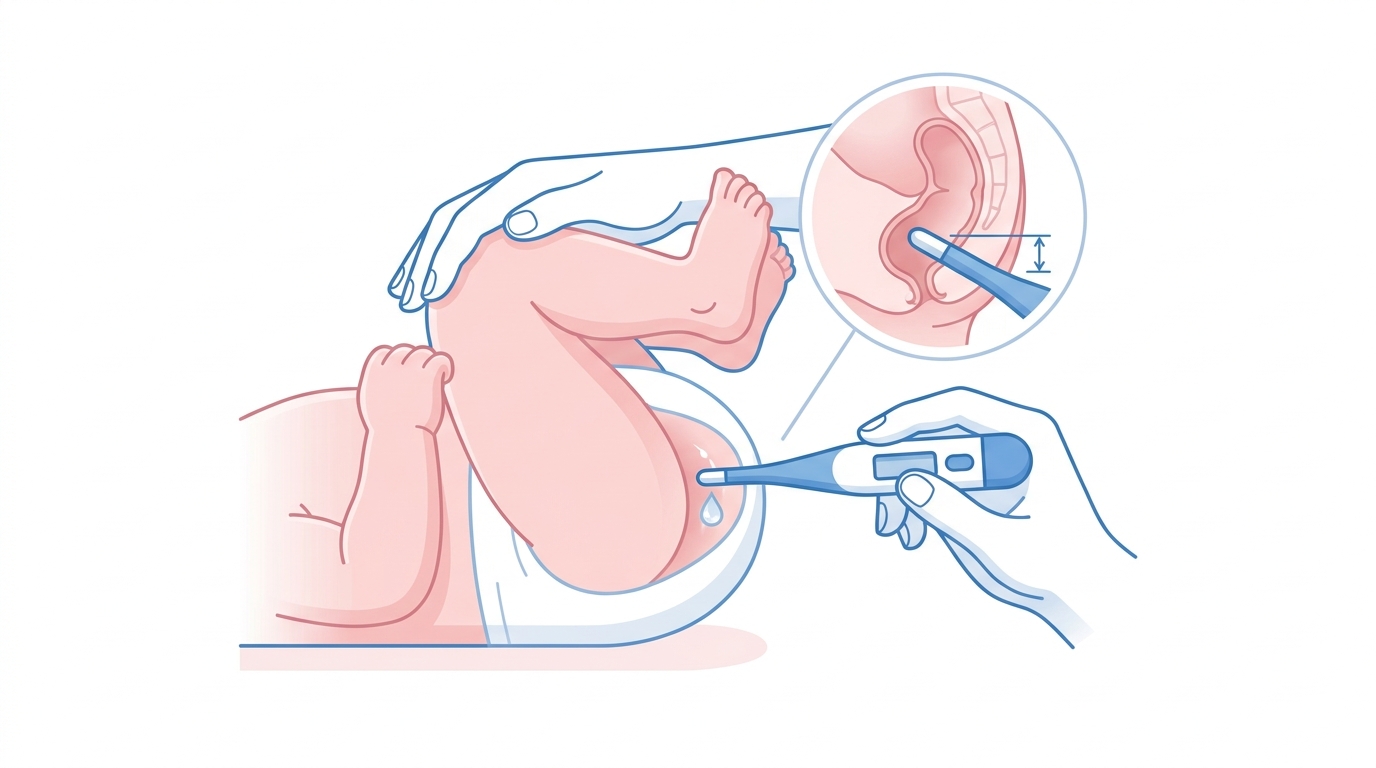
- Safe Insertion Depth: Never insert the thermometer deeper than 1/2 inch to 1 inch (1.25 cm to 2.5 cm) into the anal canal—essentially just past the metallic silver sensor tip.
- Medical Definition of Fever: A rectal reading of 100.4°F (38.0°C) or higher is clinically defined as a fever.
- Strict Prohibition: Never use vintage glass mercury thermometers due to acute risks of mechanical perforation and toxic vapor exposure. Always use an approved digital stick thermometer.
Why Is Rectal Temperature the Clinical Gold Standard in Babies?
Unlike older children and adults, young infants lack mature thermoregulatory control. Their skin-surface blood vessels rapidly constrict in response to room air, meaning peripheral measurement sites—such as the armpit (axillary) or forehead (temporal artery)—often reflect skin perfusion rather than true internal organ temperature. Axillary readings, in particular, often underestimate core temperature by 0.5°C to 1.0°C (1°F to 2°F).
Oral readings are physically impossible in infants due to non-compliance and lack of an airtight sublingual seal. This ear (tympanic) thermometers are unreliable in babies under 6 months due to narrow, curved ear canals. The rectal vault provides a stable, highly vascularized environment adjacent to central pelvic arterial circulation. In young infants—where subtle temperature shifts distinguish a mild viral self-limiting syndrome from neonatal sepsis or bacterial meningitis—precise decimal accuracy is non-negotiable.
Essential Equipment: What to Use and What to Avoid.
Before beginning, assemble your supplies in a well-lit, draft-free room:
- Digital Rectal Thermometer: Select a dedicated multi-use or purpose-built pediatric digital thermometer with a flexible tip and a broad base or guard that prevents over-insertion. Clearly label this device for rectal use only to prevent cross-contamination.
- Medical-Grade Lubricant: Pure white petroleum jelly (such as Vaseline) or water-soluble surgical lubricating jelly (such as K-Y Jelly). Clinical caveat: Avoid cooking oils, essential oils, or scented lotions, which degrade plastic components and cause chemical proctitis.
- Disinfectant: 70% isopropyl alcohol wipes or clean cotton pads soaked in lukewarm soapy water.
- Clean Diaper and Wipes: Rectal stimulation often triggers a gastrocolic or defecation reflex, so keep cleaning materials within arm's reach.
Instruments Never to Use.
The World Health Organization (WHO), CDC, and FDA strictly advise against using glass mercury thermometers in home or clinical settings. If an infant kicks or clenches suddenly, glass can shatter within the anal sphincter, resulting in deep lacerations and elemental mercury poisoning.
Pre-Procedure Preparation: Environment and Timing.
To avoid false readings and patient agitation, observe two critical physiological rules:
- Wait After Bathing or Swaddling: Warm baths, heavy blankets, sleep sacks, or tight swaddles elevate external body temperature. If your baby was bundled or recently bathed, wait 20 to 30 minutes in a climate-controlled room before taking a diagnostic reading.
- Cleanse the Probe: Disinfect the sensor tip thoroughly using warm water and mild antibacterial soap or a 70% alcohol wipe. Rinse with cool water and dry with sterile gauze before applying lubricant.
- Lubricate Generously: Apply a smooth dab of petroleum jelly over the metallic tip and lower stem. Adequate lubrication eliminates mucosal friction and prevents discomfort.
Optimal Positioning: Safe and Stable Techniques.
Securing the infant prevents sudden flailing, ensuring both comfort and safety. Choose one of two clinically recommended positions:
Position A: On Your Lap (Prone / Belly-Down).
Sit comfortably and drape your baby stomach-down across your lap. Allow their legs to dangle gently over the side of your thigh. Place your non-dominant palm firmly against your baby's lower back to steady their pelvic movements. This position naturally relaxes the gluteal muscles and anal sphincter.
Position B: On a Firm Surface (Supine / Frog-Leg).
Place your baby on their back on a firm changing mat or bed. Grasp both of your baby's ankles or lower calves with your non-dominant hand and gently flex their knees upward toward the chest—the identical posture used when wiping during a diaper change. This provides unobstructed visual access to the anal verge.
Step-by-Step Clinical Procedure: How to Take the Temperature.
- Turn On the Device: Depress the power button on the digital thermometer and confirm that the digital display resets to zero or displays its baseline readiness icon.
- Separate the Buttocks: Using your non-dominant thumb and index finger, gently spread the gluteal folds so the anal opening is clearly visible under direct light.
- Gentle, Measured Insertion: With your dominant hand holding the lubricated thermometer like a pencil, smoothly guide the tip into the anal opening. Insert it only 1/2 inch to 1 inch (1.25 cm to 2.5 cm) deep. Rule of thumb: Once the silver metal probe is fully submerged past the sphincter, do not push further.
- Stop right away at Any Resistance: Never force the probe. If you meet muscular resistance or internal obstruction, withdraw right away. Forcing the device risks mucosal abrasion or rectal perforation.
- Anchor Firmly: Rest your fingers and palm flat against the baby's buttocks while pinching the stem of the thermometer between your index and middle fingers. By moving with the baby's body, the thermometer cannot slip deeper or fall out if your child wiggles.
- Wait for the Signal: Keep the device steady until the completion tone ("beep") sounds—typically 10 to 60 seconds depending on the model. Speak softly, sing, or stroke your baby's head to keep them soothed.
- Withdraw and Record: Carefully slide the thermometer straight back along its entry angle. Read the digital display right away and log the temperature, exact time of day, and measurement route (rectal).
Do's and Don'ts: Safety and Clinical Hygiene.
Ensure procedure safety and prevent cross-infection by adhering to the following guidelines:
| Clinically Approved Practices (DO). | Dangerous Practices to Avoid (DON'T). |
|---|---|
| Use dedicated digital devices: Label the device strictly for rectal use to prevent enteric transmission. | Never use mercury glass thermometers: Glass poses severe shatter, laceration, and chemical toxicity risks. |
| Lubricate every single time: Use petroleum jelly or water-soluble lubricant to prevent anal fissures. | Never insert past 1 inch (2.5 cm): Deeper insertion provides no diagnostic advantage and risks mucosal injury. |
| Anchor against the buttocks: Cup your hand against the pelvis so your hand moves in unison with any sudden kicks. | Never leave the infant unattended: Even for a second, an unsupported thermometer can cause mechanical trauma. |
| Sanitize post-use: Wash thoroughly with warm soapy water followed by alcohol sanitization after every reading. | Never force past resistance: Forcing an instrument against an unrelaxed sphincter can perforate tissue. |
🚨 Red Flags: When to Seek Immediate Emergency Evaluation.
A fever is a physiological symptom of an underlying immune reaction, not a stand-alone disease. Because young infants deteriorate quickly under invasive infection, treat the following clinical situations as medical emergencies. Call 911 (US/Canada), 999 (UK), or present right away to the nearest Emergency Department (ER / A&E):
- Neonates and Infants Under 3 Months: Any rectal temperature of 100.4°F (38.0°C) or higher—or a subnormal temperature below 96.8°F (36.0°C)—constitutes a pediatric emergency requiring a full septic workup.
- Infants Aged 3 to 6 Months: Rectal temperature exceeding 102.0°F (38.9°C), or persistent lower fever accompanied by lethargy, refusal of feeds, or poor wet diaper output.
- Children Older Than 6 Months: Rectal temperature of 104.0°F (40.0°C) or higher, or fever persisting longer than 72 consecutive hours.
- Critical Associated Symptoms (Any Age):
- Extreme lethargy, floppiness, or inability to awaken or maintain eye contact .
- Respiratory distress (grunting, rapid flaring of nostrils, chest wall retractions) .
- Non-blanching petechial or purpuric rash (pinpoint dark red or purple spots that do not fade when pressed with a glass) .
- Full or bulging fontanelle (the soft spot on top of the infant's head) .
- Inconsolable, high-pitched, persistent crying that worsens when the infant is handled or moved .
- Convulsions, rhythmic twitching, or sustained febrile seizures .
🩺 Doctor's Clinical Note.
"In our pediatric emergency rooms, we often encounter parents who felt intimidated by rectal thermometers and instead relied on forehead scanners or armpit checks, which gave a falsely normal reading of 99.0°F while their 6-week-old baby was harboring a core temperature of 101.5°F. While hesitation is completely understandable, remember that a baby's rectum is resilient and the procedure takes under 30 seconds. Your baby might cry from the temporary cool sensation or being held still, but when lubricated and placed gently, it does not cause pain. An accurate core temperature reading in an infant under 90 days old is one of the most critical diagnostic contributions you can make as a caregiver."


💬 Comments (0)
No comments yet. Be the first to share your thoughts here.
Add Your Comment