

When your little one keeps vomiting, especially when it happens frequently, you feel a lot of stress and worry as a parent, don't you? Actually, vomiting is very common among young children. It's nothing new. But the good news is that this vomiting usually doesn't last long, and most of the time it gets better on its own in a day or two. But as a parent, it's very reasonable to feel a little scared and nervous. So, today we'll talk clearly and simply about this condition called vomiting, its causes, symptoms, things you can do at home, and when you should see a doctor.
What is this vomiting? To be precise...
Simply put, vomiting is the act of throwing up the contents of the stomach, that is, the food we eat and drink, from the stomach and back out through the mouth. It is not just a matter of coming back up into the mouth, but rather a bit too quickly and forcefully . Although this is common among young children, it is not always caused by something serious. Most of the time, it is temporary.
Why do little ones vomit like this? What are the causes?
There can be many reasons why a child vomits. Let's look at the main reasons.
Main cause: Stomach upset, i.e. gastroenteritis
Most of the time, the main reason young children vomit is a condition called gastroenteritis . Some people also call it a "stomach bug ." To be precise, it's an infection of the stomach and intestines.
- This is most often caused by viruses .
- Also, this condition can be caused by certain bacteria and parasites .
- In addition to vomiting, symptoms such as nausea (feeling like you're going to vomit), stomach pain, and loose stools (diarrhea) can also be seen in this condition of gastroenteritis.
- The good news is that vomiting caused by this gastroenteritis usually stops in less than 24 hours . Other symptoms also improve within a few days.
Are there other reasons?
Yes, vomiting can occur for reasons other than gastroenteritis.
- Food poisoning : You can vomit after eating expired food, or food that was not properly prepared or prepared properly.
- Motion sickness: You've probably noticed that some kids (and adults alike) vomit while riding in buses, cars, or vans. That's what's called motion sickness.
- Headache caused by migraine :Some children may also vomit when they have a migraine.
- Pregnancy: Although this does not apply to young children, pregnant mothers also experience morning sickness.
Rarely seen, but causes that require some concern
These reasons that we are going to talk about now are very rare. That means they don't happen to everyone. But, it's good to be aware of these too. Because these can be a bit serious.
- Intestinal obstruction: Especially in newborns and babies under a few months old, a condition called Pyloric Stenosis can cause a portion of the intestine to become blocked, causing some of the milk to leak out through vomiting.
- Other stomach and intestinal problems: Vomiting can also be a symptom of conditions such as gallstones, pancreatitis , and appendicitis.
- Increased pressure in the brain: This can happen after a hard blow to the head, in a serious illness like meningitis, or very rarely in a condition like a brain tumor. But, don't worry , these are very rare.
What other symptoms accompany vomiting?
Children often experience nausea , stomach discomfort, and cramps before vomiting. In addition, they may experience symptoms such as:
- Getting a fever
- Anorexia, not wanting to eat
- Loose stools (diarrhea)
Be very careful about dehydration!
The most important and dangerous thing that can happen when you vomit frequently and excessively is dehydration . Simply put, dehydration is when the body loses too much water and becomes dehydrated. This can happen very quickly in young children.
What are the symptoms of dehydration? Keep these in mind:
* The frequency and amount of urination decreases compared to usual (be concerned if you haven't urinated for 6-8 hours).
* When crying, there are almost no tears , or very few tears.
* The mouth and lips appear dry, sometimes cracked.
* It feels like dizziness, like the body is lifeless (an older child would say that).
* Constantly feeling sleepy, difficult to wake up, or more lethargic and lifeless than usual.
* The eyes look sunken.
* The skin feels dry when touched, and when you pull the skin up a little with your finger and let it go, the itch goes back to the old spot.
If you see any of these symptoms, it could be a sign of dehydration, so keep an eye out for them.
How does the doctor find the cause?
Most of the time, the doctor will diagnose the cause by listening to your child's symptoms (for example, how often they have vomited, whether they have diarrhea, and whether they have a fever) and examining them. If it's just a simple stomach ache (gastroenteritis), no special tests are needed.
However, if the child vomits frequently, is having a hard time, or has severe signs of dehydration, the doctor may do a urine test, blood test, or other necessary tests to see if they are dehydrated and find the exact cause of the vomiting.
How do you treat vomiting?
The treatment for vomiting depends on the cause. Vomiting caused by gastroenteritis, which we discussed earlier, usually subsides on its own within 24 hours.
The most important thing is to avoid dehydration!
The most important thing to focus on when vomiting is to prevent dehydration . The best way to do this is to give your child an Oral Rehydration Solution (ORS) like Jeevani . You can buy these at the pharmacy or supermarket (e.g. Pedialyte, Enfalyte, or other ORS brands available at the pharmacy). These ORS contain exactly the right amount of water, sugar, and salts that the body loses due to dehydration.
- If you can't find ORS, talk to a doctor immediately.
How to treat at home (only if the doctor says "OK, see you at home", especially in mild dehydration):
- Start by giving the ORS slowly, one or two teaspoons (5-10 ml) every few minutes . Don't give a large amount at once, or you may vomit again.
- For young babies: If vomiting does not continue, you can continue to feed breast milk or formula. Give ORS in between.
- Important: Do not give a dehydrated baby just water instead of ORS. Just water does not contain the nutrients, especially salts, they need at that time.
- For older children: You can give iced electrolyte popsicles. These can also help with dehydration, just like ORS.
- Do not give your child any anti-vomiting medicine unless recommended by a doctor.
- Once your baby stops vomiting: You can gradually introduce light, easy-to-digest solid foods like toast, crackers, rice, and boiled potatoes. You can also gradually introduce yogurt, fruits (like bananas), vegetables (like boiled carrots), and lean meats like chicken.
Remember, if your child continues to vomit, or if you think the symptoms of dehydration are severe, you should not keep them at home but immediately take them to the nearest hospital's Emergency Department (ETU) .
When should you definitely see a doctor?
If your child has any of these symptoms, don't waste any time and see a doctor immediately. These are "red flags" that you should definitely pay attention to.
- If you are unable to drink anything (even a drop of water) for several hours (e.g. 4-6 hours), or if you vomit immediately after drinking.
- If you have obvious signs of dehydration (the decreased frequency of urination we talked about earlier, no tears when crying, very dry mouth and lips, dizziness, excessive sleepiness, sunken eyes).
- If you have a high fever (especially any fever in a baby under 3 months old, a fever over 102°F / 39°C in a child between 3-36 months old, or a child of any age who has had a fever for more than 2-3 days).
- If the vomit contains blood (either red or coffee grounds colored), or if the vomit is green or dark brown .
- If you have a severe, unbearable stomachache , or if you have a severe backache.
- If you have a stiff/difficult neck with a sharp headache (this could be a sign of a condition like meningitis).
- If you vomit after hitting your head somewhere (especially if you fell and injured your head).
- If vomiting continues for more than 24 hours (especially in young babies).
So, what did we learn from this? Some of the most important things
Okay, we've talked a lot about this vomiting, haven't we? It would be great if you could remember these points.
- Vomiting is common in young children. Most of the time, it's due to something as simple as gastroenteritis, and it will get better in a day or two.
- The main risk when vomiting is dehydration, so it is very important to give ORS to the child.
- When treating at home, give ORS in small amounts and offer light meals once the vomiting stops.
- Always be aware of "red light" symptoms that require seeing a doctor. When such symptoms occur, see a doctor without delay.
- It's normal to feel anxious as a parent, but it's important to stay calm and smart. Pay close attention to your child's behavior and symptoms.
I hope you find this information useful. I wish your child a speedy recovery!
` Vomiting, vomiting in children, gastroenteritis, dehydration, ORS, pediatrics, stomach upset
Doctor's Note
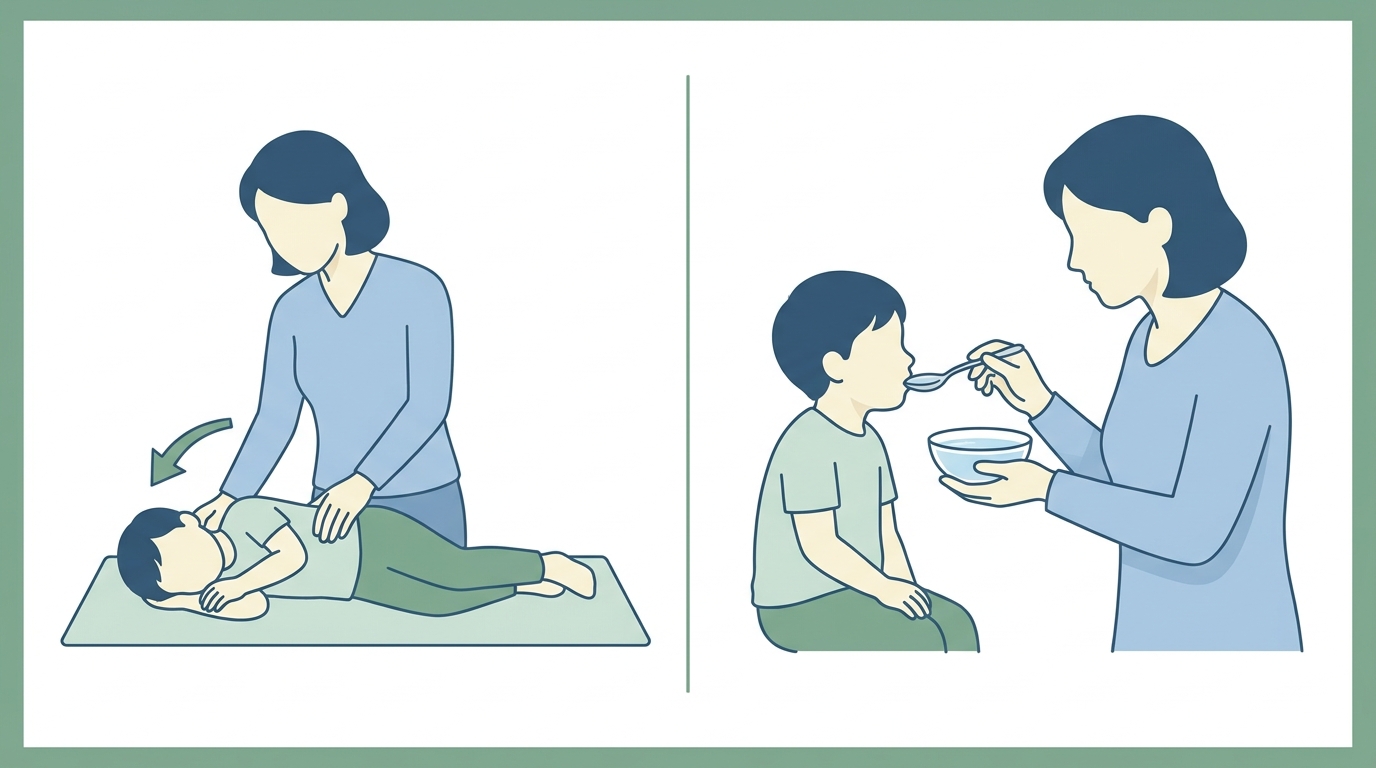
Vomiting in children can be very distressing for parents, but most vomiting situations can be managed at home. Immediately after vomiting, giving large amounts of water or food may cause vomiting again. So give the stomach a rest for at least 30 minutes after vomiting. Then slowly give ORS or lukewarm water a teaspoon at a time every 5 minutes. When the child sleeps, turn the child to the side (Recovery position) to prevent vomit from going to the lungs (Aspiration).
❓ Some more questions you may encounter (FAQ)
What should be done immediately after the child vomits?▼
Clean the baby's mouth and let the stomach rest for 30 minutes. Then give small frequent sips of ORS or fluids.
In which position should a vomiting child be put to sleep?▼
To prevent vomit from getting stuck in the throat and going to the lungs, the child should be put to sleep in the side-lying position, not on the back.
What are the dangerous symptoms that should be taken to the hospital immediately with vomiting?▼
Vomiting that persists for more than 24 hours, vomiting blood or green bile, severe stomach cramps, and symptoms of dehydration.


💬 Comments (0)
No comments yet. Be the first to share your thoughts here.
Add Your Comment