
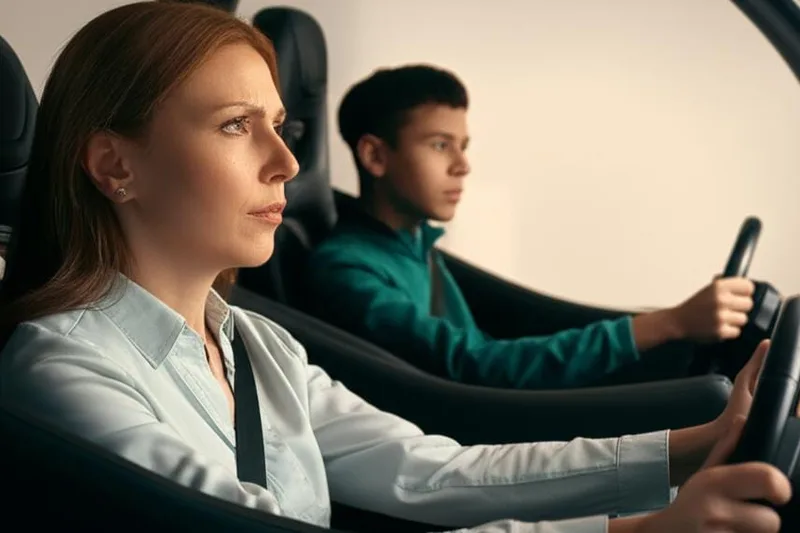
Has your child just gotten a license and started driving a car? That's a very happy thing. But, if your child has attention deficit disorder, that is, ADHD ( Attention Deficit Hyperactivity Disorder), you also feel a little scared and nervous when he drives a car, right? That's very normal. Because driving requires a lot of attention. Today we're talking about this. About a special training method that helps young children with this condition drive safely.
Why are children with ADHD said to be at higher risk of accidents?
First, let's understand this. Young people between the ages of 16 and 19 are the ones who are most likely to get into car accidents. They are at a higher risk than any other age group. There are many reasons for this, including lack of experience and lack of understanding of the dangers.
However, research has found that if you take a young child with ADHD, the risk of this accident increases by about 36% . Some studies have shown that these children are also more likely to have multiple accidents.
Think about it, one of the biggest challenges with ADHD is the difficulty of staying focused on one thing at a time. This can be especially dangerous when you're driving. Talking to a friend, looking at your phone, or thinking about something else while you're driving can quickly lead to distractions.
Simply put, the main problem is looking away from the road for too long . Researchers call this "long glances." That means taking your eyes off the road for more than 2 seconds. The chance of an accident occurring during this short period of time is very high.
The latest research that has come up with a solution to this
To find a solution to this problem, a team led by Dr. Jeffrey Epstein, PhD, of Cincinnati Children's Hospital in the United States conducted a special study. The results were published in the world-renowned *New England Journal of Medicine*.
The main goal of this research was to see if it was possible to train young children with ADHD to stop looking away from the road for more than 2 seconds, which we talked about earlier. To do this, they used a special computer program and a driving simulator.
How is this training done?
For this purpose, 152 young children with ADHD who had a license and were driving were selected and divided into two groups.
1. Intervention Group: These people were given a special computer training called 'FOCAL' (Focused Concentration and Attention Learning). After that, they were made to sit in a driving simulator and drive. In this simulator, if they looked away from the road for more than 2 seconds , an alarm would sound immediately . To stop the alarm, they had to look back at the road. They were given this training repeatedly for 5 weeks. In other words, they were trained to this habit until it became ingrained in their bodies.
2. Control Group: These were also taught the same things as in a regular driver training course (like the rules of the road). However, they did not receive any special training on attention or experience in a simulator where a LAR m sounded.
Truly amazing results!
After 5 weeks of training, both groups were tested on their driving skills. The results were truly amazing.
| What was checked | Control Group | Intervention Group |
|---|---|---|
| Number of times you looked off the road for more than 2 seconds (during a single drive) | On average 28 times | Average 16.5 times (a significant decrease) |
| Driving on the road line (Lane Weaving) | Seen more | Decreased significantly |
These are just the results of the simulator. But the researchers did something even more important.
What happened in real life?
After the training, cameras were installed in the children's real cars for a year and their driving was monitored . If something like a hard brake, a hard swerve, or an accident occurred, the cameras were installed in such a way that they would record the moment before the event.
The data received at the end of the year is very important.
The children in the group that received special training had a 40% lower risk of collisions or near-collisions compared to the other group!
This shows that what they learned in the simulator has been useful to them in real life. This means that this training is truly successful.
Lessons you can take from this as a parent
This FOCAL training program may no longer be available in Sri Lanka, but we can learn a lot from this research to help our children with ADHD.
1. Talk about the "two-second rule": Sit down with your child and talk about this. Explain that if you look away from the road while driving, you should do so for less than 2 seconds. "Even if you're looking at your phone, turning on the radio, or looking at a roadside shop, don't keep your eyes on the road for too long. Look away and then quickly look back at the road."
2. Reduce distractions: When your child is driving, reduce distractions inside the vehicle as much as possible. Teach them to control things like loud music and notifications from their phone.
3. Practice, practice, and more practice: Like anything, driving is improved with practice. Drive with your child. Practice on empty roads with little traffic at first. Gradually work your way up to more difficult situations.
4. Seek medical advice: This is the most important thing . Be sure to talk to your family doctor or the doctor who is treating your child about your child's ADHD condition and challenges like driving. Taking medication for ADHD properly can improve attention. Therefore, your doctor can give you the best advice about medication management and your child's safety.
This research shows that instead of just being afraid, we can help children with ADHD drive safely by providing the right skills and training.
Take-Home Message
- ADHD significantly increases the risk of accidents in young drivers.
- The main reason for this is looking away from the road for more than 2 seconds while driving (long glances).
- Research has shown that specific training (e.g., using an alarm) can reduce this dangerous habit and reduce the risk of accidents by about 40%.
- Always discuss your child's ADHD and driving problems with your doctor. Proper medical management is very important.
- You can also contribute to your child's safety by talking to your child about simple concepts like the "two-second rule" and minimizing distractions in the vehicle.


💬 Comments (0)
No comments yet. Be the first to share your thoughts here.
Add Your Comment