
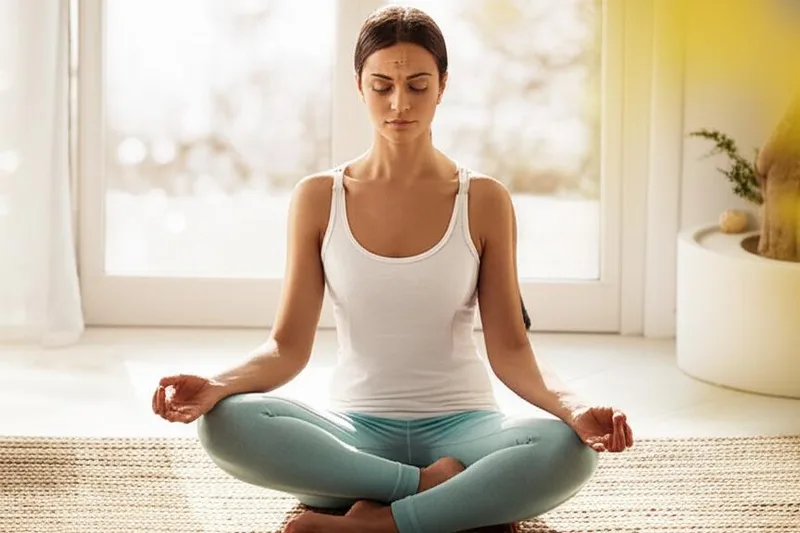
Nowadays, our lives are like a running race, aren't they? With all this, office work, household chores, children's education, exams... There are times when our minds feel like they don't have a single moment of freedom. Even when we go to bed at night, a thousand things are swirling around in our heads. Today, we are going to talk about a method that can help us get rid of these thoughts that constantly bother us and give our minds a real rest and relaxation. That is Transcendental Meditation (TM).
Simply put, what is Transcendental Meditation (TM)?
Transcendental Meditation is a very simple, natural meditation technique that helps us to let go of the thoughts that constantly bother us and run around in different directions, and to bring our minds into a state of deep relaxation. Some may think that this is just like any other meditation. But there is a slight difference here.
Imagine your mind is like a busy road. There are constant honking, cars going back and forth, and it's very hectic. TM is like stepping away from that busy road and going to a quiet, beautiful park to relax. It means transcending the level of ordinary thoughts and taking the mind to a state of 'pure consciousness' where it is completely still and deeply relaxed.
In this state, your mind is completely quiet and relaxed. There are no mental limitations. It feels like the mind is in a state of deep rest, even deeper than deep sleep.
The most important thing is that you don't need to believe in anything, change your lifestyle , or practice any religion to do this. It's just a simple technique that anyone can practice.
What is the difference between TM and Mindfulness meditation?
This is where many people get confused. TM and Mindfulness are two meditation techniques. Although both aim to heal the mind, the two methods are slightly different. Let's see how.
| Transcendental Meditation (TM) | Mindfulness meditation |
|---|---|
| A mantra is used here. It is a specific sound or word. Silent meditation on this mantra takes the mind beyond thoughts. | Here, the focus is on the present moment . For example, paying attention without judgment to the way your breath rises and falls, and the sensations in your body. |
| The goal is to 'transcend' thoughts and enter a deep, quiet, relaxed state. | The goal is to accept your thoughts and feelings as they come, without judging them, and face daily life with balance. |
| The guidance of a certified teacher is mandatory to learn this. | There is the ability to learn the basics, whether through books, YouTube videos, or apps. |
What are the benefits of TM?
Numerous studies have confirmed the health benefits of regularly practicing TM meditation.
Reduced stress, anxiety, and depression
This is the main benefit. The deep relaxation that TM provides to the mind calms our nervous system. This helps greatly in reducing the mental pressure, stress, and anxiety that accumulate throughout the day. TM has even been shown to be effective in treating severe conditions such as post-traumatic stress disorder (PTSD) in military personnel.
Blood pressure control
Excessive stress is a major cause of high blood pressure. TM helps control blood pressure by reducing stress. Some studies have found that TM, like diet and exercise, can help lower blood pressure.
Having a comfortable sleep
Do you find yourself tossing and turning in bed at night, unable to sleep, worrying about office problems or home problems? Those who practice TM can get rid of this problem. When the mind is calm, the problem of insomnia is solved. When you do TM twice a day, you can get a good night's sleep without worrying.
Improved creativity and focus
When the mind is free, you can think clearly. This improves your ability to focus on the task at hand, your problem-solving skills, and your creativity .
How do you practice TM?
This is the most important part. TM is not something you can learn on your own by watching YouTube or reading a book. It needs to be learned under a specially trained and certified TM teacher.
The training program usually lasts a few days. Here's what happens:
1. First meeting: This is a one-on-one discussion with the teacher. Here, the teacher gives you a mantra (mant RA ) that is specific to you. You are told to keep this mantra a secret.
2. Group Sessions: Over the next few days, the teacher will meet again with a small group. Here, the correct way to meditate and the experiences that occur will be explained further. You can ask any questions you may have.
3. Practice: After learning, you should practice this meditation twice a day, for about 15-20 minutes . It is usually recommended to do this in the morning before breakfast and in the evening after work before dinner.
4. Follow-up: You will meet with the teacher again about 10 days after the training ends to discuss your progress.
When doing this meditation, all you have to do is sit in a comfortable place, in a chair, close your eyes, and silently and effortlessly meditate on the mantra you have received. You don't need to focus on it or exert yourself. The important thing is to let the mantra flow through your mind while breathing normally.
Is there any risk in this?
Meditation is generally very safe, but there are a few things to be aware of.
Most importantly: If you have a mental health condition (e.g., major depression, bipolar disorder), be sure to talk to your doctor or mental health professional before starting TM or any other meditation practice.
In rare cases, meditation may worsen symptoms in people with certain mental health conditions, so it is important to seek medical advice.
Another thing is that TM is not a substitute for medical treatment. That is, if you are prescribed medication by a doctor for high blood pressure, diabetes, or any other condition, do not think, "I don't need medication because I am meditating now." Never use this as a reason to stop taking the treatment prescribed by your doctor or postpone tests. TM is only an addition to your medical treatment, which can help improve your well-being.
Take-Home Message
- Transcendental Meditation (TM) is a simple, effortless meditation technique that brings deep relaxation to the mind.
- Research has shown that this is very beneficial for problems such as stress, anxiety, high blood pressure, and insomnia.
- You cannot learn TM on your own. The guidance of a certified teacher is essential.
- If you have any mental health conditions, be sure to discuss them with your doctor before starting TM.
- TM is not a substitute for medical treatment. It is simply a health-enhancing adjunct that can be used alongside your medical treatment.


💬 Comments (0)
No comments yet. Be the first to share your thoughts here.
Add Your Comment