
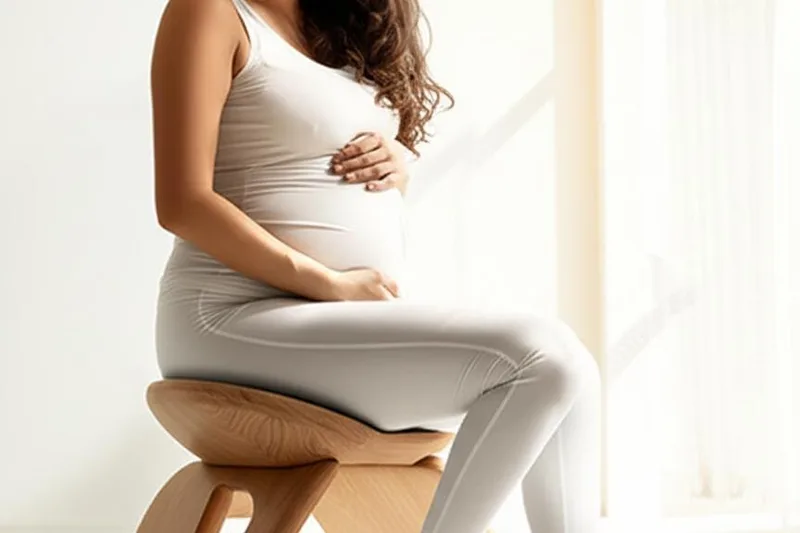
If you are a mother-to-be, you are probably looking for various things about childbirth , right? You may have heard of the name 'Birthing Stool'. Or maybe this is something new. Don't worry, it is very simple. Simply put, it is a special chair that helps the mother to deliver the baby comfortably, in a standing position. We will talk about it all today.
What is a Birthing Stool?
This is actually a chair without a back. Some of them have a cutout in the middle of the seat. The reason for this is so that the midwife or doctor can easily hold the baby when the baby comes out. We also call the chair with a back a 'birthing chair'. It allows the mother to rest her weight on her back.
Is this something new?
Think about it, this is not something that came about yesterday. This is a method that has been used by mothers in different countries of the world for thousands of years. In many cultures throughout history, babies have been born in upright positions, such as standing, sitting, or sitting on their backs. So these chairs have been a great help in that.
So why haven't we heard more about these? Over time, especially in Western countries, when doctors began to take over the primary role of delivering babies instead of midwives, these chairs were forgotten. Instead, they used the 'birthing beds' that we see in hospitals today. Perhaps it started with the mother's comfort in mind. But what really happened was that it became a habit to have the mother lie down on the bed so that it was easier for the doctor to treat her.
But now there is a lot of talk about these natural methods again. That is why you can see this 'birthing stool' facility in some hospitals and birth centers in Sri Lanka as well as around the world.
What are the advantages and disadvantages of using this chair?
Like anything, this method has its advantages and some minor disadvantages. Let's take a closer look at it. Take a look at this table.
| Advantages | Disadvantages |
|---|---|
1. Gravity helps: Being in a standing position helps the baby descend with gravity. The pelvis is also wide open, making it easier for the baby to come out. | 1. Vaginal tears: Some studies show that there is a slightly higher risk of small tears in the perineal area when giving birth in a standing position. However, there does not appear to be an increased risk of large, severe tears. |
2. Reduced unnecessary medical interventions: The duration of labor (especially the first stage) can be reduced to less than an hour. This means less strain on the mother. This can reduce the need for things like epidurals or cesarean sections . | 2. Bleeding : In some cases, there may be a little more bleeding than normal (more than 500 ml). However, some say that this may be due to differences in the methods used to measure bleeding. |
3. Safe for the baby: Since the mother is standing, the aorta, a major blood vessel, is not compressed. Therefore, the baby receives a good level of oxygen. The risk of some complications (e.g. hypoxia , acidosis ) for the baby is reduced. |
If your doctor and hospital staff are aware of this, these complications can be managed very well. |
4. Easier second stage: There may be fewer cases of forceps delivery and episiotomies during labor. |
How do I use this chair?
There are slight differences in how this is used during the two stages of labor.
In the first stage (when the fever is present)
This chair can be very helpful in the early stages of labor. When you stand up during labor, gravity helps the baby descend.
Many mothers like to sit on the other side of the chair. This means that you can lean against the back of the chair and lean against it. This makes it easier for your husband or doula to massage your back.
In the second stage (when the baby is pushing)
This is the stage where you push the baby. Using a chair at this time will help you squat properly, which will help your pelvis widen and make way for the baby to come out.
The most important thing is that this is a very familiar position for you. Many mothers find it easier to push because it feels like sitting on the toilet.
You can push straight when it hurts, and rest on the back of a chair or your partner when it doesn't hurt. This will give you a lot of strength to go through labor in a less stressful, more natural way.
Take-Home Message
- The 'Birthing Stool' is not a new thing, but a very old and successful method of assisting with childbirth.
- There are many benefits to having a baby in a breech position, such as reducing the duration of labor and reducing unnecessary medical interventions.
- Although minor adverse effects such as vaginal tearing or bleeding may occur, they can be managed under proper medical supervision.
- This method may not be suitable for everyone. The most important thing is to talk to your doctor about this. Find out if this method is right for you and if the hospital you choose to have your baby at has this facility.
- Ultimately, this is your personal decision. Choose the method that feels most comfortable and safe for you.




💬 Comments (0)
No comments yet. Be the first to share your thoughts here.
Add Your Comment