
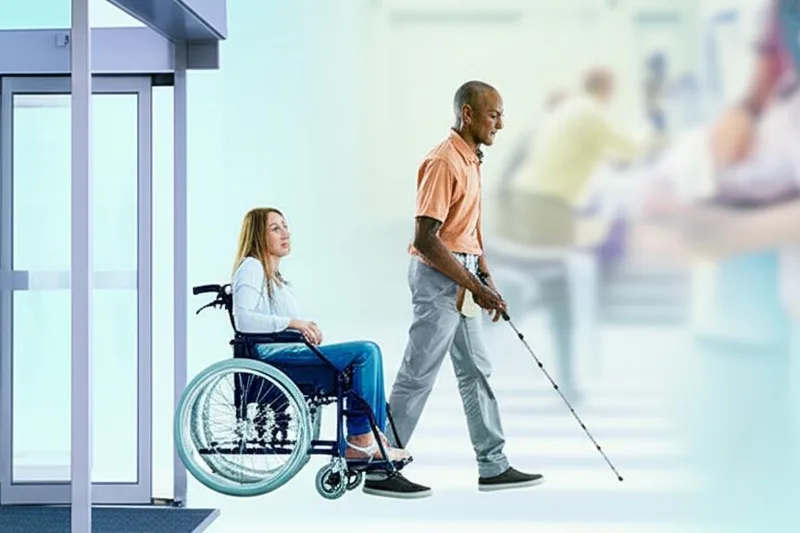
Have you ever seen a person in a wheelchair struggling to get into a store, a bank, or an office with stairs? Or parents struggling to find a school that is suitable for a child with special needs? We have all seen these things at least once in our lives. People like these should have the right to live, study, and work independently, just like the rest of us, without fear of society and without anyone's help? The fight for that right is simply called the ``Disability Rights Movement'' or the movement for the rights of people with disabilities.
What exactly is this rights movement?
Simply put, this is like a fight for human rights. The main goal here is to give people with some kind of physical or mental disability the same opportunities and rights as people without any disability. That is, to break down the barriers in society and create an environment where everyone is treated equally.
There are several types of these barriers:
- Physical barriers: For example, stairs that are not wheelchair accessible, narrow doorways, and high buses.
- Institutional barriers: Some organizations are reluctant to hire people with disabilities and do not provide them with appropriate facilities.
- Social barriers: People in society look at them with pity, marginalize them, and think, "These people can't do these things."
The goal of this movement is to eliminate all these barriers and create a society where people with disabilities can live with dignity.
How did this journey begin? - A lesson from the world
Although many countries in the world today talk about the rights of people with disabilities, this status was achieved only after a great struggle. Let's look back at that history for a moment, because our country also has a lot to learn from it.
Back in the 1800s, people with disabilities were treated in a very inhumane way. They were considered a burden on society. Some were turned into circuses, others were locked up in mental hospitals and institutions. Many people thought that these people were mentally ill, so they even subjected them to sterilization operations against their will.
However, after the First World War, when wounded and disabled soldiers began to return to the country, attitudes in society gradually began to change. The government began to help them and develop new technological devices. This allowed people with disabilities to become somewhat self-sufficient.
Even after World War II, disabled war veterans lobbied the government to provide them with the rehabilitation services and vocational training they needed. Although this made great progress, they still had difficulty accessing public restrooms, offices, shops, and buses.
This change received a major boost with the civil rights movement in the United States in the 1960s, when people with disabilities were given the opportunity to join other oppressed groups and fight for their rights.
Some important laws that changed history
As a result of this struggle, several important laws were enacted around the world that changed the lives of people with disabilities. These are also a good example for policymakers in our country.
| Law / Act | The main difference brought |
|---|---|
| Rehabilitation Act of 1973 | Government agencies and government contractors were prohibited from discriminating against people with disabilities in employment. Most importantly, laws were enacted requiring that people with disabilities have equal access to any program that receives government funding (schools, public transportation). |
| Education for All Handicapped Children Act of 1975 | It guaranteed the right of every child to education. It emphasized that children with special needs should be taught in regular classrooms. |
| Americans with Disabilities Act (ADA, 1990) | This is a very broad bill. It prohibited discrimination against people with disabilities in all areas, including employment, public places (shops, hotels, cinemas), government services, transportation, and communication. It made things like building ramps for wheelchairs mandatory. |
The difference brought to children's education
The above-mentioned education act was later expanded into the Individuals with Disabilities Education Act (IDEA). One of the most important concepts introduced here is "Individualized Education Programs" (IEPs) .
That means, for every child with special needs, the parents and teachers of that child come together to create a learning plan specific to that child. How great would it be if this could be incorporated into our country's education system?
The situation today and what we can do
It is not enough to pass laws. The fight is not over yet. Even today, people with disabilities all over the world, even in our country, have to face various prejudices and wrong attitudes.
We too can contribute to this change. It doesn't have to be a big deal. We can start with something small.
- Let's change our attitudes: Let's stop looking at someone with a disability with pity. Let's understand that they have abilities, dreams, and feelings just like us.
- Respect: Respect their privacy. Only help them if they need help. Don't force them to help.
- Consider accessibility: Check to see if your workplace or the stores you frequent have accessibility features that allow people with disabilities to enter. If there are any shortcomings, talk to the relevant people about them.
- Be a Voice: Don't be afraid to speak up for people with disabilities when you see a difference being made.
Ultimately, this is more a question of humanity than of law. It is our responsibility to ensure that every person has the right to live with dignity . The mental well-being that comes from creating such a society will be felt by the entire community. If you or someone you know is experiencing discomfort due to a disability, it is important to talk to your doctor about the medical and social support available.
Take-Home Message
- The rights of people with disabilities are fundamental human rights. They should also have equal opportunities in society.
- As important as laws and policies are, changing the wrong attitudes that are deeply rooted in society is even more important.
- As well as physical changes, such as creating wheelchair access, it is also essential to make a change in our thinking.
- We can all contribute to building an inclusive society that respects, does not marginalize, and includes people with disabilities.
- If you or someone close to you is experiencing discomfort due to a disability, discuss with your doctor the help and guidance available.




💬 Comments (0)
No comments yet. Be the first to share your thoughts here.
Add Your Comment