
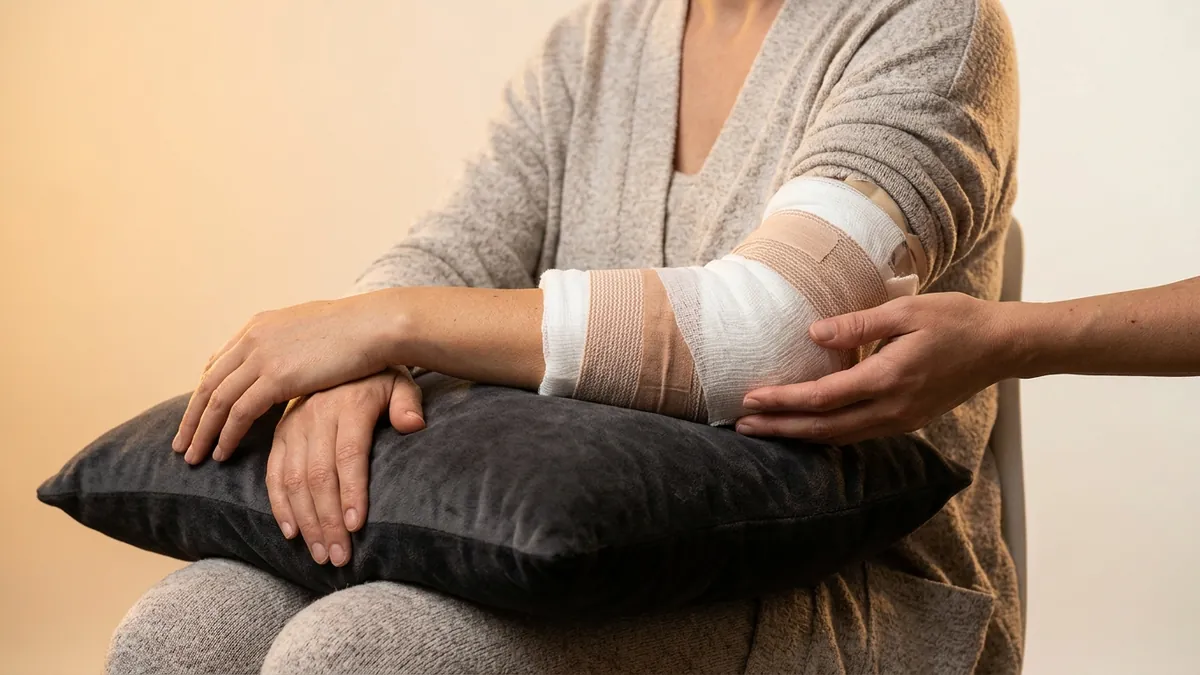
When you are getting ready to fix a pinched nerve in your elbow, understanding cubital tunnel surgery recovery time—its true clinical meaning, the causes behind faster or slower healing, normal recovery ranges, and your practical next steps—takes away so much pre-surgery worry. Have you ever wondered why bumping your "funny bone" sends an electric zap straight into your ring and pinky fingers? That sensation comes from your funny bone nerve (ulnar nerve), which travels through a narrow tissue passageway on the inside of your elbow called the cubital tunnel.
When conservative steps like nighttime elbow splinting and ergonomic adjustments no longer stop finger numbness or hand weakness, we doctors refer you from your Primary Care Physician (PCP) or family GP clinic to an orthopedic or plastic hand surgeon. Surgery relieves mechanical pressure on that trapped nerve so your hand muscles and sensation can recover.
Because skin incisions, deeper forearm muscles, and delicate nerve fibers all heal on completely different biological clocks, knowing what is normal at each milestone helps you protect your repair without rushing back too soon. Makes complete sense, right?
📌 Key Takeaways at a Glance
- Skin vs. full recovery: Your elbow incision typically heals in 10 to 14 days, light desk work resumes in 1 to 3 weeks, and full grip strength or heavy lifting takes 3 to 6 months.
- Procedure type matters: A simple nerve tunnel release (in situ decompression) heals faster than moving the nerve under forearm muscle (submuscular anterior transposition), which requires 2 to 4 weeks in a protective splint.
- Nerve regrowth speed: Pinched nerve fibers regenerate at roughly 1 millimeter per day (about 1 inch per month), meaning pinky and ring finger numbness can steadily improve for 6 to 12 months.
- Early symptom relief: Deep aching night pain in the elbow often eases within the first few weeks, long before subtle fingertip tingling completely clears.
- Safe driving rule: Never get behind the wheel until you are completely off prescription opioid painkillers and can grip and turn the steering wheel firmly without pain.
What Is the Normal Cubital Tunnel Surgery Recovery Time and Clinical Meaning?
Cubital tunnel surgery recovery time typically takes 1 to 2 weeks for light desk tasks and 3 to 6 months for full grip strength and heavy lifting. Because compressed ulnar nerve fibers regrow slowly at roughly one millimeter per day, stubborn finger numbness may steadily improve for 6 to 12 months.
Think about it for a second: when patients ask us doctors how long recovery takes, they are really asking about three separate healing layers happening under the same bandage. First, your skin incision knits shut over the first 10 to 14 days. Second, the ligaments and forearm tissues around your inner elbow calm down and regain smooth motion between weeks 3 and 8.
Third—and most important clinically—your uncompressed nerve has to repair its protective insulation (myelin sheath) and internal wiring (axons) all the way from your inner elbow down to your fingertips. That distance is roughly 10 to 14 inches (25 to 35 centimeters). Pretty surprising, right? Clinically, a successful surgery immediately halts progressive hand muscle wasting, even while your sensory nerve endings take months to finish waking up.
How Does Ulnar Nerve Surgery Work, and Why Does Procedure Type Change Healing?
Look closely at what happens inside your elbow joint whenever you bend your arm to hold a smartphone, type at a laptop, or sleep with your hands tucked under your chin. Bending your elbow past 90 degrees narrows the cubital tunnel by nearly half and stretches the ulnar nerve tightly across the inner elbow bone bump (medial epicondyle). Before recommending surgery, we doctors confirm pinched elbow nerve syndrome (cubital tunnel syndrome) using a physical exam and a nerve electrical test (nerve conduction study and electromyography, or NCS/EMG).
Why do we check that electrical test first? Because we want to distinguish elbow nerve pinching from two close look-alikes: wrist median nerve compression (carpal tunnel syndrome), which numbs your thumb, index, and middle fingers, and a pinched lower neck nerve root (cervical radiculopathy at C8–T1), which radiates down from your neck. Even ulnar nerve pinching at the wrist (Guyon's canal syndrome) spares the back of your hand, whereas elbow entrapment numbs both the palm side and back side of your pinky finger.
Once confirmed, your hand surgeon selects one of three outpatient procedures—usually under regional arm-numbing anesthesia or light general anesthesia—which directly sets your recovery pace:
- Simple nerve tunnel release (in situ decompression) or keyhole release (endoscopic release): The surgeon snips the tight fibrous roof pressing down on the nerve while leaving the nerve in its natural groove. Because minimal tissue is disturbed, early motion starts within days.
- Moving the nerve forward (ulnar nerve anterior transposition): If your nerve snaps over the bone when you bend your elbow, the surgeon moves it in front of the bone—either under the fatty layer (subcutaneous transposition) or beneath forearm muscle (submuscular transposition). Submuscular repairs require muscle detachment and stitching, adding 2 to 4 weeks of splinting.
- Inner bone trim (medial epicondylectomy): Shaving a small edge off the inner bone bump lets the nerve glide smoothly without tension, following a moderate rehabilitation schedule.
What Are the Normal Week-by-Week Recovery Ranges and Stepwise Milestones?
Have you ever wondered what your daily routine actually looks like from the afternoon you come home from the surgical center until you are lifting heavy grocery bags or gym weights again? While your surgeon will tailor exact restrictions to your procedure, we doctors guide patients through four clear clinical phases:
- Days 1 to 14 (Incision Protection & Swelling Control): You go home the same day wearing either a bulky padded bandage (after simple release) or a plaster/fiberglass splint holding your elbow bent at 30 to 45 degrees (after transposition). Keep your hand elevated above heart level on pillows for the first 48 to 72 hours and wiggle your fingers gently every hour to pump swelling out. Stitches or surgical strips are checked at your 10-to-14-day clinic visit.
- Weeks 2 to 6 (Gentle Gliding & Desk Work): Once the bulky dressing or splint comes off, you begin gentle active range-of-motion and nerve-gliding exercises, often guided by a certified physical or occupational hand therapist. Most desk and remote computer workers return to keyboard tasks in 1 to 2 weeks after simple release, or 2 to 4 weeks after transposition. Safe driving usually resumes between 1 and 3 weeks once you stop prescription painkillers and can turn the wheel firmly.
- Weeks 6 to 12 (Progressive Strengthening): Lifting limits gradually expand from a coffee mug (under 1 to 2 lbs / 0.5 to 1 kg) in month one up to moderate household loads (10 to 15 lbs / 5 to 7 kg) after week 6. Manual tradespeople, nurses, and warehouse workers typically return to modified or full duty between weeks 8 and 12.
- Months 3 to 12 (Deep Muscle & Sensory Maturation): Heavy gym lifting, golf, tennis, and contact sports resume around 3 to 6 months, especially after submuscular transposition. Meanwhile, microscopic nerve regeneration continues steadily through the one-year mark.
What Causes Faster or Slower Nerve Healing After Elbow Decompression?
Remember how we talked earlier about that one-millimeter-per-day nerve regrowth speed? Be honest—it is completely natural to compare yourself with a friend or coworker whose tingling vanished two weeks after elbow surgery while yours is taking four months, isn't it? Several well-established clinical causes explain why two people recover at very different speeds.
The single biggest factor is pre-surgery nerve severity. If your symptoms were intermittent and your NCS/EMG showed mild insulation slowdown without wire loss, relief can feel remarkably brisk. On the other hand, if the nerve stayed compressed for years—causing constant 24/7 numbness, clawing of your ring and pinky fingers, or visible muscle hollowing between your thumb and index finger (intrinsic hand muscle atrophy)—the nerve axons have much more rebuilding to do, and recovery is slower and occasionally partial.
Your overall metabolic and vascular health plays a major role too. Elevated blood sugar from poorly controlled diabetes, an underactive thyroid (hypothyroidism), low vitamin B12 levels, and older age all slow down microscopic nerve repair. Nicotine from smoking or vaping constricts tiny blood vessels feeding the healing ulnar nerve and doubles wound-healing complications. Finally, skipping gentle prescribed nerve-gliding exercises can allow sticky scar tissue to tether the nerve, whereas pushing heavy weights too early can inflame repaired forearm muscles. Finding that middle ground makes all the difference, doesn't it?
How Do Recovery Stages, Procedures, and Post-Op Symptoms Compare?
During recovery, certain sensations are harmless signs of a waking nerve, while others need prompt attention from your surgeon or family GP. Use this quick reference table to see what different post-op scenarios mean for you:
| Recovery Factor or Post-Op Finding | Clinical Meaning & Practical Action |
|---|---|
| Simple Release vs. Submuscular Transposition | Simple release frees the tunnel roof with minimal tissue trauma (1–2 weeks to light work; 6–8 weeks to full activity). Moving the nerve under forearm muscle protects unstable nerves but requires muscle healing (2–4 weeks splinted; 3–6 months to heavy lifting). What you should do: Follow your surgeon's exact splint-wearing schedule—removing a transposition splint early can pull internal muscle stitches apart. |
| Brief "Pins and Needles" or Zaps Along the Forearm | Light, fleeting electric tingles (regenerative paresthesias) over the first few months are often a reassuring sign that bruised sensory nerve fibers are reconnecting and firing again. What you should do: Continue gentle daily nerve-gliding movements and mention your progress at your routine hand therapy or surgical follow-up visit. |
| Numbness Around the Elbow Scar Itself | Tiny skin-surface sensory branches crossing the inner elbow can get stretched during incision placement, leaving a small numb or sensitive patch right next to the scar. What you should do: Once your incision is completely closed and scab-free (around week 3), perform 5 minutes of gentle circular scar massage daily with plain, fragrance-free moisturizer. |
| Mild Evening Swelling in Hand or Fingers | Fluid naturally pools in your hand if your arm hangs straight down at your side during early recovery. What you should do: Prop your forearm on pillows above heart level when resting on the sofa and gently open and close your fist 10 times every hour. |
| Worsening Weakness, New Clawing, or Severe Burning Pain | Increasing motor weakness, extreme skin sensitivity, shiny/swollen hand skin, or recurrent snapping at the elbow may signal scar tethering, recurrent nerve slippage, or a nerve pain flare (complex regional pain syndrome, or CRPS). What you should do: Book an urgent review with your hand surgeon or Primary Care Physician (PCP) / family GP clinic so early targeted hand therapy or nerve testing can start right away. |
In everyday home care across the first month, keep your dressing clean and dry during showers by slipping on a reusable waterproof arm sleeve from your local pharmacy. Fuel nerve and tissue repair with protein-rich, nutrient-dense meals—such as eggs, salmon, Greek yogurt, oatmeal, leafy greens, and berries—and stay well hydrated with water while managing mild soreness using surgeon-approved acetaminophen (paracetamol) or anti-inflammatories if safe for your stomach and kidneys.
✔️ What You Should Do & ❌ What to Avoid
- ✔️ Do elevate and move your fingers early: Keep your hand propped above heart level for the first 3 days and gently bend and straighten your fingers every hour to prevent stiffness and swelling.
- ✔️ Do practice gentle scar desensitization once healed: After stitches are out and scabs have cleared, lightly massage your healed scar and rub soft fabrics across it to calm hypersensitive skin nerves.
- ✔️ Do upgrade your desk ergonomics: Use padded chair armrests, bring your keyboard and mouse close to your body, and keep your elbows relaxed at an open 100-to-110-degree angle rather than sharply bent.
- ❌ Avoid resting your healing elbow on hard surfaces: Do not lean your inner elbow on wooden desks, kitchen counters, or car door armrests during recovery.
- ❌ Avoid lifting heavy objects too soon: Skip lifting grocery totes, laundry baskets, children, or gym weights exceeding your surgeon's weight limit (usually nothing heavier than a cup of coffee for the first 2 weeks).
- ❌ Avoid smoking, vaping, and soaking the wound: Stay completely off nicotine products to protect nerve blood flow, and never submerge your elbow in a bathtub, hot tub, or swimming pool until the skin is 100% sealed.
🚨 When to Seek Immediate Emergency Care (Red-Flag Symptoms)
If you or someone near you develops any of these red-flag symptoms, do not wait — call 911 (or 999 in the UK / 000 in Australia) immediately or go straight to the nearest hospital Emergency Room (ER / A&E):
- Signs of a spreading surgical infection: Rapidly expanding redness, hot throbbing swelling around the elbow, foul-smelling yellow or green pus draining from the incision, or a fever above 100.4°F (38°C) with chills.
- Circulation cutoff from a tight splint or swelling: Fingers turning pale white, bluish-purple, or ice-cold, accompanied by severe throbbing pressure that does not ease when you elevate your arm.
- Sudden, tense, rapidly growing lump at the elbow: A firm, painful blood pocket (expanding hematoma) forming beneath the surgical stitches or causing sudden fresh bleeding that soaks through your dressing.
- Sudden complete paralysis of your hand or fingers: New inability to move your wrist or fingers altogether after surgery.
- Post-anesthesia blood clot or chest symptoms: Sudden shortness of breath, sharp chest pain, or painful one-sided calf swelling (call 911 in the US and Canada, 999 in the UK, or 000 in Australia right away).
💡 Key Take-Home Message
- Most people return to light typing and everyday self-care within 1 to 3 weeks after cubital tunnel surgery, while full heavy-lifting strength builds over 3 to 6 months.
- Do not get discouraged if pinky and ring finger numbness lingers for months—freed ulnar nerve fibers heal steadily at roughly 1 millimeter per day for up to a year.
- Protecting your splint early on, starting guided nerve-gliding hand therapy on schedule, and keeping your elbow off hard edges give you the smoothest long-term outcome.



No comments yet. Be the first to share your question or experience below.