

Oh, does your little one suddenly get angry, cry, and roll around on the floor? Sometimes you can't figure out what to do, right? It's really normal for little ones, like two or three years old, to have these kinds of tantrums, or as we say in English, ``Temper Tantrums''. But sometimes even older children can act out in this way, unable to control their anger and frustration.
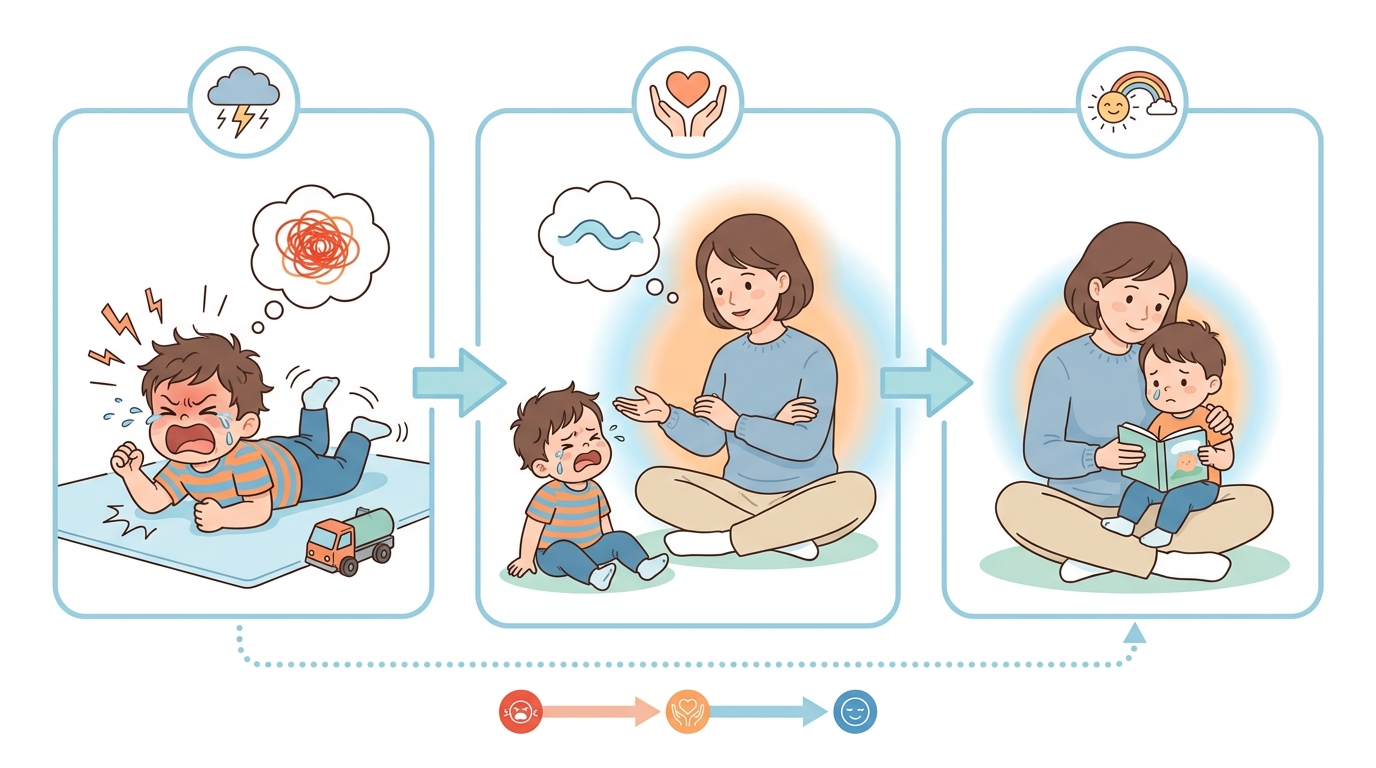
What are these temper tantrums? Let's understand them simply!
Simply put, these ``Temper Tantrums`` are a way for a child to suddenly let out a strong emotion (like anger, sadness, frustration) that they can't control. Imagine, a small child doesn't know how to put what they want into words. Then they let out their inner turmoil in this way.
At this time, the child may behave like this:
- Screaming loudly and crying .
- He lies on the ground, rolling , and flailing his arms and legs.
- Throwing things that come in your hands.
- They beat themselves up, banging their heads somewhere.
- Some children may even hold their breath .
- Trying to hit and bite others (you, your siblings).
The important thing is, this is not something the child does because they are "bad." It's just that their little brain can't handle those emotions at the time.
Why are you acting so recklessly, kid? What are the reasons?
There can be many reasons why a child might misbehave in this way. Let's look at some of the main reasons.
At a young age (around 1-4 years old)
Children at this age are more likely to have ``Temper Tantrums``. The reasons for this are:
- Inability to speak properly: They don't have the words to say they're hungry, tired, need something, or have a problem. So this is the frustration that comes when they don't know how to say it.
- Trying to do things on their own: At this age, they are gradually understanding the world and thinking, "I can do it my way!" But they can't do everything. This is how anger comes out when they can't fix a toy or put on their shoes.
- Tiredness, hunger, lack of sleep : Not only do babies get irritable when they don't get enough food or sleep, but we also get irritable. This is very difficult for little ones to handle.
- New things, changes: When they go to a new place, meet new people, or change their daily routines, they can suddenly become anxious.
Older children (after 4 years)
School-age children can also behave this way sometimes.
- Boundary testing: There are times when they do this to see, "What will mom do if I do this?"
- Difficulty controlling strong emotions :They are still learning how to deal with emotions like anger, sadness, jealousy, and fear when they arise.
- To get attention: Sometimes when you are busy, your child may behave this way to get your attention.
- Learned behavior: If a child has previously screamed and cried and asked for something and got it, they may learn, "Oh... if I do this, I'll get what I want."
- Problems at home or school: Perhaps the stress caused by things like a problem at home or a fight with a friend at school can come out this way.
- Some underlying conditions: Although very rare, conditions such as ``(ADHD)`` (Attention Deficit Hyperactivity Disorder), ``( Autism Spectrum Disorder )``, or things like excessive anxiety can also cause changes in children's behavior. If you have any doubts about this, you should definitely see a doctor.
Are all pranks the same?
No, there are actually different types of tantrums. Some are caused by a child's genuine frustration (Frustration tantrums). Others are caused by attention-seeking tantrums. Sometimes, a child uses this tactic to get what they want (Manipulative tantrums). Some children may experience ``Sensory Overload`` if the noise level suddenly increases or if they go to a crowded place.
Also, the intensity and duration of these tantrums vary from child to child. Some children calm down in a few minutes, while others may take a long time.
How do we, as parents, deal with this? How do we help our child?
Okay, so we've come to the most important part. How do we help the child and stay calm at a time like this?
1. Let's try to prevent mischief before it happens! (Prevention is better than cure!)
- Establish a consistent routine: Eating on time, sleeping on time, and playing on time are very important for children. This will help them feel secure and reduce unnecessary anxiety.
- Allow small choices: When you let your child make small decisions like, "Do you want to drink from the red cup or the blue one?", they feel like they have control over themselves.
- Praise good behavior: When your child does something good, plays calmly, give them a little praise like, "Oh, you're so good, look at how you put the toys away nicely." Then they'll be motivated to do those good things again.
- Teach them to talk about feelings: Teach them words like "Are you sad?", "You seem angry," and "Are you happy?" This will help them learn to put their feelings into words.
- Think about potential problems in advance: Imagine you are going to the store to buy groceries. If you go when you are hungry, your child is more likely to cry and ask for something. So, bring something to fill your stomach before you go.
2. Things to do when something naughty happens:
This is the hardest part, but if you keep this in mind, you can control the situation to a large extent.
- Stay calm! This is the first and most important thing . If you get upset or yell, the child will get even more scared and struggle. Take a deep breath and think, "I need to stay calm."
- Consider the child's safety: See if the child is in danger of harming themselves, others, or property. If so, take them to a safe place.
- Ignore the behavior, not the child: If you think your child is struggling to get attention (and if the child is safe), ignore the behavior for a while. But don't leave your child alone. Stay close, but don't respond to the behavior.
- Validate feelings: Once your child has calmed down a bit, say something like, "I understand that you were upset/sad about not getting the toy." This lets your child know that you understand them.
- A short break (`Time-out`): This doesn't work for everyone, but it works for some children. Give your child a short time-out that is appropriate for their age (e.g. 3 minutes for a 3-year-old) and leave them alone in a quiet, toy-free area. This shouldn't be used as a punishment, but as a way to give your child a chance to calm down.
- Distraction: This works best for very young children (under 2 years old). Suddenly point out the window and say, "Look, there's a beautiful bird outside!" or give them another toy.
3. After the prank is over:
The most important work comes after the child has calmed down.
- Hug and comfort with love: Say, "Mommy/Daddy loves you very much. We love you even when you are angry."
- Talk about the incident (once the child has completely calmed down): Ask things like, "Why are you so angry?", "What did you think?" Listen to what the child says.
- Teach them how to control their emotions next time: "Next time you're angry, tell Mom/Dad, or let's count to 10, or take a deep breath and let it out slowly."
- Don't give what the child asks for out of spite: If you give the toy or food that the child has asked for right away after he screams and cries, the child will learn, "Oh... if I do this, I will get what I want." Therefore, it is important not to give the requested thing right away, even after he has calmed down.
Never do these things!
- Do not yell, hit, scold, or threaten your child. This will only make the situation worse. The child will become more afraid and lose trust in you.
- Don't give your child what he or she asks for when he or she is struggling. Doing so will only increase the behavior.
- "If you stop crying, I'll give you chocolate."Don't give bribes like "I'll give you one." That will teach the child the wrong things.
- Don't shame your child with words like "You're a bad kid" or "You idiot." This will damage the child's self-esteem.
- Don't compare yourself to other children. Don't say things like, "Look at how good your son is, you're the only one struggling like this."
When should we seek medical advice?
Most of the time, these ``Temper Tantrums`` will subside with age. However, in cases like these, it is definitely a good idea to consult a pediatrician or psychiatrist for advice:
- If the child's tantrums are very frequent (several times a day).
- If one mischief lasts for a long time (more than 30 minutes) .
- If the child behaves very badly (harms himself severely, hits others severely, breaks things).
- If these terrible mischiefs continue even after the age of 4-5 .
- If the child is struggling, holding their breath, turning blue, or appearing to be unconscious.
- If these behaviors interfere with the child's daily activities (schoolwork, play).
- If this has become a great stress for the whole family , if it is too difficult for the parents to bear.
- If you suspect your child has ADHD, Autism Spectrum Disorder, Speech and Language Delay, or another developmental problem.
Remember, asking for help is not a sign of weakness. It can be a great relief for both you and your child.
Parents, it's very important that you take care of yourself too!
Dealing with a child's ``Temper Tantrums'' can be very tiring. You too may sometimes feel angry, frustrated, and wonder, "What am I doing?" It's very normal.
- Remember that you are not alone. Many parents go through this experience.
- Talk to your partner about this and help each other.
- Share what's on your mind with a trusted friend or family member.
- Take some time for yourself whenever possible. Take a break, do something you enjoy.
- If you are having a hard time, don't hesitate to seek help from a counselor.
Take-Home Message
Okay, so we've talked about a lot today, haven't we? Here are the most important things to remember:
- It's completely normal for children to be naughty, especially at a young age. It's part of their development.
- Patience, calmness, and consistency are the best ways to help with this.
- It is very important to teach your child to recognize and control their emotions .
- Your peace of mind is also important.
- If, despite doing everything you can, you still have concerns about your child's behavior , never be afraid to seek professional help.
This journey can be challenging at times. But you can do this! You are a good mom/dad. Move forward with confidence!
` Children's mischief, temper tantrums, parenting advice, children's behavior, behavioral problems, child psychology, emotion regulation
Doctor's Note
Temper tantrums are a natural developmental stage of children between the ages of 1 and 3. The main reason for this is that the child is unable to verbalize his frustrations or needs. When the child behaves like this, parents should not shout or get angry, but it is important to remain calm with the child (co-regulation) and after the child calms down, hug and talk with love. Avoid giving in to the child's inappropriate requests even in a public place.
❓ Some more questions you may encounter (FAQ)
What causes a child to have tantrums?▼
This is caused by the mental pressure (Frustration) caused by the child being hungry, tired, lack of sleep or not being able to say what he wants in words.
What should parents do when the child is rolling on the ground and crying?▼
To ensure that the child is not harmed, parents must remain calm, not argue with the child, and wait patiently until the child calms down.
How to teach a child to control anger (Emotional control)?▼
Practicing simple techniques such as recognizing the child's emotions when they are calm (eg 'You're angry, aren't you?') and deep breathing when angry can help.


💬 Comments (0)
No comments yet. Be the first to share your thoughts here.
Add Your Comment