
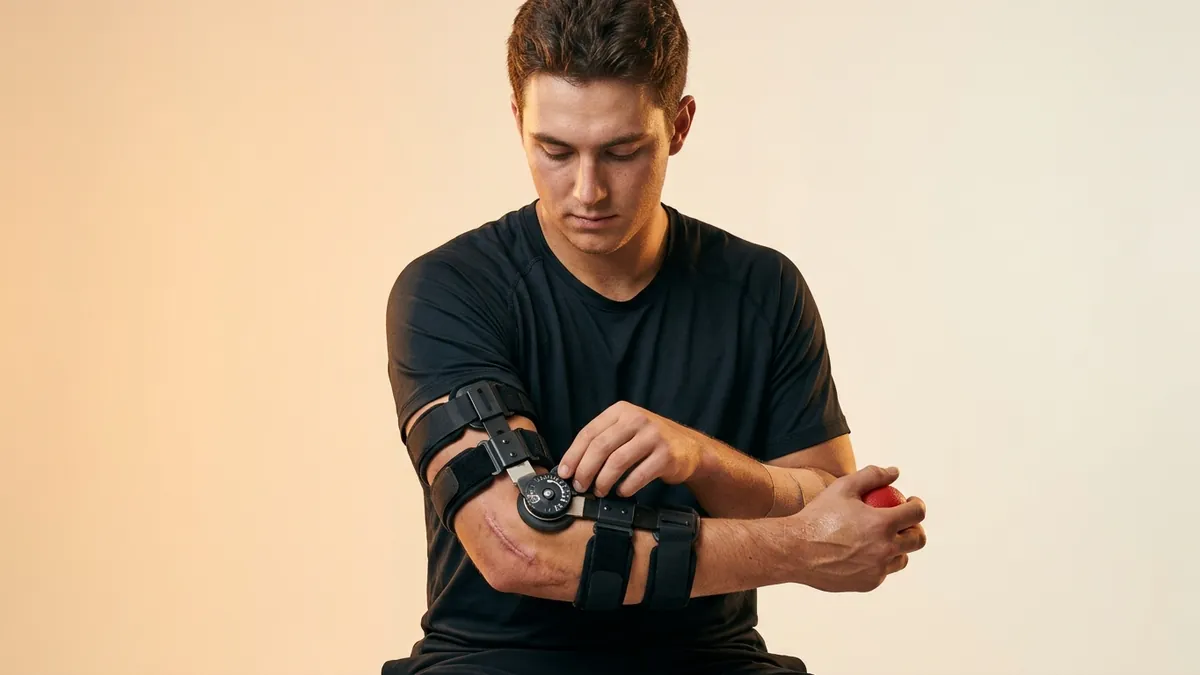
Recovery time for Tommy John surgery: clinical meaning, causes, normal ranges, and next steps is one of the first topics we doctors unpack whenever an overhead athlete or active adult tears the main stabilizing band on the inner side of their elbow. Medically known as inner elbow ligament reconstruction (ulnar collateral ligament reconstruction, or UCLR), this outpatient orthopedic procedure replaces a frayed or ruptured ligament with a healthy tendon graft so your joint stops buckling under load. Have you ever wondered why a ligament barely the size of your pinky nail takes up to a year—or even longer—to recover?
The secret comes down to deep cellular biology rather than skin healing. Your surface stitches heal within two weeks, yet the transplanted tendon tucked inside your elbow needs months of gradual blood-vessel growth and tissue remodeling before it can handle a ninety-mile-per-hour fastball, a heavy tennis serve, or a fast cricket throw from the boundary. Pretty surprising, right?
Navigating that timeline smoothly takes teamwork across your local healthcare setup—starting with an initial exam at your Primary Care Physician (PCP) or family GP clinic or a local Urgent Care center, moving to an orthopedic sports surgeon for imaging and reconstruction, and working week after week with a physical therapist or physiotherapist.
📌 Key Takeaways at a Glance
- Everyday vs. athletic timelines: Desk work, typing, and light daily tasks resume in 2 to 6 weeks, position players return in 6 to 9 months, and competitive pitchers need 12 to 18 months.
- Biology sets the pace: A transplanted tendon graft undergoes slow cellular remodeling (biological ligamentization) that no workout can safely rush.
- Repair vs. reconstruction: Select clean bone-end tears may qualify for suture-tape repair (internal brace augmentation), trimming return-to-sport recovery to roughly 6 to 7 months.
- Structured four-phase rehab: Recovery progresses from a protective splint to a hinged brace, full-body kinetic-chain strengthening, and a scripted interval throwing program.
What Is the Normal Recovery Time for Tommy John Surgery, and What Does It Mean Clinically?
The normal recovery time for Tommy John surgery is 6 to 9 months for non-throwing athletes and position players, and 12 to 18 months for competitive baseball pitchers. Clinically, this timeline reflects biological ligamentization, the gradual cellular process where a transplanted tendon graft remodels into a strong, stable elbow ligament.
Think about it for a second: when we doctors talk about "recovery," there are actually two completely different finish lines. For everyday living—buttoning a shirt, typing at a laptop, cooking dinner, or driving once you are out of a locked splint and off prescription pain relievers—most adults feel comfortable within 4 to 6 weeks. Heavy manual labor or gym lifting usually waits until Months 3 to 4.
Competitive overhead sports demand far greater patience. Returning to full-effort pitching, javelin, gymnastics, or tournament tennis requires waiting until new collagen fibers align, mature, and anchor firmly inside your bone tunnels. Clinical clearance never relies on the calendar alone; your surgeon and therapist also check for full pain-free joint motion, balanced grip and shoulder strength, and clean throwing mechanics before signing off.
How Does Tommy John Surgery Work, and What Causes UCL Tears in the First Place?
Your inner stabilizing elbow ligament (ulnar collateral ligament, or UCL) connects your upper arm bone (humerus) to your inner forearm bone (ulna). Every time you whip your arm overhead—pitching a baseball or softball, bowling or throwing in cricket, serving in tennis, or bracing during a wrestling takedown—huge outward-bending force (valgus stress) pulls the inner elbow apart. Over thousands of throws without enough off-season rest, microscopic tears accumulate until the ligament stretches out or snaps with a sharp pop.
During standard Tommy John surgery, an orthopedic surgeon harvests a spare tendon from your own forearm wrist crease (palmaris longus tendon) or inner knee hamstring (gracilis tendon), known as a self-donated graft (autologous tendon graft), or uses a screened donor tendon (allograft). That tendon is woven in a figure-of-eight loop through tiny bone tunnels and anchored tightly. Because your funny-bone nerve (ulnar nerve) sits millimetres away, the surgeon carefully protects or gently repositions it to prevent lingering ring- and pinky-finger tingling (ulnar neuropathy).
Before referring you for surgery, we doctors always rule out look-alike inner elbow conditions using a hands-on exam and a dye-enhanced joint scan (magnetic resonance arthrogram, or MRA). Common mimics include Golfer's elbow tendon inflammation (medial epicondylitis), forearm muscle tears (flexor-pronator mass strain), and isolated nerve pinching (cubital tunnel syndrome). We rarely stop to think about how crowded that inner corner of the elbow is, do we?
How Does Standard Reconstruction Compare to Internal Brace UCL Repair?
If you follow sports news, you have probably noticed some athletes returning to competition just 6 or 7 months after an elbow UCL operation instead of missing an entire year. Have you wondered whether they had a shortcut version of Tommy John surgery? In reality, those athletes usually underwent primary ligament repair with suture-tape reinforcement (internal brace ligament repair) rather than a full tendon graft reconstruction.
Look closely at what happens here: instead of replacing the entire ligament with a brand-new tendon, the surgeon reattaches your native ligament directly to the bone and lays a medical-grade, collagen-coated synthetic ribbon alongside it like a seatbelt. Because your body does not have to convert a separate tendon into a ligament from scratch, rehabilitation moves safely along at almost twice the pace.
However, strict anatomical rules decide who qualifies. Internal brace repair only works when the tear pulls cleanly off the top or bottom bone attachment (an avulsion tear) and the remaining ligament fibers look healthy and thick. Chronic mid-ligament fraying, bone spurs, calcified tissue, or repeat tears are contraindicating factors that require traditional tendon reconstruction. On the flip side, mild partial tears often heal in 3 to 6 months with braced rest and physiotherapy alone—no scalpel needed. Now that makes sense, right?
What Are the Step-by-Step Rehabilitation Stages and Normal Milestone Ranges?
Remember how we talked about biological ligamentization earlier? To protect that remodeling graft while preventing a stiff, frozen joint, orthopedic and physiotherapy protocols divide recovery into four milestone-driven stages with clear range-of-motion (ROM) targets:
- Stage 1 — Immediate Protection (Weeks 1 to 2): Your elbow rests in a padded splint angled at 60 to 90 degrees to shield the incision and fresh bone tunnels. Gentle finger squeezes, wrist movement, and shoulder posture drills begin right away to pump down swelling.
- Stage 2 — Controlled Motion & Hinged Bracing (Weeks 3 to 6): You transition into a dial-locked hinged elbow brace. Each week, the brace opens wider—often moving from 30–100 degrees in Week 3 to full straightening and bending (0 to 135+ degrees) by Week 6—paired with light forearm exercises.
- Stage 3 — Total Kinetic-Chain Strengthening (Months 2 to 4): Once the brace comes off, targeted resistance bands and light weights (such as the Thrower's Ten program) rebuild your forearm muscles, rotator cuff, shoulder blades, core, and hips so your legs and trunk absorb throwing force.
- Stage 4 — Interval Throwing & Sport Return (Months 4 to 18): Around Month 4—only after achieving full pain-free motion and roughly 85 to 90 percent strength symmetry—athletes begin scripted flat-ground tossing. Pitchers step onto a mound around Month 9, face live batters around Months 10 to 11, and return to full competition between Months 12 and 18.
Be honest—once your elbow feels completely pain-free around Month 3, you would feel tempted to test a hard throw in the backyard too, wouldn't you? Yet Months 2 through 4 are actually when the remodeling tendon graft is biologically weakest, making strict discipline essential.
How Do Recovery Timelines Differ by Sport, Role, and Daily Activity?
Every patient's calendar looks slightly different depending on joint load, sport position, and surgical method. Use this side-by-side clinical guide to match your routine with realistic expectations and next steps:
| Activity, Sport, or Clinical Scenario | Clinical Timeline & Recommended Next Step |
|---|---|
| Desk Work, School & Everyday Tasks | Typing, writing, eating, and light household chores resume in 2 to 6 weeks as brace angles widen; driving resumes once out of a locked splint and off sedating pain medication. What you should do: Set up an ergonomic keyboard, use voice-to-text during Weeks 1 and 2, and confirm legal driving clearance with your surgeon. |
| Non-Throwing & Position Athletes (Hitting, Tennis, Gymnastics, Cricket Batting) | Full return typically takes 6 to 10 months because lower peak valgus torque or two-handed bat swings stress the healing graft earlier and less severely than pitching. What you should do: Follow a sport-specific progression—batters often start dry swings at Month 4 and tee hitting around Month 5 under therapist supervision. |
| Baseball Pitchers, Softball & Javelin Throwers (Primary UCLR) | Competitive return takes 12 to 18 months; about 80 to 90 percent reach prior play levels, though full command and endurance often peak closer to 15 to 18 months. What you should do: Log every throw during your interval throwing program, pause immediately for inner elbow tightness, and stick to strict pitch counts. |
| Internal Brace Primary UCL Repair | Clean bone-end tears reinforced with collagen-coated suture tape often allow return to play in 6 to 7 months because native ligament tissue heals without full graft conversion. What you should do: Ask your orthopedic specialist after your MRI whether tear location and tissue quality make repair a safe option for you. |
| Revision Tommy John Surgery (Second Tear) | Replacing a failed prior graft requires 15 to 24 months due to scar tissue, revised bone tunnels, and slower remodeling, with lower return-to-same-level rates (65 to 78 percent). What you should do: Work with a dedicated sports biomechanist and physiotherapist to correct hip, trunk, or shoulder flaws before throwing again. |
What Practical Daily Care, Nutrition, and Next Steps Support Safe Healing?
Real-world recovery starts with smart home habits during the first month. Keep your surgical dressing clean and completely dry until sutures or sterile strips are cleared—wrapping your splint carefully during showers. Prop your forearm on two pillows at night so your hand rests slightly above heart level to curb throbbing swelling. When icing for 15 to 20 minutes, always wrap a thin towel around the cold pack and avoid pressing hard over the inner elbow groove—do you recall that sensitive ulnar nerve resting right beneath the skin there?
Your healing graft also relies on steady nutritional building blocks. Aim for protein-rich, easy-to-eat meals—such as Greek yogurt with berries, scrambled eggs on whole-grain toast, oatmeal or porridge with nuts, grilled salmon, or roast chicken paired with vitamin C-rich oranges, kiwifruit, or bell peppers (capsicum)—to fuel new collagen fibers. Check with your Primary Care Physician (PCP), family GP, or pharmacist before taking high doses of anti-inflammatory tablets (NSAIDs like ibuprofen or naproxen) beyond the first few days, as prolonged heavy use can upset your stomach and subtly slow tendon-to-bone healing.
Finally, do not overlook the mental side of missing a full season. Feeling frustrated or anxious during Month 5 of repetitive band drills is completely normal. See? That is why we doctors encourage staying connected with teammates, tracking small strength wins, and checking in with your GP clinic or a sports counsellor if rehab burnout creeps in.
✔️ What You Should Do & ❌ What to Avoid
- ✔️ Do wear your hinged brace exactly as locked: Keep the dial set to your prescribed degree limits even when your elbow starts feeling normal around Week 4.
- ✔️ Do train your hips, core, and shoulder blades: Strong legs and trunk rotation take huge stress off your healing inner elbow once throwing begins.
- ✔️ Do observe a true off-season after clearance: Take 2 to 3 consecutive months off from overhead throwing every year and follow age-appropriate pitch limits.
- ❌ Don't test your arm early: Never throw a ball, carry heavy grocery bags, or push up from chairs using your surgical arm before your therapist clears you.
- ❌ Don't push through inner elbow soreness: Mild muscle fatigue is fine, but sharp inner-joint pain during an interval throwing phase means stop and step back a level.
- ❌ Don't smoke, vape nicotine, or skip sleep: Nicotine constricts tiny blood vessels feeding your tendon graft, measurably slowing ligament remodeling.
🚨 When to Seek Immediate Emergency Care (Red-Flag Symptoms)
If you or someone near you develops any of these red-flag symptoms, do not wait — call 911 (US & Canada), 999 or 111 (UK), or 000 (Australia) immediately or go straight to the nearest hospital Emergency Room (ER / A&E):
- Signs of deep surgical infection: Fever above 101°F (38.3°C), chills, foul-smelling yellow or green drainage, or hot redness spreading rapidly from the elbow or graft incision.
- Compromised hand circulation: Fingers on the operated arm turning pale, bluish, or icy cold, severe unrelenting throbbing inside a tight splint, or inability to feel a wrist pulse.
- Sudden progressive nerve loss: Rapidly worsening numbness, complete loss of sensation in your ring and pinky fingers, or new claw-like weakness when trying to spread your fingers.
- Blood clot warning signs: Unexpected calf pain or one-sided leg swelling, sudden shortness of breath, or sharp chest pain after surgery.
- Acute violent re-injury: A fall onto your outstretched arm accompanied by an audible pop, sudden deformity, or rapid balloon-like joint swelling.
💡 Key Take-Home Message
- Respect your graft's cellular clock: Everyday tasks return within weeks, non-pitchers recover in 6 to 9 months, and pitchers require 12 to 18 months for full tendon-to-ligament maturation.
- Earn every stage clinically: Safe return to sport depends on pain-free motion, whole-body strength, and passing a step-by-step throwing program—never calendar dates alone.
- Partner with your care team: Coordinated check-ins between your orthopedic specialist, physiotherapist, and family GP clinic give you the highest odds of a lasting, pain-free comeback.

No comments yet. Be the first to share your question or experience below.