
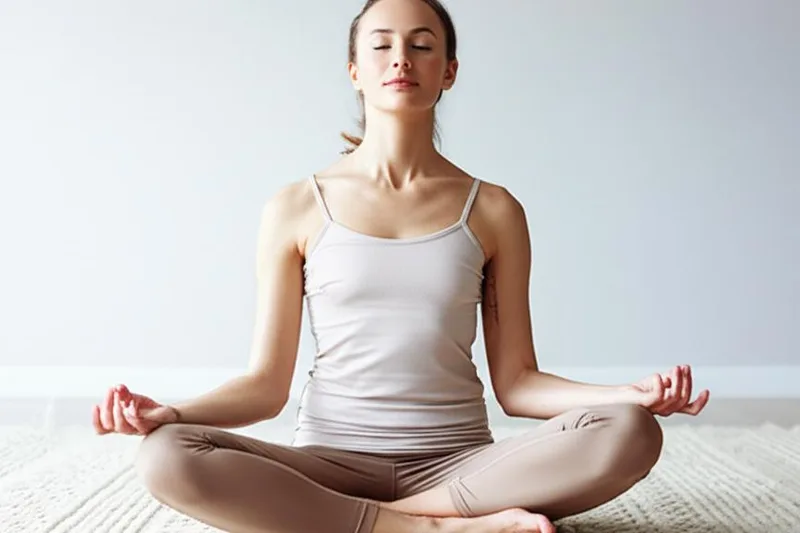
Breathing is a very normal thing for us, isn't it? We all breathe constantly to survive. But did you know that taking a little time, consciously, and properly breathing can have incredible benefits for your health? It can especially help you manage things like stress, anxiety , and depression. So today, let's talk about three very simple breathing exercises that you can do at home, in the office, or even while traveling on the bus.
Why is this breathing exercise so important?
Simply put, there is a big connection between our breathing and our mental calm. Have you ever noticed that when you are a little stressed or scared, your breathing becomes faster and shallower? We call it "chest breathing". That is, breathing only from the chest. This means that the body does not get enough oxygen and the body's "fight-or-flight" system is stimulated.
But when we breathe consciously, deeply, and slowly, our body's "rest-and-digest" calming system kicks in. This slows down our heart rate, regulates our blood pressure, relaxes our muscles, and makes us feel more at ease. So this breathing exercise is a powerful tool for regaining control of our minds.
Method 1: Pursed Lip Breathing
This is the simplest and easiest way to start out of these exercises. The main thing with this is to control your breathing. Doing this helps to expel the old air that is stuck in the lungs and keeps the airways open for a longer time. This makes breathing very easy and light.
Think of it like blowing out a hot cup of tea, or blowing out a candle. You should position your lips in the same way.
Let's see how to do this step by step.
| Steps | What to do |
|---|---|
| Step 1 | First, relax the muscles in your face, neck, and shoulders, and sit or stand comfortably. |
| Step 2 | Now take a slow breath in through your nose. |
| Step 3 | Pucker your lips into a small circle, as if you were going to blow out a candle. |
| Step 4 | Now exhale slowly through pursed lips. The important thing is to take longer to exhale than it took to inhale. Don't force the breath out, let it come out naturally. |
You can do this exercise whenever you feel short of breath or when you are tired. When you practice it several times a day, it will become your normal breathing pattern.
Method 2: Paced Breathing
In this, we focus on how often and how fast we breathe. In situations like anxiety and stress, our breathing rate increases without us realizing it. In medical terms, we call this ``Hyperventilation''. So, by consciously controlling our breathing rate, we can reduce many of the physical symptoms caused by stress.
This is a little more complicated than the previous method. Here we control the time we breathe in and out by counting.
There are several variations of this method. "Square Breathing" and " 4-7-8 Breathing " are two of the most popular.
| Steps | Here's how to do it |
|---|---|
| Step 1 | First, exhale as much air as possible from your lungs, but not so much that it feels uncomfortable. |
| Step 2 | Now, while counting to four in your mind, slowly inhale through your nose. You can count at any speed you like. Breathe in until your lungs are full. |
| Step 3 | Now hold your breath in. You are doing "Square Breathing" and holding your breath for a count of four . You are doing "4-7-8 Breathing" and holding your breath for a count of seven . Keep the count at the same rate. |
| Step 4 | Now exhale. "Square Breathing" is when you exhale slowly while counting to four . "4-7-8 Breathing" is when you exhale slowly while counting to eight . Empty your lungs completely at this time. |
| Step 5 (Square Breathing only) | If you are doing "Square Breathing", after exhaling, hold your breath for a count of four without inhaling again. Then start again at step 2. |
Repeat this process as many times as necessary until you feel calm. It may take a while to find a comfortable counting pace for you, and that's okay. Over time, you'll be able to count more slowly and calm your mind more.
Method 3: Belly / Diaphragmatic Breathing
We also call this `(Diaphragmatic Breathing)`. The reason for this is that our diaphragm muscle is involved in this process. This method involves taking slow, deep breaths and taking in more air into the body. As mentioned earlier, when we are stressed and anxious, we tend to breathe shallowly, only from our chest.
But when you practice this "belly breathing," your lungs expand all the way down and take in more air. This not only eliminates the feeling of "suffocation," but also helps to relieve the physical symptoms of stress.
How to do this?
- Step 1: Sit up straight in a chair, stand with good posture, or lie down on the floor. Place one hand on your chest and the other on your stomach.
- Step 2: Now take a slow breath in through your nose. But don't let the hand on your chest move like that . Instead, breathe in so that your stomach comes forward, so that your stomach expands. You should feel the hand under your stomach rise up.
- Step 3: Now exhale through your mouth. You will feel the hand under your belly go down again.
At first, you may feel a little lightheaded because you are not used to breathing deeply like this. This is very normal. If this happens, breathe normally for a while and sit still until the feeling goes away. Take some time to get used to this.
The important thing is to make one or more of these exercises a part of your daily routine. By setting aside 5 to 10 minutes a day to practice these things, both your mind and body will be ready to manage stress and pressure whenever it arises.
Take-Home Message
- Breathing exercises are a very simple and very powerful way to manage stress and anxiety .
- When first starting out, start with something simple like pursed lip breathing .
- Practice these when you are calm and not under any pressure. Then it will be easier to use them in an emergency.
- It's normal to feel dizzy at first when doing the "belly breathing" exercise. If that happens, take a break.
- Even though these are simple exercises, if your anxiety or stress is severe, definitely talk to your doctor about it.


💬 Comments (0)
No comments yet. Be the first to share your thoughts here.
Add Your Comment