

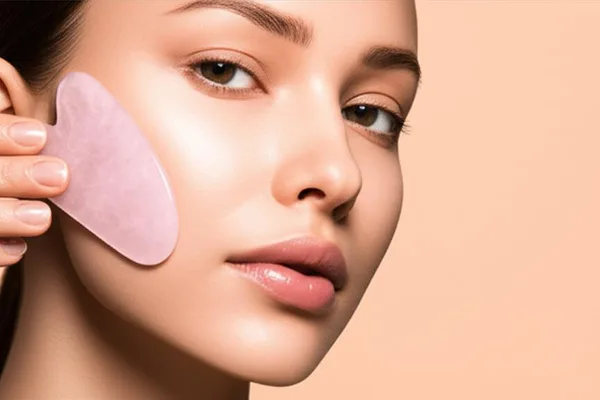
You've probably seen videos on social media or beauty blogs of people gently rubbing their face and neck with a beautifully polished stone. Many people love doing this. That's why it's called 'Gua Sha'. When you see this, you might be wondering, "What's really going on with this? Is there any benefit to just rubbing your skin with a stone?" Okay, so today we're going to talk about Gua Sha from the very beginning.
Simply put, what is Gua Sha?
Gua Sha is a traditional healing technique that has been practiced in East Asian countries, especially China, for thousands of years. It involves a trained practitioner using a small, smooth-edged instrument to gently rub your skin in one direction. Some people also use the term "skin scraping." However, it is not actually a painful scraping.
According to traditional Chinese medicine, the healthy existence of our bodies depends on the unimpeded flow of an energy called 'chi' throughout the body. They believe that if this energy flow becomes blocked somewhere, that is where illness and pain begin to occur. The goal of Gua Sha is to allow this blocked energy to flow freely again.
This is sometimes called "coining" or " skin scraping". This method is also known as "Kerikan" in Indonesia and "Cao gio" in Vietnam.
Similarities with Western medicine
Although this method is new in our countries, physical therapists and chiropractors use a similar method. It is called ``instrument-assisted soft tissue mobilization (IASTM)``. It also uses a similar instrument to loosen tight muscles and scar tissue. However, there is no talk of 'chi' energy there. It is a method that focuses entirely on muscles and tissues.
How to do a Gua Sha massage?
When you go for this treatment, first an oil is applied to the affected area of your body. Then, a Gua Sha device, which looks like a stone, is used to massage your skin lengthwise and downwards.
When you do this, the very fine blood capillaries under the skin break. As a result, small, red dots appear on the skin. It looks like a rash. This is medically called `(petechiae)`. Don't be alarmed by this, it will disappear completely in a few days.
The therapist may gradually increase the pressure, but only to the extent that you can tolerate it.
Remember, Gua Sha is not a painful treatment. It should be done very gently, especially when applied to the face.
This treatment can be done anywhere on the body, such as the back, neck , arms, legs, and buttocks.
What are the benefits of this?
When we massage our skin in this way, it is believed that our body's immune system and nervous system are activated. Some studies show that this improves blood circulation, reduces pain, and speeds up the healing process in the area.
But remember, extensive scientific research is still underway on this topic, so these results cannot be 100% guaranteed.
| Health status | What the studies say |
|---|---|
| Tight muscles | It can help relax tight muscles and reduce pain. |
| Migraines | One study found that Gua Sha reduced migraine pain as part of a 14-day treatment, but more research is needed. |
| Neck pain | One study found that people with chronic neck pain experienced significant short-term pain relief. |
| Perimenopausal symptoms | One study found that symptoms such as insomnia and excessive sweating were relieved by performing Gua Sha once a week for 8 weeks. |
| Breast fullness during breastfeeding | A study revealed that Gua Sha relieved pain and made breastfeeding easier when the breasts were swollen and painful during breastfeeding. |
| Other situations | There are also suggestions that it may help with conditions such as Hepatitis B and Tourette's syndrome, but there is not enough evidence to confirm them. |
Sometimes these reported results can be due to the ``placebo effect.'' That is, when you strongly believe that a certain treatment will help you, you may actually experience an improvement in your symptoms .
Are there any side effects and risks to this?
Gua Sha is generally considered a safe procedure, but some people may experience minor side effects.
- Bruising or discoloration of the skin may occur.
- You may feel a little sore or bruised after the treatment.
- These symptoms usually disappear within 3-4 days.
- Very rarely, a bacterial infection can occur if the device is not cleaned properly.
Who is not good at doing Gua Sha?
This treatment is not suitable for people with certain health conditions. Before you try this method, be sure to talk to your doctor to make sure it is safe for you.
| Who should not have this treatment? | |
|---|---|
| People with diabetes | People with blood circulation problems |
| People taking blood thinners to prevent blood clots | Women who are pregnant or planning to become pregnant |
| People with active infections, wounds, or cancers on the skin | People who have received injections such as `(botulinum toxin)` or `(fillers)` to the face in the past month |
| People with skin conditions such as psoriasis or rosacea should avoid doing this to their face. | |
Gua Sha equipment and how to do it at home
There are various tools and materials used to perform Gua Sha. The most popular are those made from polished stones such as rose quartz and jade. In addition, a Jade Roller can also be used for this purpose.
If you're doing this at home, the most important thing to remember is to clean the device thoroughly with soap after each use. Also, don't use it if there's even the slightest crack or break in the device. This can damage the skin.
The correct way to do Gua Sha on the face
If you are trying this on your face, follow these steps.
1. Cleansing: First, clean your hands and face thoroughly. The Gua Sha tool should also be clean.
2. Apply oil: Apply a face oil or serum that is suitable for your face. This will help the device glide over your skin more easily. If you have acne-prone or sensitive skin, choose an oil-free product.
3. How to hold the device: Hold the device at a 35-45 degree angle so that it touches the skin.
4. Pressure: Apply very light to medium pressure . Never press too hard.
5. Direction: Always massage from the inside of the face outwards, and from the bottom up .
- Neck: Rub upwards from the nape of the neck towards the ears.
- Jaw area: Rub from the center of the chin along the jawline towards the ear.
- Cheeks: Rub along the cheek outwards towards the ear.
- Under the eyes: Very gently move from under the eye towards the ear.
- Forehead: Rub upwards from the middle of the eyebrow to where the hairline begins.
Some experts say that doing this two or three times a week can yield good results.
Take-Home Message
- Gua Sha is an ancient healing technique originating in China, but extensive scientific research is still needed to confirm its benefits.
- This is believed to provide relief from muscle pain and swelling, but results may vary from person to person.
- It's not good to feel pain when doing Gua Sha. You have to be very gentle, especially when doing it on the face.
- People with diabetes, those taking medication to prevent blood clots, and pregnant women should avoid this treatment.
- Before you try this method, be sure to consult your doctor to make sure it is appropriate and safe for you.




💬 Comments (0)
No comments yet. Be the first to share your thoughts here.
Add Your Comment