

Congratulations to you and your family! The joy you feel when a little baby comes into this world cannot be expressed in words. So, right after the baby is born, he or she will have his or her first doctor's check-up in the hospital. This is a very important thing. Let's see what happens at this time and what you should expect.
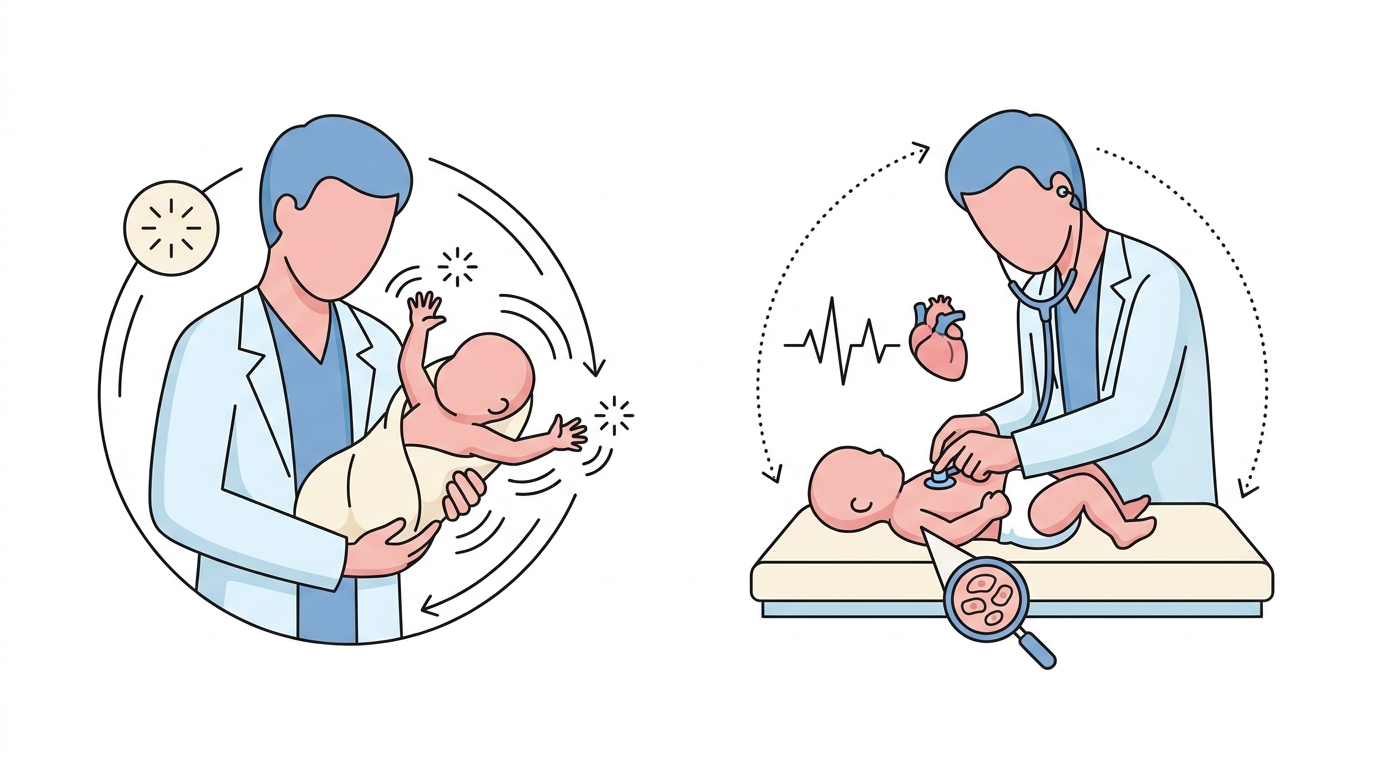
What happens in the hospital?
At the hospital, the doctor and nurse will work together to take care of your baby. There's nothing to worry about, all of this is done for the baby's health.
How to Check Baby's Growth
First, they measure your baby's weight, height, and head circumference . Then they record these measurements on their ``growth chart.'' This is how they understand whether the baby is growing properly.
Questions for You, Advice for You
Next, the doctor or nurse will ask you questions about how to care for your baby. This is a great time to talk to them about any questions or concerns you may have. They will give you valuable advice.
Feeding
- Breastfeeding : They say that breast milk is the best nutrition for a baby . However, if breastfeeding is sometimes difficult, formula milk can also be used to provide the necessary nutrition for your baby. Newborns should be fed when they are hungry. This usually means every 1 to 3 hours . The doctor or nurse will probably watch you feed and help if there are any problems.
- Formula Feeding: A formula-fed baby will drink about 1-1½ ounces (30-45 milliliters) at a time.
- Feeding the calf: Don't forget to feed the calf only when it is half full or completely full after feeding. As the calf grows, the amount of milk it drinks increases, so the number of feedings per day decreases.
How to Pee and Poop
- Amount of urination : A breastfed baby will urinate about once or twice a day until the mother's milk comes in properly. By 3-5 days, each baby should be having about 6 wet diapers a day .
- How to poop: Newborn babies may poop about once a day for the first few days. For the first few days, their poop is dark black and tarry . After 3-4 days, it becomes a bit runny and greenish-yellow . Breastfed babies usually poop several times a day, while formula-fed babies poop less often. This is normal.Don't be afraid, okay?
Sleeping
A newborn baby can sleep for about 14-17 hours out of 24 hours . However, they wake up frequently (both day and night) to feed.
- Breastfed babies usually wake up to feed every 1-3 hours .
- Formula-fed babies tend to sleep a little longer, waking up every 2-4 hours (the formula takes longer to digest, so the baby feels full).
- Until the puppy gains weight properly, which is the first few weeks, don't let him sleep for more than 4 hours between feedings. After that, it's okay for the puppy to sleep for longer periods of time.
Baby's Development
Newborn babies need to do these things:
- They look intently at faces and brightly lit objects that are about 8-12 inches (20-30 centimeters) away.
- Responds to sounds – may turn away from mom or dad's voice, sit silently, blink , twitch, or cry.
- The arms and legs are kept in a bent position .
- These innate reactions (`newborn reflexes`) should be good:
- Rooting and sucking reflex : When something is placed near the lips, the baby turns its head in that direction and begins to suck milk.
- Grasp reflex: If you put a finger inside your hand, you will grasp it tightly.
- Fencer's pose: When the head is turned to one side, the arm on that side is extended and the arm on the other side is bent.
- Moro reflex (startle response): If suddenly startled, the child throws out both arms and legs and then brings them back in.
Full Body Examination
Right in front of you, the baby will be undressed and a full body examination will be performed. This will include checking the baby's eyes, listening to the baby's heart, checking the pulse, checking the umbilical cord, and checking the baby's spine, hips, and legs.
Some Special Screening Tests
Several special tests (`screening tests`) are also performed to check for certain diseases that could be harmful to the baby.
- These tests are performed by taking a small drop of blood from the puppy's heel .
- Also, before leaving the hospital , the baby's hearing is tested (`hearing test`) and oxygen levels are checked .
First Vaccines
Your baby should receive his first vaccinations at the hospital. These vaccines protect babies from serious childhood diseases.It is important to get your vaccines on time. Vaccine schedules may vary slightly, so talk to your doctor to find out exactly what is going on.
Remember These Until the Next Check-up
Take care of these things until your next check-up, which is in a few days.
About Feeding Methods
For Breastfeeding Mothers
- Help your baby latch on properly : Open your mouth wide, place your tongue under it, and take as much of your breast into your mouth as possible.
- Do not use bottles or pacifiers until your baby is well-acquainted with breastfeeding.
- Breastfeed your baby whenever he is hungry .
- Pay attention to signs that your baby is full (e.g., pulling away from the nipple, covering his mouth).
- Take your prenatal vitamin or multivitamin daily.
For Formula-Feeding Mothers
- Give your baby an iron-fortified formula .
- Follow the instructions on the formula packet exactly when making and storing bottles.
- Do not add extra water to your baby's formula.
- Do not hold bottles or put your baby to sleep with a bottle in his mouth.
- Give your baby a bottle of milk whenever he is hungry .
- Pay attention to signs that your baby is full (e.g., pulling away from the bottle, covering his mouth).
How to take care of your baby daily (Daily Baby Care)
- Wash your hands thoroughly before handling the baby. Keep the baby away from people who are sick.
- Hold the baby, take care of its needs. You can't spoil a newborn baby.
- Place the diaper below the umbilical cord to dry. The umbilical cord usually falls off in 10-14 days.
- Apply a little petroleum jelly to the genitals or the front of the penis of circumcised boys .
- A baby girl may have a vaginal discharge with a few drops of blood during the first week of life . This is nothing to worry about.
- Keep the body moist (`sponge baths`) until the umbilical cord falls off and, in the case of a boy, the circumcision site heals. Test the water by placing your wrist in it to see if it is too hot. Use unscented soaps and lotions .
When to See the Doctor
During these times, you should definitely see a doctor:
- When viewed from the bottom (rectal) of the babyIf the fever is 100.4 Fahrenheit (38 Celsius) or higher .
- If the puppy is showing signs of illness , not eating, urinating , or pooping.
- If you don't latch on properly or suck properly while breastfeeding.
- If you are not satisfied with breastfeeding.
- If the body appears to be yellow (jaundice) .
- If the area around the umbilical cord or the circumcision site is red and pus-like .
- Don't give any medicine without talking to the doctor.
Mom's Well-being is Also Important!
It's normal for new mothers to feel tired and overwhelmed at times. But if these feelings are very strong, if you feel sad, angry all the time, or anxious, talk to your doctor .
Worried About Living Conditions?
Are you worried about your living situation? Do you have the things you need to take care of your baby? Do you have enough food, a safe place to stay, health insurance? Talk to your doctor about this. He or she can tell you about community resources or refer you to a social worker.
Safety First!
How to prevent Sudden Infant Death Syndrome (SIDS)?
This is very important. `SIDS` is the sudden death of a baby without any obvious cause. Here are some things you can do to prevent it:
- When putting your baby to sleep, always put him or her to sleep face-up, on a flat, firm mattress, in a crib or bassinet. Do not put your baby to sleep on his or her stomach or side. Do not place bumpers, blankets, pillows, or soft toys on the sides of the crib.
- Breastfeed if possible.
- Keep your baby in a crib in your room, next to your bed, until their first birthday, or at least for 6 months. This is when the risk of SIDS is highest. (Bed-sharing is not recommended.)
- Keep the room temperature comfortable and prevent the baby from getting too hot . Dress the baby according to the room temperature, do not overdress . Do not cover the baby's head while sleeping. Check for sweating and if the body feels hot to the touch.
- If your baby likes it, let him sleep with a pacifier . If your baby refuses the pacifier, don't force it. If the pacifier is swallowed while sleeping, don't put it back in. If you are breastfeeding, don't give him pacifier until he is used to breastfeeding properly.
- Don't let your baby sleep on anything that isn't specifically designed for babies.For example, things like seating devices (like car seats), feeding pillows, and infant loungers.
- Do not use devices that claim to reduce the risk of SIDS (such as sleep positioners or monitors that measure a baby's heart rate and breathing). There are no products that actually do this.
- Make sure that any sleeping surface or product you use for your baby's sleep is approved by a reputable agency, such as the US Consumer Product Safety Commission (CPSC). (If in Sri Lanka, choose products that are certified safe and meet the standards.)
Other Safety Tips
- Do not smoke or use e-cigarettes. Do not allow anyone to smoke or vape near your baby.
- Always place your baby in a rear-facing car seat, in the back seat of the vehicle .
- Never leave your baby alone in a car.
- Do not leave your baby alone when he is awake, especially in high places or while bathing.
- Never shake your baby – it can cause brain hemorrhage and even death. If you ever feel like you might hurt your baby, put your baby in the crib or somewhere safe for a few minutes and call a friend, relative, or your doctor for help.
- Protect your baby from the sun by keeping him covered and in the shade as much as possible. Sunscreens are not recommended for babies under 6 months of age. However, if the shade and clothing do not provide adequate protection, a small amount of sunscreen can be applied to a baby under 6 months of age.
These check-up sheets are in line with the American Academy of Pediatrics (AAP)/Bright Futures guidelines.
Take-Home Message
So, a newborn's first doctor's check-up is a very important step in the baby's health journey.
Don't be afraid, ask questions, and listen carefully to what the doctor and nurse are saying. They are there to help you and your baby.
The most important thing is to take care of the baby's food, sleep, development, and safety. As a mother, your health is also important. Only if you are healthy can you take good care of your baby. So, we all wish you and your baby a happy and healthy start to this new journey!
` Infant health, first medical check-up, newborn care, breastfeeding, formula, baby sleep, SIDS prevention
ukat juk’ampinaka Doctoran qillqatapa
ukat juk’ampinaka Janïr mä jichhak yurir wawax qullañ utat mistuñkama (Visita de bien-niño de Recién Nacido), nayrïr jach’a qullañ uñakipañaw lurasi. Aka chiqanx wawax yurïwitpach pesaje, largo ukat p’iqin circunferencia ukanakaw uñakipata. Chuyma ch’allxtawi, pulmón lurawi, nayranaka ukhamaraki kunjamasa cadera articulaciones (Chequeo de displasia de cadera) ukaxa wali suma uñakipatawa qullirina. Akax wawax reflejos instintivos básicos (Reflejos recién nacidos - Reflejo Moro) ukanakax sum irnaqaskiti janicha uk uñjañatakiwa, ukhamarak chuchuñax sumti janicha uk yatiñataki.
❓ ukat juk’ampinaka Mä qawqha juk’amp jiskt’äwinakampiw jikisipxasma (FAQ) .
ukat juk’ampinaka ¿Kunatsa jichhak yurir wawar nayrïr doctoran uñakipañapa (Chequeo de nuevo nacido) wali wakiskiri?▼
ukat juk’ampinaka Ukax nayratpach uñt’añatakiw yanapt’i, kuna jan walt’awis congénitas jan ukax jan walt’awinakas utji (Chuyman usu congénita, Ictericia) ukampirus wawax yurïwipatx anqäx pachar uñt’ayañatakiw yanapt’i.
ukat juk’ampinaka ¿Kunas reflejo Moro ukax?▼
ukat juk’ampinaka Wawax mä akatjamat istʼasisa jan ukax liwxataspa ukhaxa, amparanakap kayunakap ladonakapar chʼalltʼasaw pechopar wasitat jistʼantaspa. Ukax wawax sistema nervioso ukan k’umarätap uñacht’ayi.
¿Kuna vacunas ukanakas wawarux churañapa janïr hospitalat mistuñkama?▼
ukat juk’ampinaka BCG (antituberculosis) vacuna ukaxa jank’akiw yurita ukatxa vacuna oral poliomielitis (OPV 0 dosis) ukaxa churatarakiwa.


💬 Comments (0)
No comments have been posted yet. Add your comment here for the first time.
Add your comment