As a mother, how scared do you feel when your naughty little one suddenly starts crying because his arm or leg hurts after playing? Even if he falls a little or gets hit somewhere, it's normal to worry, "Oh, I don't know if something serious has happened to my child." Today we are going to talk about a common bone fracture in young children, but if you are properly informed, it can heal quickly. We call this a "Greenstick Fracture". The name may sound a little strange, but let's talk about it simply.
What is a greenstick fracture?
Simply put, a ``Greenstick Fracture'' is a bone in a child (we call it a bone)
that doesn't completely break in two, but rather just pops out on one side. It's like when you take a raw stick or a raw wooden stick and try to bend it, one side pops out, but the other side isn't completely broken, right? That's how it is. That's why it's called a "greenstick." Imagine your child is playing on the playground and suddenly their hand falls. Then, a little pressure is put on the bone in their hand. In an adult, the bone might break completely in two. But the bones of young children are a little different.
Why is this more common in young children?
This condition, called ``Greenstick Fracture,''
is most often seen in children under the age of 10. There is a specific reason for this. That is, the bones of young children
are softer and more flexible than the bones of adults.
The nature of children's bones
A child's bone is like a newly growing branch of a tree. It bends a little, but it doesn't break, because it has more moisture, which means it's more alive. The thin membrane (periosteum) that surrounds the bones of children is also thicker and stronger than that of adults. So when a bone is put under pressure, instead of breaking completely, this periosteum, which helps hold the bone together, bends or bursts on one side.
To be precise, children's bones have more of a protein called ``collagen'' and less of ``minerals . '' This is why they have this flexibility .
Difference with adult bones
Now, adult bones are not like that. They have grown over time, are well-deposited with minerals like calcium, and are strong, but a little dry. Like a well-dried wooden stick. If you try to bend it, it will snap in two, not just crack on one side like a raw stick. Similarly, if an adult is injured, the bone is more likely to break completely (a ``complete fracture``). But because of this special flexibility in the bones of young children, the bone will only bend or crack on one side. The other side may still be intact.
How does something like this happen? What are the common reasons?
Young children are very active. They run, jump, climb trees, and play. So it's normal for them to get minor falls and bruises while doing these things. The main cause of a ``Greenstick Fracture`` is
a fall . Think about it this way:
- Your little one falls while playing with an outstretched hand. This is often the main reason for a ``Greenstick Fracture '' in the wrist or forearm.
- Sometimes it can also be caused by a direct blow to the arm or leg from a toy or something else.
- Minor accidents that occur while playing sports, for example, playing soccer or riding a bicycle.
In this type of accident, the bone is suddenly subjected to a bending or twisting force. Although the force is not enough to completely break the bone, it is enough to cause it to snap on one side, like a raw stick.
What are the symptoms? How can you recognize them?
Now you may be wondering, "How do I know for sure if my baby has a ``Greenstick Fracture''?" Here are some signs to look out for:
- Severe pain: If the baby continues to cry and is in pain, refusing to even touch the area where the accident occurred, such as an arm or leg, that is a major sign.
- Swelling: The injured area may be swollen and possibly red .
- Reluctance to use limbs: For example, in the case of the hand, the patient may be reluctant to grasp or lift anything with their hand. In the case of the leg, the patient may limp or may be unable to walk without trying to walk or bear weight.
- Deformity: Sometimes the broken bone in the arm or leg may appear slightly bent or have an odd shape . However, not all greenstick fractures have this major deformity. Sometimes there is only minor swelling and pain.
- It hurts when touched: The area where the accident occurred may be so painful that you won't even be able to touch it.
Most importantly: If a child falls and continues to complain of pain, swelling, or a loss of use of the affected limb, do not dismiss it as just a minor bruise. It is best to seek medical advice.
When should I see a doctor?
If your little one has had an accident and is showing one or more of the symptoms I mentioned earlier,
see a doctor immediately. Especially:
- If the pain does not subside after a few hours.
- If the swelling is getting worse.
- If you notice any changes in the shape of your arms or legs.
- If the baby doesn't want to move or use their arms/legs.
At times like this, it's important to see a doctor as soon as possible rather than just applying oil at home and waiting. Because if not treated properly, there's a high chance that the bone will misalign or break again easily.
How do doctors diagnose this exactly?
When you go to a doctor, the first thing they do is ask you about the accident. Then they examine the baby. They look for pain, swelling, and changes in shape. Then,
they often order an X-ray to see exactly what happened to the bone. An X-ray is the only way to tell if the bone is broken, bent, or fractured, or if it is a greenstick fracture. An X-ray can clearly show the bone, which is like a raw stick, with one side broken and the other side bent.
What is the treatment? Will it get better soon?
If you are diagnosed with a ``Greenstick Fracture'', don't panic.
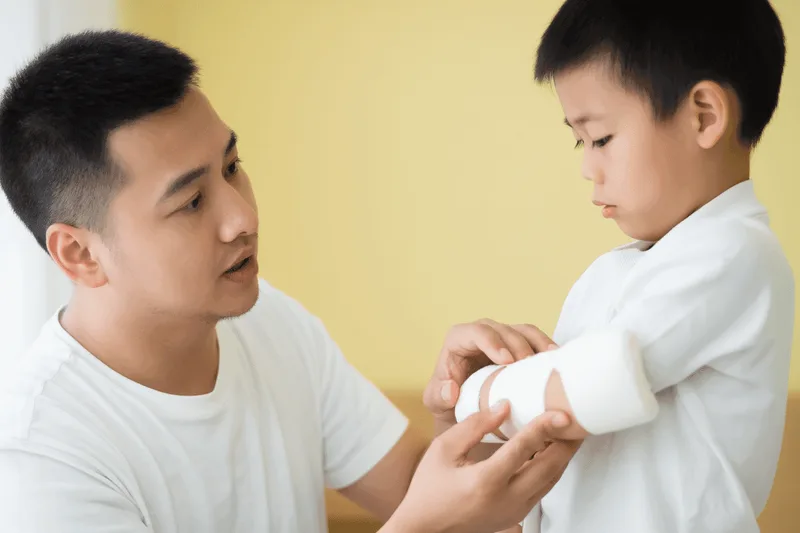
These are usually very treatable conditions, and they are common in young children. As a treatment, the doctor will often put a splint on the broken bone to help it set properly and prevent it from moving again.
General treatment methods
- Plaster of Paris (POP) cast: This is often done. A full cast is placed on the arm or leg to immobilize the bone. This will need to be left in place for several weeks. Usually, it will take about 4-6 weeks.
- Splint: Sometimes, especially if there is a lot of swelling, a splint (something that is not as rigid as a cast and has support on only one side) can be used first, and then a cast can be applied after the swelling has gone down. Alternatively, if the fracture is not too severe, the splint can be left on for a long time.
While this cast or splint is in place, the bone begins to heal from the inside.
What do you do for the pain?
The doctor
will prescribe a painkiller for the baby to reduce the pain. Usually, something like ``Paracetamol'' is given. It should be given exactly as the doctor says, and at the right time. There may be some pain and discomfort in the first few days after the cast is put on. At such times, keeping the arm or leg slightly elevated can also reduce the pain.
Recovery time and things to be aware of
It usually
takes about 4 to 6 weeks for a ``Greenstick Fracture'' to heal. However, this can vary slightly from baby to baby, depending on the nature of the fracture. The doctor will tell you when to remove the cast. While the cast is in place, be aware of the following:
- Do not get the cast wet: When bathing or doing anything that involves water, cover the cast tightly with a plastic bag or something waterproof. Getting it wet can cause skin problems and weaken the cast.
- Don't put anything inside the cast: Sometimes, when scratching, young children try to put things like rulers and pens inside the cast. Don't do that. It can cause skin injuries and infections.
- Check the skin around the cast: Always check the edges of the cast for redness, sores, or blisters. If you notice any of these, tell your doctor .
- Check the color and temperature of the fingers: Check to see if the fingers that are visible through the cast on your hand or leg are blue, pale, numb, or extremely cold. If so, it means the cast is too tight and may be restricting blood flow. You should inform your doctor immediately.
Even after the cast is removed, you need to be a little careful until the doctor tells you to. It's not good to go running, jumping, or lifting weights right away. You need to get used to normal activities again. Sometimes you'll be told to do some small exercises to regain the movement of your arms or legs.
Could this cause other problems?
A ``Greenstick Fracture`` is usually treated properly and promptly,
and there are usually no long-term problems. The bone heals completely, and the child can run and play as before. However, if not treated properly, or if the doctor's instructions are not followed properly, sometimes a few minor complications can occur. For example:
- Malunion: If the bone is not properly immobilized with a cast or splint, the bone may become slightly misaligned. This can eventually affect the function of the arm or leg.
- Refracture: If the cast is removed before it has healed properly and the same injury occurs again, the bone is more likely to break again.
- Sometimes, very rarely, there can be a small impact on the growth of the bone (`growth plate injury`), especially if the fracture occurs near one of the growing ends of the bone (growth plate). However, this is very rare in the case of ``Greenstick Fracture``.
That's why it's so important to see a doctor and get treatment as recommended, even if it's a minor accident.
How do you protect your baby from these kinds of injuries?
There is a saying that "prevention is the best cure." So, there are a few things we can do to protect our little ones from such `(Greenstick Fracture)` as much as possible:
- Make your home environment safe: Place slippery surfaces (carpet, rug) in areas where young children run and jump. Do not leave things like toys lying around on the floor. They can get tangled in them and fall.
- Be careful when playing: Keep your eyes on them, especially when playing on playgrounds and climbing surfaces. Be careful in places where there is a risk of falling.
- Safety gear: Encourage your child to use helmets, knee pads, and elbow pads when playing sports like cycling and skating.
- Balanced diet: Give your child foods that contain calcium and vitamin D (milk, yogurt, cheese, green vegetables, fish) to strengthen bones. This helps keep bones healthy.
- How to fall correctly (Protective reflexes): This is a bit difficult, but when children are allowed to play actively from a young age, they become a little more accustomed to controlling their bodies by placing their hands and feet properly when they accidentally fall, preventing major accidents.
It may not be possible to prevent accidents 100% of the time, because young children are very mischievous. However, we can greatly reduce the risk.
Things to remember in summary
Okay, so I hope you now have a good understanding of the ``Greenstick Fracture'' we talked about today. Finally, let's remind ourselves of the most important things:
- ``(Greenstick Fracture)`` is a condition in young children where a bone only cracks on one side and does not break completely. Like a green stick.
- This is common in children under 10 years old, because their bones are soft and flexible.
- Falls are the main cause.
- The main symptoms are pain, swelling, and unwillingness to use the arm/leg.
- If in doubt, see a doctor immediately. An X-ray is the only way to confirm.
- Treatment involves a cast or splint. It heals in about 4-6 weeks.
- Following your doctor's instructions carefully is very important for a speedy recovery and to prevent complications.
Remember, if something like this happens to your little one, don't panic. This is a very treatable condition. With your love, care, and the doctor's advice, your child will be playing again in no time!
If you have any other questions, don't be shy about asking your family doctor. They are always ready to help you.



💬 Comments (0)
No comments yet. Be the first to share your thoughts here.
Add Your Comment