

Your little one is now four months old, isn't it? Words cannot express the joy you feel as your baby grows and learns new things. It's important to see your doctor or nurse at this time to learn about your baby's health and development. Let's see what happens at this 4-month check-up and what you need to know.
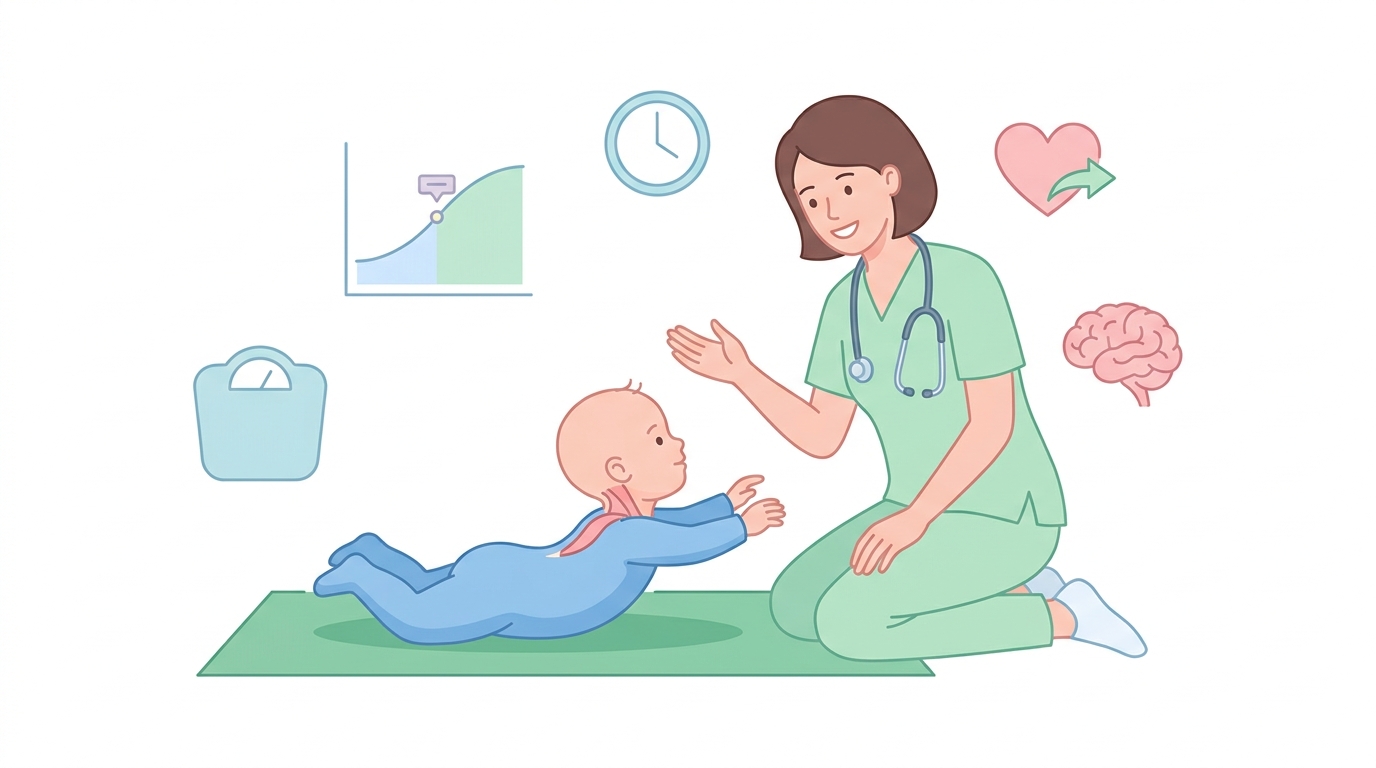
What happens when you go to see the doctor this time?
When you meet the doctor or nurse, they will check a lot of things about your baby and ask you questions. Don't worry, they are all doing this for the baby's best interest.
How to monitor baby's growth
First, the doctor or nurse will measure the baby's weight, height (length), and head circumference . Then, they will plot these measurements on a special chart called a "growth chart." This is how they can tell if the baby is growing properly. That is, if the baby is growing and developing at the right rate for his or her age, the baby's head will grow.
Questions the doctor asks and advice you can give
Next, the doctor will ask you about your baby. You can ask any questions or concerns you have at this time. They will also give you valuable advice.
About food and drink
At this point, your baby will still need breast milk or formula . Babies are usually ready to start eating solid foods around 6 months of age. This means things like iron-fortified cereals and pureed meats. However, before starting any solid foods, you should definitely talk to your doctor . He or she will be the one to tell you if your baby is ready for solid foods and what to give them.
About how to urinate and defecate
Babies this age should urinate several times a day, which means they should wet several nappies. They should also poop regularly. Some babies poop every day, while others poop every two to three days. As long as the poop is soft, it's normal . But if the poop is dry, hard like a rock, or seems difficult to pass, you should tell your doctor about it.
About sleep
Babies at this age sleep between 12 and 16 hours a day. This includes naps during the day. Most babies sleep for about 5 to 6 hours at a time at night. However, babies, especially those who are breastfed , may wake up more often . This is normal.
About baby's development (developmental milestones)
By 4 months, your baby will have started doing lots of new things. Check to see if your baby is doing these things:
- Do you turn your head to your side when you talk?
- Like 'Uu', 'Aaah'Do they make sounds like birds (cooing)?
- Does he respond by making some noise when you talk to him?
- Do you laugh a little, do you giggle? (This is not laughing out loud yet)
- When they see you, do they move or make noise to get your attention?
- Do you look at your own hands with interest?
- Will you grab a toy when you give it to you?
- Do you keep your head straight while holding it?
- Do they push up onto their elbows/forearms while lying on their stomach?
- Do you use your hands to play with toys?
Just think, all these little things are showing us how your baby's brain is developing.
>
However, if your child still isn't doing one or more of these things, or if they seem to be doing something they used to, then definitely talk to your doctor about it . There's nothing to worry about, but it's good to be aware.
Full body check-up
Next, the doctor will remove all of the baby's clothes in front of you and perform a complete physical exam . This will include checking the baby's eyes , listening to the heart, checking the pulse, checking the hip bones, and paying attention to the baby's movements.
You also need to remember about vaccines.
Vaccines are very important to protect your baby from serious diseases. Therefore, it is essential to give your baby the vaccines on time. The vaccination schedule may vary slightly from one clinic to another. Therefore, ask your doctor to find out which vaccines are being given this time and which ones will be given next.
The mother's mental well-being is also important (Postpartum Depression)
You know, it's normal for mothers to feel sad and depressed after having a baby. This is called postpartum depression . This is something that many mothers can experience. Therefore, your baby's doctor may ask you about your happiness and mental state. They may also have you fill out a short questionnaire. This is to help you, not for anything else.
Should we remember these things until the next check-up (in 6 months)?
Okay, now let's see what other things you need to take care of your baby until the next 6-month check-up.
More about food and drink
- As said before,The baby still only needs breast milk or formula.
- Most babies are ready to start eating solid foods around 6 months of age. But some babies may be ready a little earlier. If your doctor tells you to start solid foods , keep these things in mind:
- If anyone in your family has food allergies, tell your doctor about it .
- Start with a small amount of iron -fortified single-grain cereal mixed with breast milk or formula . Or, you can start with another iron-rich food, such as pureed meat .
- Use a small spoon made especially for babies (infant spoon) to feed. Do not give cereal in a bottle of milk.
- If your baby seems to be pushing food out with his tongue too much, he may not be ready for solid foods yet. Try again in about a week.
- Don't give your baby other solid foods until he gets used to eating cereal from a spoon.
- Introduce only one new food at a time . Wait a few days before introducing the next new food to see if there is any allergic reaction.
- If you are breastfeeding, continue to give vitamin D supplements . Breastfed babies may also need iron supplements until they are getting enough iron from the foods they eat. Talk to your doctor about this.
- Pay attention to the signs your baby gives when he is hungry and when he is full .
- Do not give fruit juice until 12 months of age.
- Do not lean milk bottles against anything, or put your baby to sleep with the bottle in his mouth.
These things are also important when taking care of a puppy (daily care)
- Most babies start teething around 4 months of age . This can be a little painful. To help ease the pain, give your baby a clean, wet washcloth or a teething toy (teether). Ask your doctor if you can give him acetaminophen (e.g. Panadol) for pain.
- Clean your baby's gums by gently wiping them with a clean, damp cloth or a very soft toothbrush .
- Sing songs, talk, read books, and play with your baby. Babies learn best when they interact with people.
- Screen time like TV, videos, and phones is not good for babies of this age. However, it is okay to talk to someone far away through a video call.
- When your baby is awake, play with him on his tummy under your attention (tummy time).This will help strengthen the muscles in his neck and back. Provide a safe place for the baby to crawl and roll over.
- Limit the time your baby spends in infant seats, bouncers, and swings .
- It's normal to feel tired and overwhelmed at times when you're a new mother. But if these feelings are very strong, or if you feel sad, angry, or anxious, talk to your doctor .
- If you have questions about your living situation (e.g., food, shelter, health insurance), talk to your doctor about those as well . They can tell you about community resources or refer you to a social worker.
The baby's safety comes first!
It is very important to think about safety during this time, as the baby will start to roll over and throw its limbs.
How to prevent sudden infant death syndrome (SIDS)?
Sudden Infant Death Syndrome (SIDS) is something we all fear. Here are some things you can do to reduce the risk:
- When putting your baby to sleep, always place them on their back , on a firm, flat mattress . Never place them on their stomach or side. Put them to sleep in a crib or bassinet. Do not place crib bumpers, blankets, pillows, or soft toys in the crib.
- If possible, breastfeed your baby .
- Until your baby's first birthday, or at least until they are 6 months old (the risk of SIDS is highest during this time), sleep in a separate crib in your room, next to your bed . Never let your baby sleep in your bed (bed-sharing).
- Keep the room temperature comfortable and protect the baby from excessive heat . Dress the baby appropriately for the room temperature. Do not overdress . Do not cover the head while sleeping. Check for sweating and body heat.
- If possible, let your baby sleep with a pacifier . If your baby doesn't like the pacifier, don't force it. If the pacifier is swallowed while sleeping, don't put it back in. If you are breastfeeding, give the pacifier after your baby has become accustomed to breastfeeding.
- Do not let your baby sleep in equipment that is not designed for sleeping (e.g., car seats, feeding pillows, infant loungers, etc.).
- Do not use any devices (e.g., sleep positioners, heart rate monitors) that claim to reduce the risk of SIDS . There are no products that actually do this.
- Make sure that everything you use to put your baby to sleep meets safety standards approved by a reputable agency, such as the U.S. Consumer Product Safety Commission (CPSC) .
Other important safety tips
- Never use infant walkers. They are very dangerous and can cause serious injuries. Walkers also do not encourage walking and can actually delay it.
- Your baby will soon start reaching out and grabbing things and putting them in his mouth . So, don't leave small objects or poisons where he can get them. Don't leave toys with wires, cords, or loops nearby.
- Never leave your baby alone when he is awake, especially on high places (beds, sofas) or in the bath .
- Never shake your baby – it can cause brain hemorrhage and even death. If you ever feel angry or worried that you might hurt your baby, put your baby in a safe place (in the crib) and go outside for a few minutes. Call a friend, relative, or your doctor for help.
- Always travel with your baby in the back seat of the car, in a rear-facing car seat . Never leave your baby alone in the car.
- Do not smoke, use e-cigarettes, or vape . Do not allow anyone else to do so near your baby.
- Protect your baby from sun exposure as much as possible. Cover your baby with clothing and keep them in the shade. Sunscreen is not recommended for babies under 6 months of age . However, if there is insufficient protection from shade and clothing, a very small amount of sunscreen can be applied to a baby under 6 months of age (ask your doctor about this).
Finally, I have to say... (Take-Home Message)
So, I hope you now have a good idea about your 4-month-old baby's check-up. All of this is done for your and your baby's health . Remember, if you have any questions or doubts, never be afraid to ask the doctor or nurse. They are there to help you.
I wish you and your baby all the best for a happy and healthy life!
`Baby health, 4 month check-up, baby growth, baby development, solid foods, baby safety, SIDS, vaccinations, postpartum depression
Doctor's Note
During the 4-Month Well-Child Visit (4-Month Well-Child Visit), many physical skills of the baby are assessed. The doctor will check if the baby is trying to crawl, trying to roll over, and lifting the chest and head up while lying down with weight on the elbows (Tummy time milestones). Here, the baby is observed looking at objects and reaching out to grasp them, as well as turning the head towards the sound. Also, the second dose of vaccine to be given at 4 months will also be given here.
❓ Some more questions you may encounter (FAQ)
What are the baby's major motor milestones at 4 months?▼
Ability to lift chest and head well in crawling position, reach for toys, and hold head upright.
What is the vision of a 4-month-old baby?▼
Babies can see colors well and have the ability to visually track moving objects and people's faces.
Is it appropriate to introduce solid foods at this age?▼
no The World Health Organization recommends that exclusive breastfeeding is best until the age of 6 months.





💬 Comments (0)
No comments yet. Be the first to share your thoughts here.
Add Your Comment